


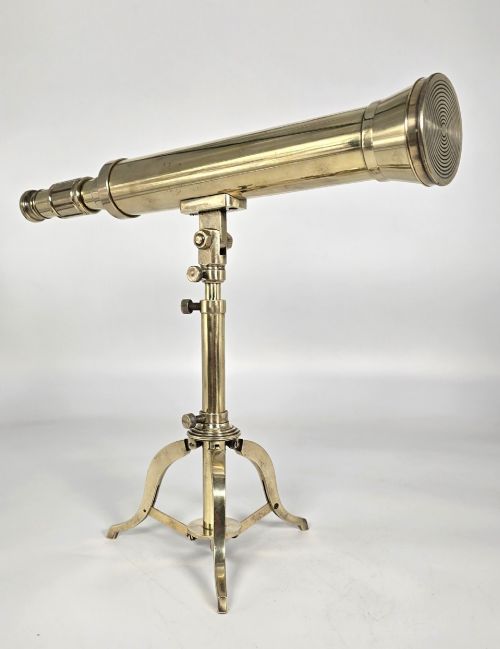


Nautical Spyglass Telescope
A nautical spyglass telescope brings distant horizons into sharp focus, offering both maritime heritage and practical optics for collectors.
Nautical Spyglass Telescope
A nautical spyglass telescope is a portable optical instrument designed for marine observation, land navigation, and astronomical viewing. When searching this phrase, buyers encounter extendable draw tubes housed in brass, leather, and timber.
The pieces on this page span several centuries, originating from Georgian workshops through to Edwardian manufacturers. Single draw and multi-draw formats appear frequently, alongside dedicated tabletop versions mounted on original folding tripods.
How they were made
Maker workshops utilised heavy brass for structural barrels and draw tubes, ensuring smooth sliding action and durability at sea. Lenses of optical glass were ground and fitted into primary objectives and eyepieces.
Outer bodies frequently feature hand-stitched leather dressings, mahogany sleeves, or turned fruitwood casings. Specialised makers integrated sliding sunshades and protective dust caps into the exterior brass housings.
Some nineteenth-century captains swore their spyglass doubled as a convincing speaking trumpet when shouting across choppy water.
What varies in quality
Quality rests upon the clarity of the optical glass and the precision engineering of the sliding draw tubes. Instruments bearing signatures from established London opticians demonstrate superior mechanical tolerances and lens grinding.
The selection of external materials further distinguishes output, ranging from plain unadorned brass to finely figured mahogany and stitched leather coverings. Complete sets featuring fitted wooden cases and original folding tripod stands command greater distinction.
Nairne & Blunt·Ross of London·Voigtländer & Sohn·Clarkson·Steward of London·Newton & Co·Broadhurst Clarkson & Co·Cary London·L. Casella·Chadburn Brothers·Dollond·Davis of London·John Gilbert
The Nautical Spyglass Telescope Glossary
- Draw
- A sliding tubular section of a telescope barrel that extends for focusing. Multi-draw instruments collapse down for portability.
- Objective
- The primary lens at the front of the telescope that gathers light and forms the initial image. Larger objectives provide brighter fields of view.
- Terrestrial
- An optical configuration designed for viewing land objects upright rather than upside down. These incorporate erecting lenses within the draw tubes.
- Achromatic
- A lens design corrected to bring two wavelengths of light into focus in the same plane, reducing colour fringing. Many eighteenth and nineteenth-century instruments utilise this configuration.
- Spyglass
- A small, handheld refracting telescope used historically at sea. The term encompasses single-draw and multi-draw portable configurations.
Nautical Spyglass Telescope: Frequently Asked Questions
What is an officer of the watch telescope?
This specific format was designed for naval officers on deck duty to scan the horizon and identify signals. They are typically robust, weather-resistant handheld instruments built for daily maritime service.
Many examples feature leather-wrapped barrels to provide a secure grip in cold or wet conditions. They often include day or night lenses for varying light levels.
How do I date an antique spyglass?
Examine the signature engraving on the draw tube, as maker names and operational addresses often narrow down the production decade. Material choices, such as mahogany versus nickel plating, also point toward specific periods like the Georgian era or the early twentieth century.
Mechanical complexity increased over time, moving from simple two-draw wooden bodies to multi-draw brass tubes. Consulting maker records helps confirm precise manufacturing years.
How should I display a tabletop telescope?
Place the instrument on a stable wooden surface near a window to enjoy natural light and distant views. If the piece includes a folding brass tripod stand, secure the mount firmly to prevent tipping.
Keep brass components polished with appropriate cloths while preserving any aged patina. Avoid placing optical instruments in direct, harsh sunlight for extended periods.