


Natural History Watercolour Study
A natural history watercolour study brings the observation of birds, insects, and flora directly onto the wall with intimate detail.
Natural History Watercolour Study
A natural history watercolour study captures subjects from the natural world with careful observation, spanning from Victorian naturalism to mid-century British art. These works appear across various formats, including framed paintings, wall art, and delicate pith paintings.
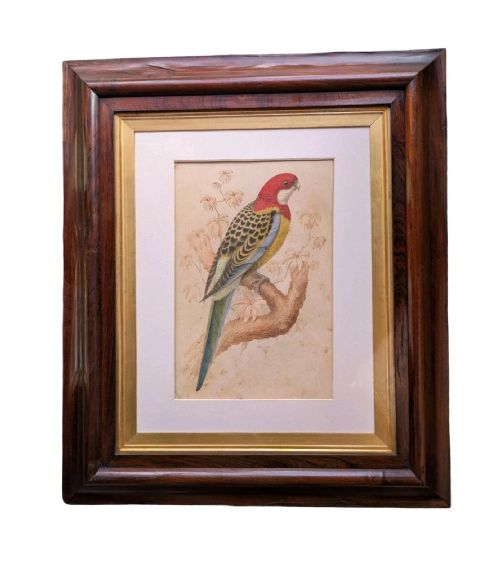
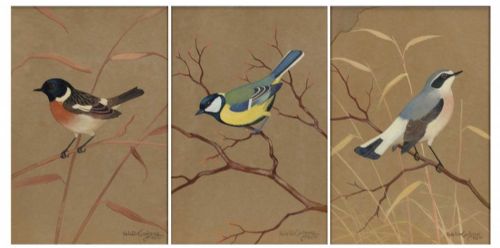
The selections encountered here range widely in period, covering eighteenth-century works, Victorian pieces, and mid-century examples. Subjects focus heavily on ornithology and botany, presenting birds, parrots, lapwings, and botanical arrangements with precise rendering.
Framing varies considerably across the selection, featuring timber frames, ebonised surrounds, and deep giltwood mounts that complement the works on paper. Buyers frequently encounter individual bird portraits alongside grouped sets and detailed insect studies.
Materials and technique
These works are executed primarily on paper using watercolour paint, and occasionally gouache, applied to capture the fine textures of feathers, wings, and petals. Artists utilised these water-soluble mediums to achieve delicate tonal gradations and lifelike botanical details.
Support materials include traditional paper sheets alongside specialised surfaces like Chinese pith paper, which absorbs pigment to create luminous botanical and insect studies. Frames fashioned from timber or ebonised wood protect these fragile works on paper.
The listings include works from the nineteenth and twentieth centuries, utilising watercolour, gouache, and pith paper.
Assessing quality and execution
Quality in a natural history watercolour study rests upon the precision of the draftsmanship and the accuracy with which the subject is rendered. Skilled observation separates a stiff anatomical diagram from a vibrant painting that retains a sense of life.
The preservation of the paper and the vibrancy of the pigments dictate the visual impact of the piece over time. Tonal depth, confident brushwork, and the harmony of the framing elements all contribute to the distinction of the better examples.
R. Hurst·Ralston Gudgeon·M Simpson·William Andrews Nesfield·Harry Bright·Paul-Louis Barruel·Donald Watson·Cuthbert Edmund Swan
The Natural History Watercolour Study Glossary
- Watercolour
- A painting method in which the paints are made of pigments suspended in a water-based solution. This medium allows for translucent washes that suit delicate feather and floral details.
- Gouache
- An opaque water-based paint that provides heavier coverage and brighter highlights than standard watercolour. Artists often combine gouache with watercolour to add depth to botanical studies.
- Pith painting
- Artwork created on thin sheets of pith plant material, common in nineteenth-century Chinese export art. The porous surface absorbs pigments deeply, giving insects and butterflies a distinctive velvety appearance.
- Giltwood mount
- A wooden mount covered in a thin layer of gold leaf, often placed inside a frame. Deep giltwood mounts were favoured in Victorian framing to create space and draw the eye inward to the artwork.
- Ebonised frame
- Wood that has been treated to resemble dense, black ebony. This dark framing style was popular in the nineteenth century for setting off colourful bird and insect watercolours.
Natural History Watercolour Study: Frequently Asked Questions
How should I hang these watercolours?
Protect these paintings from direct sunlight to prevent the pigments from fading over time. Keep them away from damp environments to preserve both the paper and the timber frames.
Group smaller studies together on a wall to create a cohesive display, or let a larger framed bird painting act as a single focal point.
What subjects are most common?
Birds feature heavily among these listings, ranging from British garden birds to exotic parrots and macaws. Botanical studies of flowers and detailed paintings of butterflies and insects also appear frequently.
Artists focused closely on naturalism, recording specimens with scientific precision alongside artistic flair.
How do I date a study?
Examine the framing materials, the style of the mounting, and any inscriptions left by the artist or previous owners. Nineteenth-century pieces often feature ebonised frames or deep giltwood mounts.
Mid-century works tend to show different paper characteristics and signature styles that align with twentieth-century British art developments.
Are these works original paintings?
The selection consists of original hand-painted watercolours and gouache studies on paper rather than modern mass-produced prints. Each piece represents an individual artist's direct observation of their subject.
Signatures, brushstroke textures, and variations in the paper confirm the hand-painted nature of these works.