





Narrow Floor Rug
A narrow floor rug brings elongated pattern and texture to hallways and corridors, offering centuries of hand-knotted craftsmanship underfoot.
Narrow Floor Rug
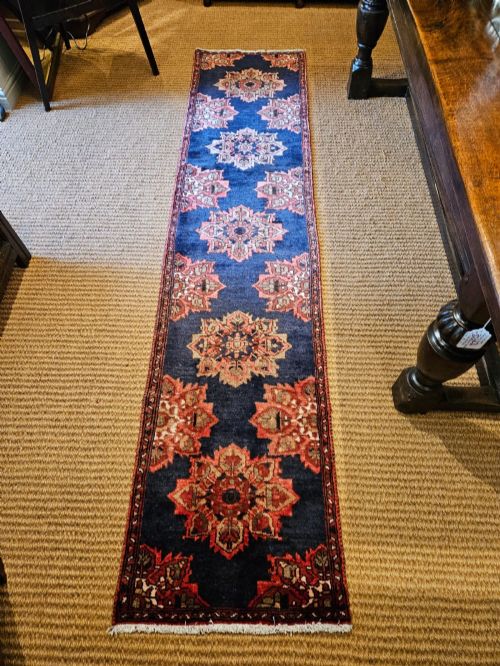
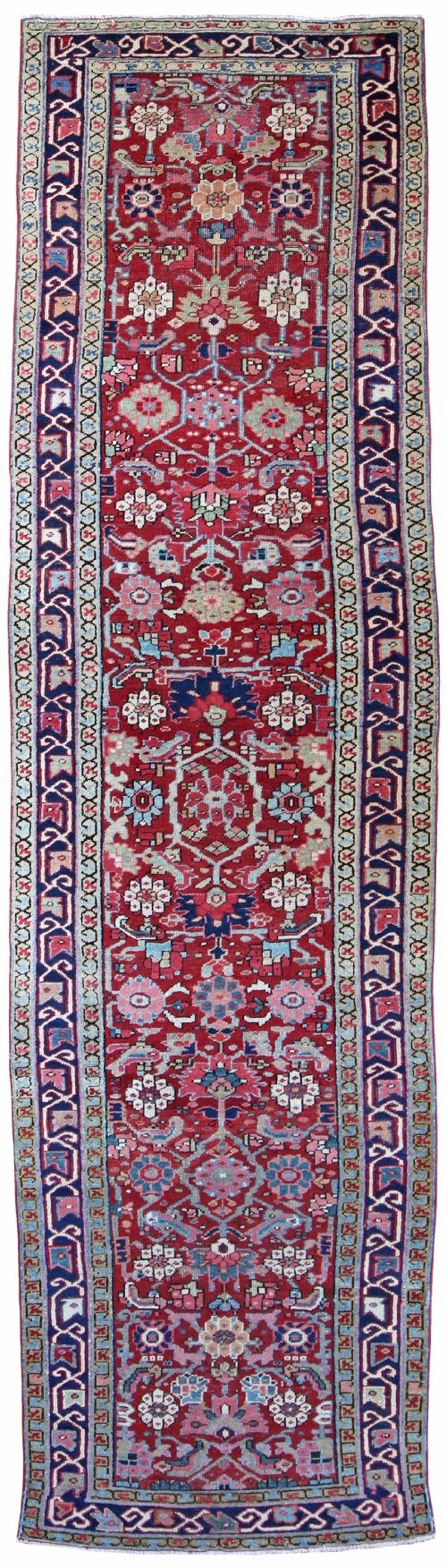
A narrow floor rug serves primarily as a runner for corridors, hallways, and long spaces, appearing across periods from the late nineteenth century into the twentieth century. These pieces encompass specific regional styles such as Persian Heriz, Karaja, Bidjar, and Kurdish weaves, alongside Moroccan Berber and Caucasian Shirvan examples.
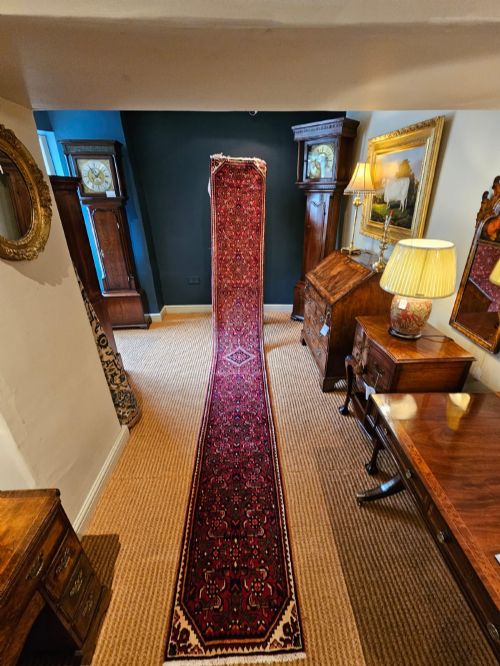
The format relies on elongated rectangular proportions designed to span considerable lengths while maintaining a restricted width. Examples range from compact lengths up to extensive room-scale runners exceeding ten metres.
Originating largely from traditional workshops and tribal weavers across Persia, the Caucasus, and North Africa, these textiles utilise wool and cotton construction. Buyers encounter distinctive regional palettes and geometric or floral motifs tailored to narrow architectural spaces.
Evaluating quality and execution
Quality rests in the precision of the knotting density and the crispness of the geometric or floral drawing. Finer execution reveals itself in the clarity of medallions and borders along extended linear formats.
The integrity of the wool pile and the stability of the foundational cotton or wool structure dictate longevity. Well-preserved pieces maintain even pile height and straight structural alignment along substantial lengths.
One extraordinary pair of antique Hamadan narrow runners stretches to an astonishing ten metres in length.
The Narrow Floor Rug Glossary
- Runner
- A long, narrow rug designed specifically for corridors, hallways, and stairs. This format defines the majority of pieces found in this category.
- Warp
- The stationary vertical threads stretched upon a loom before knotting begins. These form the structural skeleton of the rug and often emerge visibly at the fringe ends.
- Weft
- The horizontal threads passed across the warps between rows of knots to secure the pile in place. Together with the warp, they constitute the foundation.
- Selvedge
- The bound edge running along the long sides of a rug that prevents the weave from unravelling. Traditional examples feature sturdy overcast whipping in wool.
- Pile
- The upright cut or looped ends of the knotted yarn that form the usable surface of the rug. In these pieces, the pile consists primarily of hand-spun wool.
Narrow Floor Rug: Frequently Asked Questions
Where do narrow floor rugs work best?
These elongated textiles suit hallways, corridors, staircases, and narrow passages where standard rectangular carpets fail to fit. Their proportions draw the eye along architectural lines while protecting high-traffic flooring.
Placing them in narrow spaces also introduces warmth and acoustic damping to hard timber or stone surfaces.
How do I identify a Persian Heriz runner?
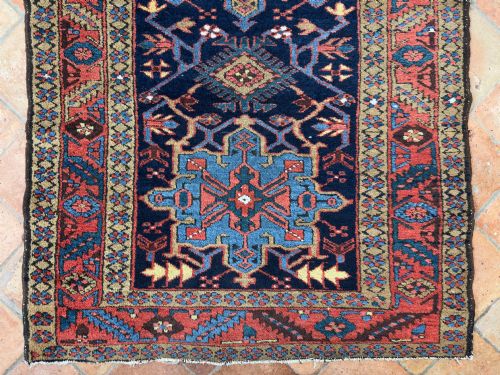
Heriz runners typically display bold geometric medallions, large-scale corner spandrels, and robust rectilinear floral motifs. Their colour palette often incorporates deep navy blues, terracotta reds, and ivory accents.
The weave tends to be sturdy and heavy, reflecting the mountainous region of North-West Persia where they were knotted.
What materials make up these rugs?
The pile is almost exclusively hand-spun wool, chosen for its resilience and capacity to hold rich dye colours. Foundation threads supporting the knots are generally composed of cotton or wool.
This combination provides the structural strength necessary for rugs subjected to continuous walking.
How do tribal runners differ from city pieces?
Tribal runners, such as Kurdish, Caucasian Shirvan, or Moroccan Berber examples, feature spontaneous geometric patterns, amulets, and asymmetric village designs. City and workshop pieces, like Heriz or Bidjar, exhibit more formal, symmetrical layouts and precise cartoon-guided execution.
Both traditions utilise natural wool and traditional dyeing methods across the nineteenth and twentieth centuries.