




Napoleon III Boulle Cabinets
Napoleon iii boulle cabinets are nineteenth-century French and Victorian statement furniture pieces offering striking tortoiseshell and brass inlay for grand interiors.
Napoleon III Boulle Cabinets
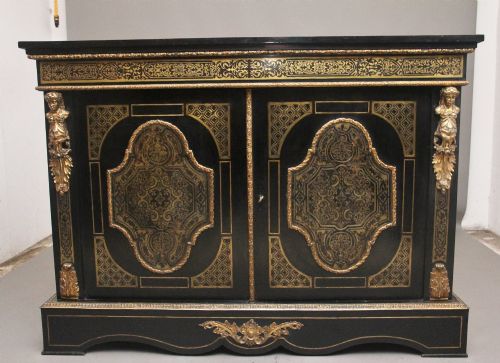
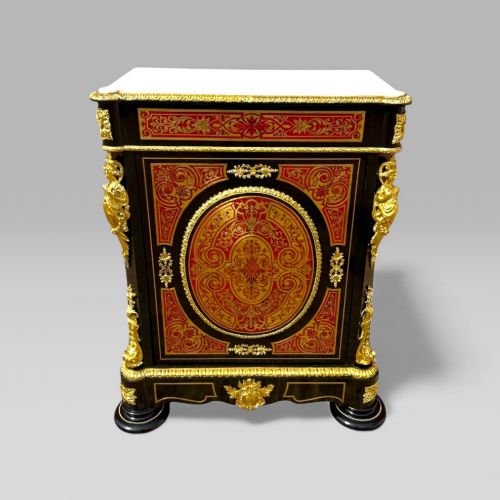
Napoleon iii boulle cabinets are nineteenth-century pieces defined by intricate brass and tortoiseshell marquetry set into ebonised or rosewood timber carcases. The evidence shows these pieces appearing under styles such as French Napoleon III, Victorian Boulle Revival, and Louis XVI Style, reflecting mid-nineteenth-century historicism.
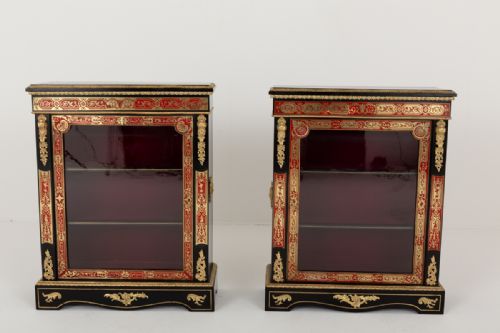
Buyers are most likely to meet pier cabinets, side cabinets, and credenzas on this page, alongside smaller forms like writing desks and bibliotheques. Many examples are finished with marble tops and ormolu mounts, appearing singly or as matched pairs dating between 1850 and 1880.
How they were made
Craftsmen built these pieces using ebonised wood or rosewood as a dark foundation to contrast with inlaid brass and tortoiseshell marquetry. Ormolu and gilt bronze mounts define the borders, corners, and feet, while marble slabs frequently form the upper surfaces of pier cabinets and credenzas.
The decorative technique relies on precise cutting of metal and shell veneers, mounted onto carcases alongside glass panels in display cabinets and vitrines. Velvet linings occasionally appear inside, complementing the exterior gilt metal mounts and glass display doors.
Listings demonstrate that ebonised wood, brass, and tortoiseshell form the primary material palette across nineteenth-century boulle cabinets and credenzas.
What varies in quality
Quality in these cabinets rests on the precision of the brass and tortoiseshell inlay and the crispness of the cast ormolu mounts. Finer examples display meticulous control in the marquetry patterns across serpentine fronts and breakfront carcases.
The choice of secondary materials, such as heavy marble tops and substantial gilt bronze rather than lighter gilt metal, separates standard production from superior exhibition pieces. The integrity of the ebonised timber and the presence of matched pairs further distinguish the higher tier.
The Napoleon III Boulle Cabinets Glossary
- Boulle
- A marquetry technique using cut brass and tortoiseshell inlaid in opposing counter-forms, named after the cabinetmaker André-Charles Boulle. This decorative method defines the visual identity of nineteenth-century revival cabinets.
- Ormolu
- Gilded bronze mounts applied to furniture edges, corners, and feet to provide decorative accent and structural protection. These cast metal ornaments are characteristic of French Napoleon III and Louis XVI style pieces.
- Pier Cabinet
- A narrow cabinet designed to stand against the wall space between windows. These upright forms frequently feature glass doors and marble tops.
- Credenza
- A low, long sideboard or cabinet often fitted with doors and open display sections. In nineteenth-century examples, these pieces incorporate serpentine fronts and rich marquetry.
- Bonheur du Jour
- A small writing desk featuring a superstructure of drawers and pigeonholes above the main writing surface. The evidence shows these delicate writing cabinets finished with ebonised boulle work.
Napoleon III Boulle Cabinets: Frequently Asked Questions
What is a boulle cabinet?
A boulle cabinet is a nineteenth-century piece decorated with contrasting brass and tortoiseshell inlay against an ebonised wood ground. These items reflect French and Victorian revival tastes.
They frequently feature ormolu mounts, glass display doors, and marble tops, serving as focal points in period drawing rooms.
Where were pier cabinets placed?
Pier cabinets were specifically designed to occupy the narrow strip of wall between two windows in nineteenth-century reception rooms. Their upright proportions maximised display space without blocking light.
They often incorporated mirrored backs or glass shelves to reflect natural light around the interior.
How do I tell Napoleon III style from Victorian?
Napoleon III pieces generally exhibit French cabinetmaking conventions, focusing on precise ormolu mounts and exact tortoiseshell marquetry. Victorian examples often interpret these same French forms through British manufacturing traditions.
Both periods overlap heavily in the mid-nineteenth century, sharing ebonised timber carcases and similar serpentine proportions.
Can I use a credenza for storage?
Credenzas provide enclosed cupboard space behind panelled or glazed doors, making them practical for storing glassware and tableware. Their long, low profile offers substantial surface area on top.
Interior shelving allows for organised storage while keeping delicate items protected behind lockable doors.