
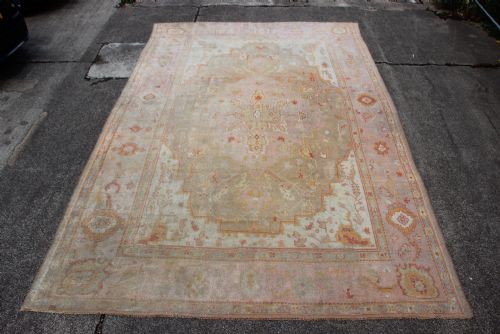


Muted Hand Knotted Rug
These muted hand knotted rug examples offer faded wool floor coverings that bring subtle historic warmth to an interior.
Muted Hand Knotted Rug
The styles seen here draw heavily from traditional regional weaving centres, notably Ushak, Ziegler, Bidjar, Sivas and Hamadan. Tribal patterns also appear, including Afghan tribal work and Ottoman Turkish prayer designs.
Most entries date from the late nineteenth century, around eighteen eighty to eighteen ninety, alongside examples from nineteen hundred and the early decades of the twentieth century. Buyers often encounter soft faded patinas and gentle neutral palettes across these origins.
Materials and construction
These textiles rely primarily on wool and cotton as foundational materials, with occasional use of angora wool seen in specific Ushak pieces. Artisans tied individual knots by hand onto supportive warps and wefts to build dense, durable floor surfaces.
Natural dyeing traditions and the passage of time produced the characteristic soft and faded colourways recorded in the listings. Foundation threads of cotton typically support the pile, while wool provides the tactile texture of the surface.
One listed Afghan rug carries an inscribed date of thirteen forty-seven AH, neatly bridging ancient calendar systems with twentieth-century woolcraft.
Qualities of distinction
Distinctions across these pieces rest on the fineness of the knotting, the balance of the composition and the integrity of the design. Larger carpets with balanced floral or geometric layouts demonstrate greater workshop complexity than smaller format runners.
The nuance of the patina and the subtlety of the faded tones contribute significantly to the visual weight of each textile. Variations in regional weaving execution separate standard village productions from finer urban workshop carpets.
The Muted Hand Knotted Rug Glossary
- Hand knotted
- A method of textile production where individual strands of yarn are tied manually to the foundation warp threads. This technique ensures durability and distinct textural depth.
- Ushak
- A traditional Turkish rug-making centre known for large-scale floral motifs and soft, subdued palettes. Carpets from this origin often display gentle abrash and expansive fields.
- Ziegler
- A nineteenth-century commercial carpet style designed for Western interiors, usually featuring softened Persian-inspired patterns. These pieces typically display muted tones and expansive neutral backgrounds.
- Prayer rug
- A small textile featuring a specific architectural mihrab design indicating the direction of Mecca. These formats were traditionally used for daily personal devotions.
- Patina
- The surface appearance acquired by age, wear and natural fading of the wool dyes. A soft patina indicates organic softening over decades of existence.
Muted Hand Knotted Rug: Frequently Asked Questions
How do I clean an antique rug?
Professional specialist cleaning is essential for nineteenth-century wool textiles to preserve the delicate structure and natural dyes. Domestic cleaning methods can damage the fragile historic fibres.
Gentle surface maintenance involves careful vacuuming without a rotating brush bar. This prevents undue friction on the hand-tied pile while removing embedded dust.
Where were these carpets made?
The pieces originate primarily from Turkish, Persian and Afghan weaving traditions. Specific towns and regions include Ushak, Sivas, Bidjar and Hamadan.
Production spans from major urban workshops to tribal communities. Each area utilised distinct regional motifs and knotting structures.
Are these rugs suitable for daily use?
Wool and cotton construction provides natural resilience suitable for domestic environments when placed with a proper underlay. High-traffic areas benefit from placement in lower-impact zones to protect the antique pile.
Heavier carpets function well in living spaces and reception rooms. Smaller runners suit hallways and transitional floor areas.
How do I date a woven carpet?
Dating relies on stylistic analysis, structural examination of the foundation, and dye analysis. Certain pieces include woven inscriptions or dates in Islamic numerals, such as the Afghan Aqcha example dated thirteen forty-seven AH.
Changes in chemical dye introduction around the late nineteenth century also help establish chronological parameters. Comparing known workshop patterns refines the estimated period of origin.