



Music Storage Stool
A music storage stool brings order to sheet music while offering a comfortable seat beside the instrument.
Music Storage Stool
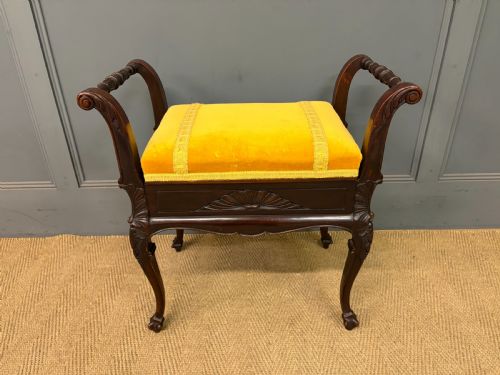
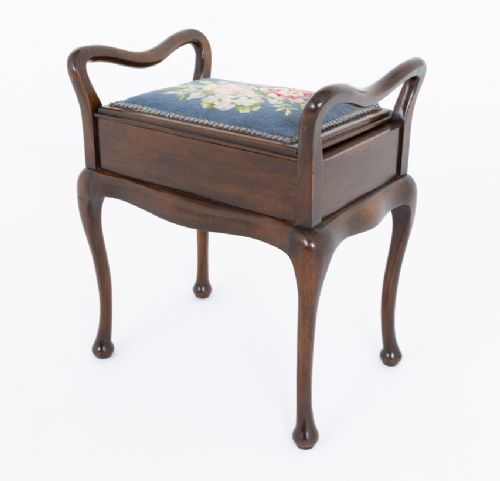
A music storage stool is a practical seating option designed to keep scores and folios close at hand beneath a hinged or falling lid. These pieces appear in forms ranging from single seats to wider duet proportions made for two players.
The examples gathered here span from the nineteenth century through the Edwardian era and into the Art Deco period. Buyers will frequently encounter mahogany and walnut frames styled with Edwardian Sheraton Revival details or simple Victorian proportions.
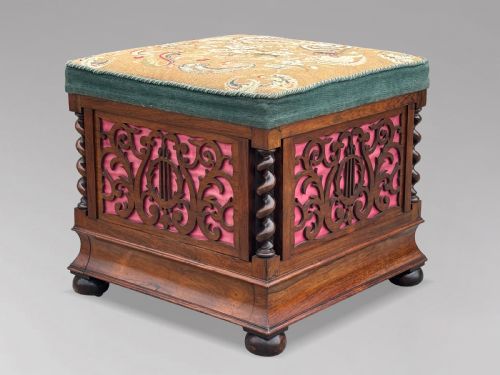
Makers of the period adapted standard piano stools and ottomans to meet the demands of domestic musicians. Many incorporate lift-up upholstered tops or fall-front compartments to conceal sheet music cleanly away.
How they were made
Cabinetmakers built the primary carcasses of these stools in solid timber and veneers, relying principally upon mahogany and walnut. Boxwood inlay frequently provides delicate linear contrast along the borders of Edwardian and revival examples.
Seating portions incorporate traditional upholstery fabric, velvet, or woven tapestry supported by internal wooden frameworks and brass hinges. Fall-front mechanisms and lift-up lids require precise joinery to ensure smooth daily operation without binding.
Music Storage Stool Retail Price Guide 2026
Typical asking prices for music storage stool among the pieces listed under this phrase on Sellingantiques today, from the lower quarter to the upper quarter. They describe what is for sale here now, not the wider market.
Every pianist eventually accumulates enough sheet music to jam a fall-front compartment permanently shut.
What varies in quality
The distinction between standard production pieces and finer examples rests upon the choice of timber figure and the crispness of any inlay work. Dense mahogany and richly grained walnut elevate the presence of a stool far beyond plain utility.
Hardware choice and internal carpentry also mark the grade of the piece. Robust brass fittings and well-fitted internal compartments for sheet music demonstrate a higher standard of original workshop construction.
The Music Storage Stool Glossary
- Duet stool
- A wider seating form designed to accommodate two pianists side by side. These versions often feature generous internal compartments to hold larger collections of sheet music.
- Fall front
- A hinged front panel that drops forward to grant direct access to internal shelves or compartments. This mechanism keeps scores neatly organised without requiring the user to lift the main seat.
- Canterbury stool
- A specialised variant combining seating with partitioned storage sections beneath or beside the seat. The design takes its name from traditional freestanding music and book racks.
- Boxwood inlay
- Narrow strips of pale wood embedded flush into the darker primary timber surfaces. Cabinetmakers utilised this technique extensively during the Edwardian Sheraton Revival period.
Music Storage Stool: Frequently Asked Questions
What is a music storage stool?
A music storage stool is a specialised seat equipped with a hidden compartment beneath the cushion for holding sheet music. These pieces served domestic musicians by keeping scores tidy beside the piano.
They combine practical storage with traditional furniture forms, appearing in styles ranging from plain Victorian walnut to inlaid Edwardian mahogany.
How do I identify an Edwardian piano stool?
Edwardian piano stools frequently display light mahogany timbers accented with contrasting boxwood inlay. They often exhibit Sheraton Revival proportions and delicate tapered legs.
Makers working in this period favoured clean architectural lines combined with subtle decorative stringing rather than heavy carving.
What is the difference between a single and duet stool?
A single stool provides seating and storage space sized for one person at the keyboard. A duet stool is substantially wider to accommodate two players simultaneously.
Duet versions naturally offer larger internal compartments underneath the hinged or fall-front seat to handle more extensive music folios.
How should I care for the upholstery?
Original or period-appropriate upholstery fabrics, velvet, and tapestry require gentle brushing and protection from direct sunlight. Maintaining stable indoor humidity preserves both the textile fibres and the surrounding wooden frame.
Avoid harsh chemical cleaners on antique fabric surfaces to protect the integrity of the weave.