
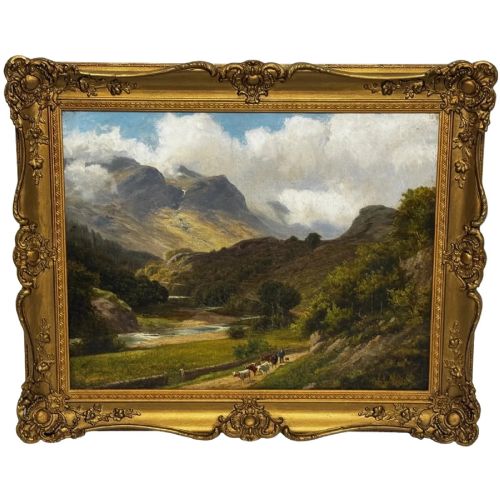
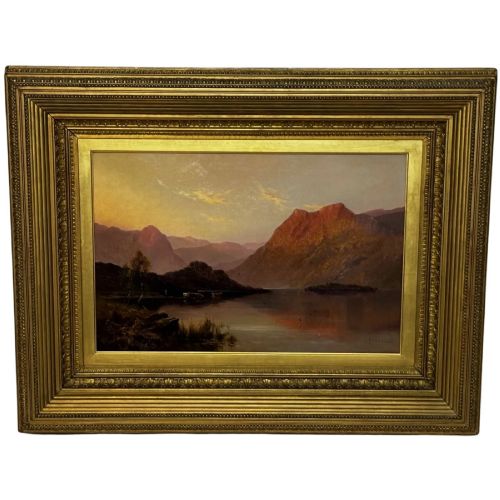
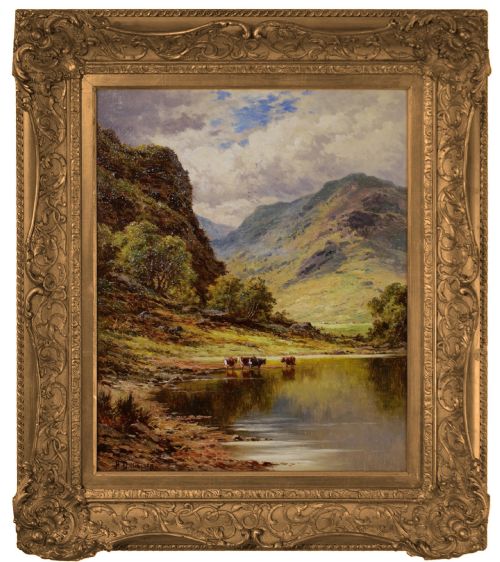


Mountain Lake Oil Painting
A mountain lake oil painting captures the grand stillness of high water and distant crags, bringing nineteenth-century atmosphere straight to the wall.
Mountain Lake Oil Painting
A mountain lake oil painting presents expansive vistas of tranquil waters set against dramatic peaks, capturing the sublime topography favored by nineteenth-century artists. These works transport the viewer directly to Scottish highlands, Alpine ranges, or the English Lake District.
The versions most commonly met on this page date from the Victorian and Edwardian eras, spanning British, Scottish, and European schools. Canvases range from intimate cabinet pieces to large framed landscapes intended to dominate a room.
How they were made
Artists built these compositions using oil paint applied to woven canvas stretched over wooden frames, occasionally utilising wooden panels or board supports. Pigments were layered to create deep atmospheric perspective, capturing mist over water and shadow across rock faces.
Finished works were typically housed in ornate gesso and giltwood frames that added structural weight and visual brilliance. Moulded ornament and applied gilding on the timber frames enhanced the romantic glow of the painted scenes.
Subjects encompass Scottish highlands, Alpine peaks, and the English Lake District interpreted through British Realism and Romanticism.
What varies in quality
Quality rests in the handling of light and the confidence of the brushwork, distinguishing master landscape painters from competent contemporary copyists. Stronger works render the subtle transition of daylight across mountain ridges and water with precise atmospheric depth.
The integrity of the original canvas, the stability of the pigment layer, and the preservation of the giltwood frame dictate the desirability of a piece. Finer examples retain their original stretchers and untouched paint surfaces without extensive restoration.
Alfred Fontville de Breanski Jr·Henry H. Parker·Frank Hider·Charles Leslie·Giulio Cecchini·John Douglas Perrett·Stephen Enoch Hogley·Alfred de Breanski·Alfred de Breanski Snr·Benjamin Williams Leader·Sidney Richard Percy·William Mellor·Samuel Hart Turpin·Percy Lancaster·Charles Pettitt·William J Solby·Henry Charles Heath·Benjamin Hold·Paul Fenton
The Mountain Lake Oil Painting Glossary
- Gesso
- A plaster-like mixture applied to wood frames before gilding to provide a smooth base for gold leaf. This ground substance is moulded into decorative relief patterns.
- Giltwood
- Timber that has been coated with a thin layer of gold leaf or gold powder. It frames nineteenth-century canvases to catch interior light.
- Oil on Canvas
- Pigment mixed with drying oils, such as linseed, spread across woven fabric. This medium allows for rich blending and long-term durability.
- Romanticism
- An artistic movement emphasising emotion, individualism, and awe of untamed nature. It heavily influences the dramatic skies and rugged terrain seen in these subjects.
- Stretcher
- The wooden frame that holds a painted canvas taut. Original stretchers help confirm the age and authenticity of an antique painting.
Mountain Lake Oil Painting: Frequently Asked Questions
How do I hang a heavy framed landscape?
Heavy giltwood frames require secure wall anchors fixed directly into masonry or timber studs to bear the substantial weight safely. Steel picture wire rated well above the canvas weight should be attached firmly to heavy-duty D-rings on the stretcher frame.
Position the painting at eye level to ensure the horizon line draws the viewer naturally into the scene. Avoid hanging the canvas in direct sunlight to protect the oil pigments and gesso frame from degradation.
What periods do these paintings come from?
The works primarily date from the nineteenth and early twentieth centuries, encompassing the Victorian and Edwardian eras. Painters during this period frequently travelled to scenic European and British waterways to capture direct topographical studies.
Styles span from Romanticism and the Italian School to British Realism. This range reflects shifting artistic approaches to natural light and landscape recording over several decades.
Where were these landscape views painted?
Artists sought inspiration across the English Lake District, the Scottish Highlands, Alpine ranges in Austria and Switzerland, and Italian lakes. Specific locations like Windermere, Loch Lubnaig, and the Snowdon Range frequently appear in the titles.
These sites were popular destinations for Victorian travellers and painters responding to the rising popularity of picturesque tourism. Canvas inscriptions or signatures often record the precise geographical spot.