






Moorland Landscape
These moorland landscape works capture remote upland terrain through the brush of Victorian and early twentieth-century artists.
Moorland Landscape
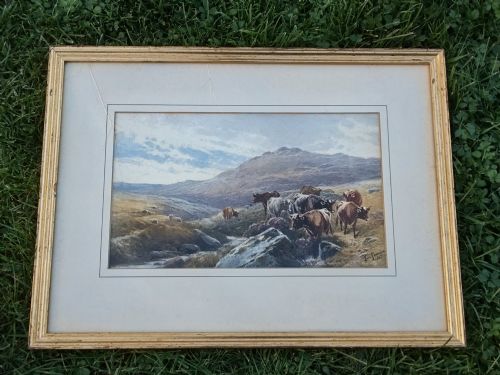
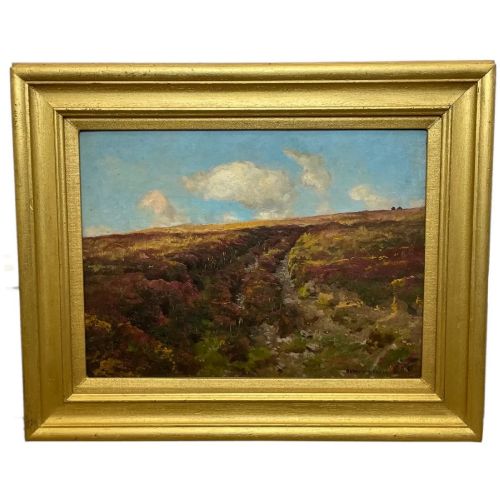
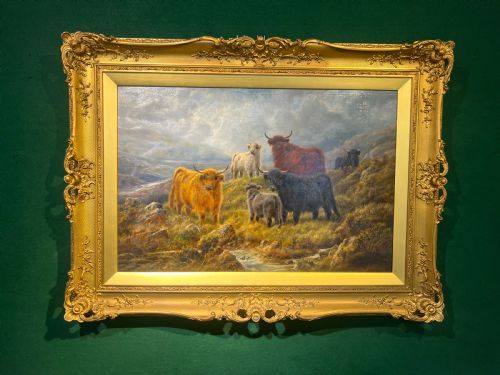
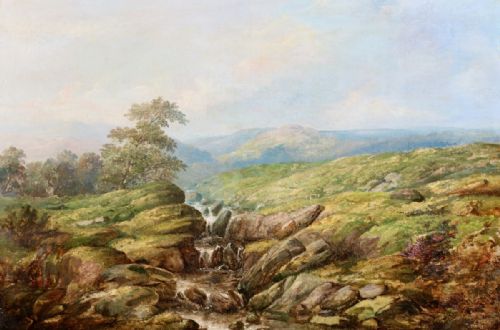
A moorland landscape depicts wild, elevated terrain through traditional painting mediums, centring on uncultivated country with notable expanses of sky and heather. Buyers seeking these works encounter framed oil paintings, watercolours, and pastels that record rural topography from the nineteenth and early twentieth centuries.
The pieces on this page span several decades of British art, ranging from Victorian watercolours to 1930s West Country oils. Regional settings feature prominently, including Dartmoor, Exmoor, and Yorkshire, alongside depictions of livestock, sporting dogs, and figures navigating remote paths.
Materials and methods
Artists working on a moorland landscape primarily utilised oil paint or watercolour applied to canvas, wood panel, board, or paper. Oil paintings on canvas or wood provide deep pigmentation for dark peat soils and atmospheric weather, while watercolours on paper capture the softer, diffused light of upland mists.
Framing forms an integral part of these pieces, with many works retaining period gilt or wooden frames that complement the natural tones of the subject matter. Pastels and gouache also appear occasionally, offering a velvety texture suited to broad expanses of moor.
Moorland Landscape Retail Price Guide 2026
Typical asking prices for moorland landscape among the pieces listed under this phrase on Sellingantiques today, from the lower quarter to the upper quarter. They describe what is for sale here now, not the wider market.
Several sheep and ponies appear to have spent centuries patiently posing on soggy hillsides for itinerant Victorian painters.
Distinctions in quality
The strength of a moorland landscape lies in the artist's handling of light, weather, and topography, separating dynamic observational work from formulaic studio production. Superior examples convey the specific atmosphere of high terrain through confident brushwork and precise tonal control.
Provenance and documentation also influence distinction, with signed works and clearly identified regional locations holding firmer attribution. The integration of livestock, sporting elements, or human figures within the vast terrain further enhances the composition's narrative depth.
Thomas Rowden·Tom Campbell·Arthur Wardle·Robert Watson·Joseph Knight·F.J. Snell·Charles Walter Simpson·Owen Bowen·James Orrock·John A. Houston·Florence Hess·Colin Graeme Roe·John Charles Tunnard·Edmund Morris Wimperis·Ernest Higgins Rigg·Peter Jackson·Arthur H. Enock·Frederick Richard Lee·Charles James Adams·Rowland Henry Hill·Robert Cleminson·Alfred Graham
The Moorland Landscape Glossary
- Watercolour
- A painting method in which fine pigment is suspended in a water-based, translucent solution. It is traditionally applied to heavy paper stock to create luminous, delicate washes.
- Oil on Canvas
- A technique utilising pigments bound in a drying oil medium spread across a stretched fabric surface. This combination allows for rich colour depth and textured impasto application.
- Gouache
- An opaque water-based paint type that includes a white pigment filler, creating a heavier, matte finish. It is often combined with watercolour to build solid highlights.
- Wood Panel
- A rigid flat support made from timber used by artists as an alternative to canvas. Panels provide a firm, stable surface for detailed oil painting.
- British Impressionism
- An artistic approach adopted by late nineteenth and early twentieth-century painters focusing on spontaneous brushwork and natural light. It shifted academic focus towards outdoor observations of rural life.
Moorland Landscape: Frequently Asked Questions
What periods do these paintings come from?
The works originate predominantly from the Victorian era and the early twentieth century, spanning from the late 1800s through to the 1930s. This timeframe encompasses distinct movements such as British Impressionism and the Scottish School.
Artists during this period frequently travelled to remote British uplands to record regional topography directly from nature. Their output reflects the prevailing artistic techniques and materials of those decades.
How should I hang a moorland landscape?
These pieces suit rooms with good natural light that complements the earthy pigments and atmospheric tones of upland scenes. Pairing them with traditional wooden furniture or neutral walls allows the historic frames and subject matter to stand out.
Keep paintings away from direct sunlight and damp environments to protect the integrity of canvas, paper, and period gilt frames. Proper wall placement ensures the subtle details of sky and terrain remain easily visible.
Are watercolours different from oil paintings here?
Watercolours utilise translucent washes on paper to achieve delicate effects of light and weather, whereas oil paintings employ thick pigments on canvas or wood panel for rich textures. Watercolours are inherently more sensitive to light and require protective glass framing.
Oil paintings offer greater durability and deeper colour saturation, which suited artists capturing dramatic storms or dark peat bogs. Both mediums were widely used to interpret remote British scenery during the nineteenth and early twentieth centuries.
How do I identify a specific moor location?
Many paintings include descriptive titles inscribed on the reverse, on old gallery labels, or within the artist's recorded works. References to specific regions like Dartmoor, Exmoor, or Yorkshire often point to identifiable geographic markers.
Local topography, vegetation types, and geological formations depicted by the artist can also offer clues to the exact setting. Contemporary regional records help connect the painted scenery to specific British moorlands.