
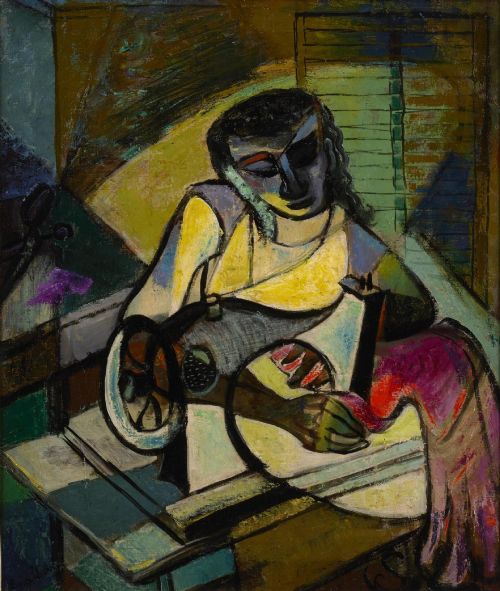


Modernist Female Oil Painting
These modernist female oil painting examples capture twentieth-century portraiture and figure studies through energetic brushwork and varied framing.
Modernist Female Oil Painting
A modernist female oil painting captures the human figure through twentieth-century lenses, spanning decades from the nineteen-twenties to the nineteen-sixties. Collectors encounter evocative depictions of women, ranging from relaxed nudes sunbathing on cliffs to seated studies and bohemian studio models.
The pieces on this page represent diverse European artistic circles, including French colourists and School of Paris practitioners. Works stretch across the nineteen-twenties, thirties, forties, and fifties, illustrating shifting approaches to portraiture and bodily form.
Every modernist female oil painting reflects the aesthetic preoccupations of its decade, whether through Art Deco inclinations or Mid-Century Expressionism. Buyers find both intimate canvas sketches and larger framed compositions bearing signature marks.
Materials and technique
Artists executed these works primarily with oil paint applied to stretched canvas panels, utilising the rich medium to build texture and depth. Brushwork ranges from smooth academic application to abstracted, expressive marks that define the figure.
Supporting these canvases are period surrounds including oak frames, wooden structures, and gilt wood mouldings. These housings often date directly to the creation of the painting, preserving the visual integrity of the period.
Listings feature works spanning the 1920s through the 1960s, executed in oil on canvas and housed in wooden or gilt frames.
Evaluating quality and execution
Distinction in these works rests upon the confidence of the brushwork and the expressive handling of the female form. Strong compositions demonstrate an assured command of posture and light, whether depicting a reclining study or a seated portrait.
The integrity of the original canvas support and the preservation of the pigment layer contribute significantly to the standing of a piece. Original framing that complements the modernist aesthetic also elevates the overall presentation.
Lena Gurr·Raymond Moritz·Peter Jackson·Pinchus Kremegne·Yetta Kane·Bernard Meninsky
The Modernist Female Oil Painting Glossary
- Oil paint
- A slow-drying medium composed of pigments suspended in a drying oil, typically linseed. This substance allows artists to blend tones smoothly or build thick impasto textures.
- Canvas
- A heavy woven fabric stretched across a wooden stretcher frame to serve as a durable surface for painting. It remains the standard substrate for oil works across the twentieth century.
- Impasto
- A technique where paint is laid onto a canvas in very thick areas, making brush strokes or palette knife marks visibly prominent. This method adds tangible physical depth to the painted surface.
- School of Paris
- A loosely defined community of artists living and working in Paris during the early and mid-twentieth century. Many foreign-born painters contributed to this vibrant hub of modernist experimentation.
- Expressionism
- An artistic style where the artist seeks to depict subjective emotions rather than objective reality. Works in this vein often feature distorted forms and intense, non-naturalistic colour palettes.
Modernist Female Oil Painting: Frequently Asked Questions
What periods do these paintings represent?
The works span several decades of the twentieth century, with particular concentration in the nineteen-twenties, thirties, forties, and fifties. Artists during these years embraced progressive styles like Mid-Century Expressionism and School of Paris modernism.
Each era brought distinct approaches to portraying the female form, moving from Art Deco elegance to bolder, abstracted brushwork in later decades.
How should I display a canvas painting?
Displaying these works requires careful consideration of ambient light and humidity to protect the oil pigments and canvas supports. Keeping paintings away from direct sunlight prevents the oil paint from fading or degrading over time.
Matching the canvas to a sympathetic wooden or gilt frame preserves the historical character of the piece while securing it safely against environmental shifts.
What subjects are most common?
Figure studies and female nudes dominate these listings, capturing women in domestic settings, outdoor landscapes, and bohemian artist studios. These compositions range from intimate portrait sketches to abstracted still lifes set within natural environments.
Artists focused heavily on human posture and mood, reflecting contemporary shifts in how the female body was represented in fine art.