
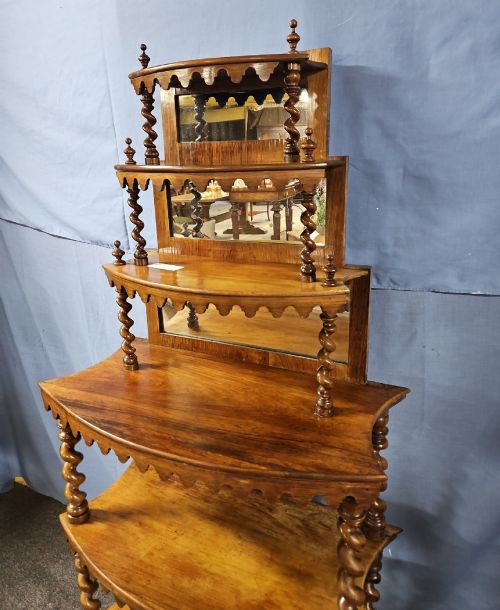
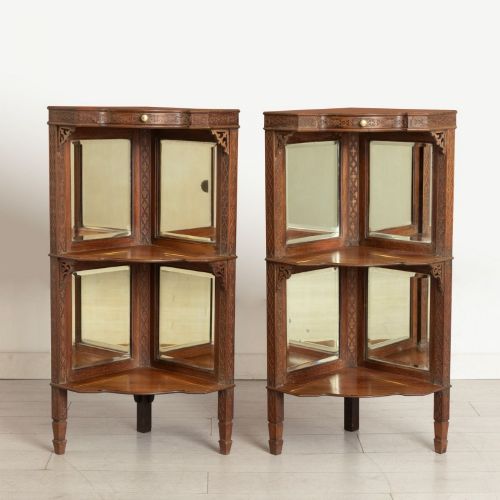


Mirrored Back Etagere
These mirrored back etagere pieces bring reflective depth and open tiering into a room, offering display space that catches the light.
Mirrored Back Etagere
A mirrored back etagere combines open shelving with glass or mirror backing, creating a layered display surface for ornaments and small objects. Buyers searching for a mirrored back etagere encounter varied forms spanning Victorian, Regency, and Georgian periods, alongside pieces from 1860, 1880, and 1900.
The objects listed under this phrase encompass etageres and whatnots, corner display cabinets, console tables, side cabinets, and wall shelves. Among these, multi-tiered shelving units with mirrors and timber frames dominate the selection.
Makers such as Edwards & Roberts appear in the evidence alongside designs attributed after Donald Ross. The construction employs timbers including rosewood, mahogany, walnut, satinwood, oak, and yew wood.
Materials and construction
Makers built these pieces using dense hardwoods like mahogany, walnut, rosewood, and yew wood, often enhanced with marquetry or inlay work. Brass and parcel gilt details appear alongside glass and mirror glass panels fitted into the backs of the shelves.
Structural variety includes barley twist supports, carved oak elements, and tiered configurations designed to hold display items securely. Surface treatments range from natural wood grains to cream paint finishes with gilt highlights.
Materials documented across the listings include mirror glass, brass, rosewood, mahogany, satinwood, walnut, and yew wood.
Quality and execution
The sophistication of the timber selection and the precision of inlaid marquetry define the upper tier of these pieces. Dense grain figures in walnut and rosewood combined with crisp carving elevate the execution.
The integration of the mirror glass and the stability of multi-tiered structures determine the overall integrity of the piece. Finer examples balance delicate shelf supports with robust joinery to sustain daily display use.
Edwards & Roberts·Donald Ross
The Mirrored Back Etagere Glossary
- Etagere
- A piece of furniture consisting of a set of open shelves for displaying small objects or ornaments. The addition of a mirrored back reflects light and the objects placed upon them.
- Whatnot
- A multi-tiered piece of furniture used for storing or displaying books, ornaments, or bric-a-brac. These items often feature slender uprights and multiple open platforms.
- Marquetry
- The art and craft of applying pieces of veneer to a structure to form decorative patterns. This technique frequently employs contrasting timbers on table tops and cabinet doors.
- Barley Twist
- A type of turning shaped like a spiral resembling a stalk of barley. This decorative motif appears on the upright supports of display shelves and tables.
Mirrored Back Etagere: Frequently Asked Questions
What is a mirrored back etagere used for?
These pieces serve primarily for the display of decorative objects, porcelain, and small collections. The open tiers allow items to be viewed from multiple angles.
The mirrored glass backing reflects ambient light and creates an illusion of greater depth behind the displayed pieces, brightening darker corners of a room.
How do I identify a Victorian whatnot?
Victorian whatnots typically feature multiple stacked shelves supported by turned columns or uprights, often incorporating a small drawer or mirrored back. The timber used is commonly walnut, mahogany, or rosewood.
Decoration during this period frequently includes turned barley twist supports and subtle carved details rather than heavy architectural elements.
What timbers were used for these shelves?
Makers relied on durable and decorative hardwoods such as mahogany, walnut, rosewood, satinwood, oak, and yew wood. These timbers provided the necessary strength for slender vertical supports.
Surfaces were often polished to highlight the natural grain, or embellished with contrasting marquetry inlay and parcel gilt accents.
Where should I place a wall shelf unit?
Wall shelves with mirrored backs work effectively in principal reception rooms, hallways, or dining spaces where vertical display space is required without occupying floor area. Securing them firmly to a wall is essential.
Positioning them opposite or adjacent to light sources maximises the reflective quality of the mirror glass.