
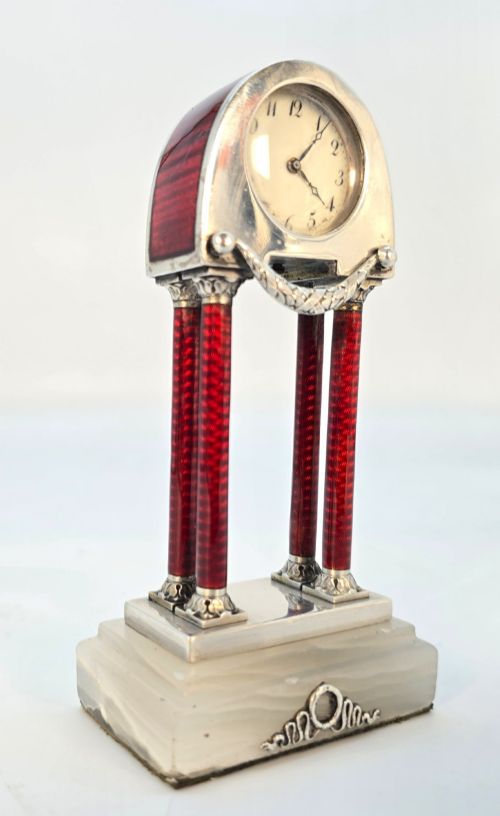


Miniature Silver Timepiece
A miniature silver timepiece sits easily on a desk or travels in a pocket, offering precision within a compact frame.
Miniature Silver Timepiece
Every miniature silver timepiece on this page combines portable timekeeping with precious metal work, drawing on traditions from the nineteenth and twentieth centuries. These objects take several forms, most frequently appearing as small carriage clocks, boudoir timepieces, and desk clocks.
The selection ranges from Victorian Gothic skeletons and Edwardian carriage models to Art Deco alarms and enamelled pieces. Buyers frequently encounter French and English origins among these items, alongside Viennese workshops.
How they were made
Silversmiths constructed the outer cases using solid silver and sterling silver, often supporting the movements with internal brass frameworks. Glass panels protect the dial face, allowing a clear view of the mechanism while shielding the delicate hands.
Many examples incorporate decorative techniques such as hand chasing, repousse work, and translucent guilloche enamel applied over engine-turned metal. Leather and wood occasionally supplement the primary metal structures, particularly on travelling and bedside variants.
Listings feature items spanning the nineteenth century through the 1930s, incorporating silver, enamel, brass, glass, leather, and wood.
What varies in quality
Quality rests upon the crispness of the chased decoration, the weight of the solid silver case, and the complexity of any enamel work applied to the surface. Finer pieces display deliberate hand-finishing on the metal mounts rather than simple cast repetition.
The reputation of the maker and the sophistication of the internal movement further distinguish standard examples from exceptional ones. Enamelled items show distinction through smooth, unbroken colour surfaces free from firing flaws.
Georg Adam Scheid·J Batson & Son·Liberty's London·Bayard·Asprey·Goldsmiths & Silversmiths
The Miniature Silver Timepiece Glossary
- Guilloche enamel
- A decorative technique involving precise, intricate geometric patterns engraved beneath translucent enamel layers.
- Carriage clock
- A small, portable spring-driven clock originally designed for travel during the eighteenth and nineteenth centuries.
- Repousse
- Metalwork shaped by hammering from the reverse side to form raised designs on the front.
- Skeleton clock
- A timepiece designed with an open framework so the gear train and movement remain fully visible.
- Portico clock
- A timepiece built in the architectural style of a miniature classical portico with supporting columns.
Miniature Silver Timepiece: Frequently Asked Questions
How do I wind a miniature silver timepiece?
Most of these small clocks operate via a key or a small butterfly winder attached directly to the movement plates at the back. Turn the winder gently until you feel firm resistance, taking care not to over-wind the internal mainspring.
Allow the clock to rest on a stable, level surface while running to ensure the balance wheel maintains an even beat.
Where should I place a boudoir clock?
Boudoir and desk clocks suit small surfaces where their fine detail can be appreciated close up, such as a mantelpiece, dressing table, or writing desk. Keep them away from direct sunlight, damp environments, and radiators to protect sensitive enamel and leather components.
Because many were originally built for travel, their compact size permits easy relocation around the home.
How do I identify an Edwardian silver timepiece?
Edwardian timepieces often display hallmarks dating between the early twentieth century and the First World War, alongside specific stylistic cues influenced by Art Nouveau and traditional carriage clock formats. Look for refined floral enamelling and lighter, more delicate silver framing compared to heavier Victorian counterparts.
Maker marks stamped into the silver case can help confirm the precise period of production.
Can these travel clocks still be used daily?
Many vintage and antique models continue to keep reliable time if they have received proper mechanical servicing from a qualified clockmaker. Treat them with care, as their miniature gears are more delicate than those found in standard household clocks.
Regular gentle handling preserves both the mechanical movement and the outer silver case.