


Military Battle Wall Art
Military battle wall art brings dramatic historical conflict into a room through oil paintings, engravings, and tapestries from several centuries.
Military Battle Wall Art
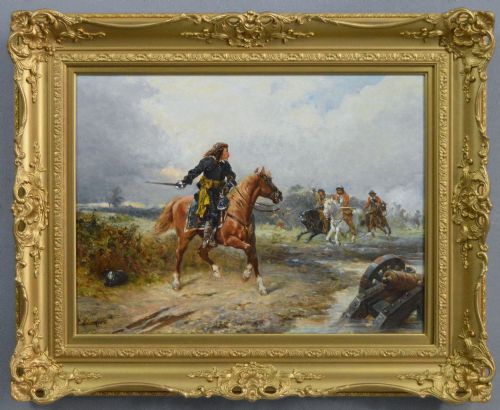
Military battle wall art encompasses framed prints, oil paintings, and engravings depicting historical skirmishes and naval engagements. These works capture significant conflicts ranging from the seventeenth century through the mid-twentieth century.
You are most likely to encounter nineteenth-century prints and eighteenth-century oil paintings on canvas within these listings. Common subjects include naval battles, cavalry skirmishes, and portraits of commanders such as Napoleon.
The objects vary widely in their medium, running from pen and ink drawings to giltwood-framed oil paintings and tapestry embroideries. Each piece reflects the artistic style of its specific period, spanning Georgian, Victorian, and mid-century realism.
Materials and execution
Works in this category rely primarily on oil on canvas, paper for engravings and ink drawings, and textiles for embroidery. Artists and makers applied ink, oil pigment, and coloured threads to record complex battle formations and sea engagements.
Frames play a significant role in the presentation of these pieces, frequently utilising wood and giltwood to house the artwork securely. Printmakers utilised wood engraving and fine engraving techniques to produce detailed historical scenes on paper.
Several commanders make repeat appearances across the centuries, proving that Napoleon simply refused to stay off the wall.
Judging quality in battle scenes
Quality in these works depends largely on the precision of the draughtsmanship and the dynamism of the composition. Master painters and skilled engravers capture the chaos of cavalry skirmishes and naval actions with a clarity that lesser hands miss.
The preservation of the medium, whether oil paint on canvas or ink on paper, dictates the visual impact of the piece. Finer works retain their original framing materials, such as period giltwood, which complements the historical subject matter.
Jean Sobieski·Francis Russell Flint·Philips Wouwerman
The Military Battle Wall Art Glossary
- Engraving
- A printmaking technique where an image is incised onto a metal plate or wood block to hold ink. This process allows for sharp detail in historical battle prints.
- Giltwood
- Wood that has been treated with a thin layer of gold leaf. Frames made from this material often surround oil paintings and large prints from earlier centuries.
- Cavalry skirmish
- A military engagement between mounted troops. This subject recurs frequently in seventeenth and eighteenth-century European paintings.
- Oil on canvas
- A painting medium using pigments bound with a drying oil spread over stretched fabric. It provides rich colour depth suited to dramatic conflict scenes.
Military Battle Wall Art: Frequently Asked Questions
What periods do these artworks cover?
The available pieces span from the seventeenth century through to the mid-twentieth century.
Earlier works typically feature seventeenth and eighteenth-century oil paintings, while the nineteenth century is heavily represented by prints and engravings.
How were these battle scenes created?
Artists used various mediums including oil on canvas, pen and ink drawings, wood engravings, and tapestry embroidery.
Framing materials like wood and giltwood were commonly employed to finish the presentation of these historical works.
What subjects appear most frequently?
Naval engagements, cavalry skirmishes, and famous military commanders such as Napoleon are common subjects.
Specific historical events like the Second Anglo-Afghan War also feature in the visual records.
How do I choose the right piece for a room?
Consider the scale of the artwork and the medium that best suits your space, whether a large oil painting or a detailed framed print.
The period style, ranging from Georgian to mid-century realism, can help guide your selection to match an interior scheme.