




Mid Century Urban Landscape
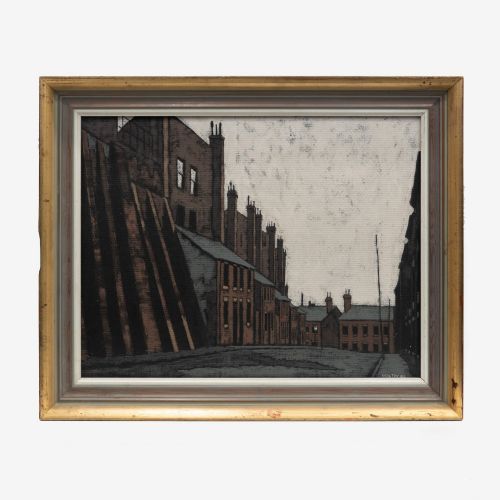
These mid century urban landscape paintings capture city streets, bridges and rooftops through the lens of mid-century modernism.
Mid Century Urban Landscape
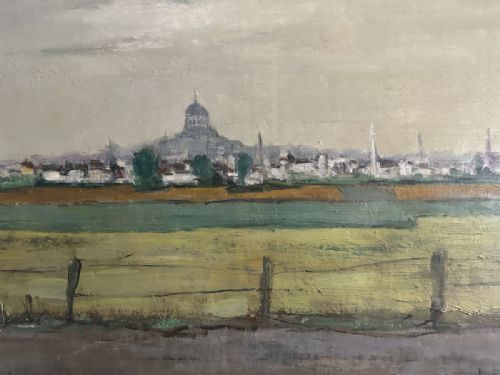
A mid century urban landscape brings metropolitan streets, continental cities and industrial rooftops into focus through mid-century modernism, expressionism and impressionism. These oil paintings and watercolours record the character of cities from Paris to London during the nineteen-forties, nineteen-fifties and nineteen-sixties.
Buyers encounter works spanning continental European scenes to British city views, often featuring bridges, figures and architectural elements. The predominant forms utilise oil paint on canvas and board, framed within wood or gilt moulding.
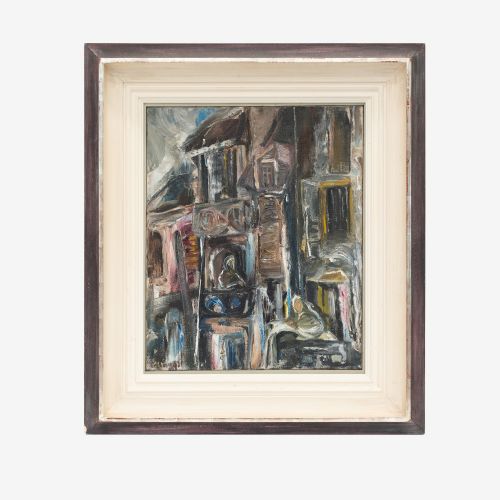
The aesthetic bridges post-impressionist tradition with bolder twentieth-century brushwork. Works range from thick impasto abstracts of cityscapes to specific topographical studies like Charing Cross Bridge and Notre Dame.
Materials and Techniques
Artists apply oil paint to canvas, board and panel supports using brushes and palette knives. Several works employ thick impasto techniques, building physical texture into the paint surface to describe urban buildings and winter rooftops.
Watercolour on paper appears alongside traditional oil paintings. Finished pieces find completion within wood frames and gilt moulding designed to complement the composition.
The selection covers styles from northern realism and expressionism to post-impressionist city views.
Judging Quality and Execution
Quality rests in the handling of light, shadow and spatial depth across metropolitan architecture. Stronger examples demonstrate confident brushwork and tonal control that lift a city view beyond mere record.
The integration of medium supports the subject, whether through flat post-impressionist planes or vigorous impasto texture. Framing choices also contribute, as period wood frames and gilt moulding complete the visual presentation.
Stuart Walton·Lilian Colbourn·E A Minardo·Job de Vogel·Jack Merriott
The Mid Century Urban Landscape Glossary
- Impasto
- Paint applied thickly to a canvas or board, standing out in relief from the surface. This technique adds tactile dimension to architectural elements and city streets.
- Oil on Board
- A painting executed with oil colours upon a rigid wooden or composite board rather than stretched fabric. This support offers a firm surface favoured by many twentieth-century artists.
- Mid-Century Modern
- A design and art movement spanning the middle decades of the twentieth century. It embraces simplified forms and expressive interpretations of traditional subjects.
- Post-Impressionist
- A stylistic approach following impressionism that focuses on symbolic content and expressive use of colour. Artists working in this manner emphasise structure and emotional resonance over strict optical realism.
- Watercolour
- A paint consisting of pigment suspended in a water-soluble binder, typically applied to paper. It creates luminous washes and delicate architectural details.
Mid Century Urban Landscape: Frequently Asked Questions
What periods do these paintings date from?
The listings span the nineteen-forties, fifties and sixties, reflecting mid-century modernist approaches to urban subject matter.
These decades saw artists experiment with both representational city views and more abstract impasto interpretations.
What materials were used to create them?
Artists worked primarily with oil paint on canvas or board, alongside watercolour on paper.
Works are typically housed in period wood frames or gilt moulding.
Which cities and locations appear most often?
Parisian views featuring Notre Dame and various European streets recur across the selection alongside London bridges.
Continental cityscapes and winter rooftops also form a core part of the subject matter.
How do I distinguish impressionist from abstract cityscapes?
Impressionist works focus on light and atmosphere within recognizable streets and bridges. Abstract cityscapes utilise heavy impasto and geometric forms to evoke the energy of the metropolis rather than precise topography.