
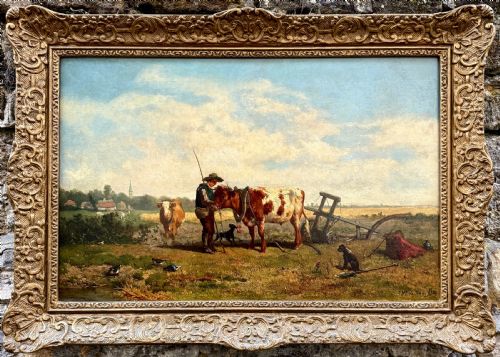


Mid Century Rural Landscape
A mid century rural landscape captures fields, farms and villages through the expressive brushwork of the twentieth century.
Mid Century Rural Landscape
A mid century rural landscape presents pastoral scenes, farmyards and country villages through oil and watercolour paintings. These works range from mid-century British compositions to continental views and nineteenth-century realist depictions. Buyers encounter framed canvas works and board paintings that record agricultural life, cottages and rolling hills.
The selection here leans heavily toward mid-century British school pieces, post-impressionist canvases and twentieth-century watercolours. Many works focus on specific regional settings such as Yorkshire farms, Manx views and French countryside. The subjects span autumn harvests, winter sheep droving and quiet village lanes.
How they were made
Artists painted these scenes using oil paint or watercolour applied to canvas, board, paper or panel. Many works employ thick oil paint to build texture in fields, trees and farm buildings. Watercolours and gouache capture lighter atmospheric effects in rural settings.
Canvases are often housed in ebonised or gilt frames that complement the painting style. Support materials range from traditional stretched canvas to sturdy boards and heavy paper sheets.
Several canvases record specific agricultural moments, including haymaking, autumn harvests and sheep droving in winter.
What varies in quality
The strength of the composition and the confidence of the brushwork determine the distinction in these paintings. Stronger pieces demonstrate a assured handling of light, shadow and spatial depth within the rural setting. Weaker examples rely on formulaic arrangements with less expressive application.
The integrity of the original surface and the harmony of the framing also influence the standing of a piece. Works retaining their period frames and untouched paint layers hold greater visual coherence.
Harry Freckleton·William JB Jenkins·Fred Lawson·John Hobson Nicholson·John Frederic Greenwood·Henry Earp Senior·Gudrun Sibbons·Helmut Reuter·Charles McAuley·Alastair Flatterly·Reginald Mills·Arthur Bateman·Johannes de Haas
The Mid Century Rural Landscape Glossary
- Post-Impressionism
- An art movement extending beyond impressionism that prioritised symbolic content and expressive use of paint. This style influences many mid-century rural landscapes.
- Oil on Canvas
- Pigments bound in a drying oil applied to a stretched fabric surface. This medium allows for rich texture and deep colouration.
- Watercolour
- Paint consisting of transparent pigment suspended in a water-based solution. It is typically used on paper to create luminous rural views.
- Gouache
- An opaque water-based paint that provides solid areas of colour and matte finishes. Artists use it for detailed landscape studies.
- Ebonised frame
- Wood finished to resemble dark ebony. These frames provide a strong linear boundary for mid-century canvases.
Mid Century Rural Landscape: Frequently Asked Questions
What is a mid century rural landscape?
It is an original painting from the middle decades of the twentieth century depicting farms, fields, villages and country life. These works utilise oil paint or watercolour to record rural scenes.
The style often draws on post-impressionist or mid-century British traditions, focusing on the character of the countryside rather than strict topographical accuracy.
Where were these paintings displayed?
These works were originally hung in domestic interiors, artist studios and regional exhibitions. They brought views of farms and open fields into town and city homes.
Today, they suit living rooms, studies and hallways where their pastoral subject matter adds warmth and historical character.
How do I date a rural landscape?
Dating relies on stylistic clues, artist signatures, framing and the materials used. Mid-century works often feature expressive brushwork and specific colour palettes characteristic of the nineteen-fifties and nineteen-sixties.
Inscribed titles on the reverse, artist biographies and exhibition labels also help place a painting within a specific decade or period.
Are these paintings signed by the artist?
Many of the works listed feature signatures or initials from the painter, while others remain attributed to specific schools or studio sales. Signed pieces often include secondary documentation or exhibition provenance.
Unsigned works are judged on their technique, palette, canvas type and framing materials to determine their school and period origin.