


Mid 19th Century Rug
A mid 19th century rug offers tactile warmth and rich historical depth, bringing authentic nomadic and village artistry directly onto your floor.
Mid 19th Century Rug
When you search for a mid 19th century rug, you encounter hand-knotted floor coverings and textiles created across Anatolia, Persia, Central Asia, and the Caucasus during the 1850s and 1860s. These pieces include tribal main carpets, village weaving, and specialised formats such as torba face fragments and prayer rugs.
The most common examples on this page originate from Turkish weaving centres like Konya, Mudjur, Ladik, Kirsehir, Milas, Bergama, and Megri. Alongside these Anatolian pieces, Turkmen tribal items such as Tekke and Ersari works appear frequently, representing the nomadic traditions of Central Asia.
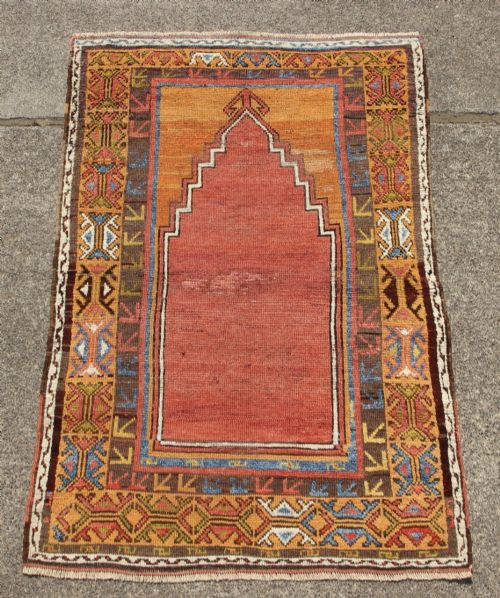
Prayer rugs form a significant portion of the selection, identifiable by characteristic mihrab niches designed for devotional use. Other pieces display geometric torba formats, elongated Talish proportions, and distinctive Qashqai or Afshar tribal designs.
How they were made
Weavers constructed these textiles entirely from hand-spun wool, utilising traditional upright looms to tie individual knots by hand. This organic material provides a durable foundation that softens gracefully over generations of use.
Colour derives from natural dyes applied to the wool fibres, yielding varied hues across green, yellow, blue, and red grounds. These natural colorants produce subtle tonal shifts within individual fields and borders.
Mid 19th Century Rug Retail Price Guide 2026
Typical asking prices for mid 19th century rug among the pieces listed under this phrase on Sellingantiques today, from the lower quarter to the upper quarter. They describe what is for sale here now, not the wider market.
Listings span the 1850s and 1860s, featuring wool materials, natural dyes, and regional styles from Anatolia, Persia, and Central Asia.
What varies in quality
The distinction between standard examples and the finest items rests upon the density of the weave and the precision of the knotting. Pieces described as having a very fine weave demonstrate exceptional technical skill from the weaver.
Visual impact relies heavily on the palette and design execution, where uncommon ground colours like yellow or green elevate a piece. The clarity of geometric motifs and the preservation of original borders also determine the standing of each textile.
The Mid 19th Century Rug Glossary
- Prayer rug
- A small textile featuring a mihrab design, traditionally used for daily Islamic prayer. These pieces often depict architectural arches or niche motifs pointing towards Mecca.
- Torba
- A small Turkmen wall-hanging bag or storage sack, frequently featuring gul motifs and curled leaf designs. Surviving examples often circulate as face panels or fragments.
- Mihrab
- The arched niche depicted on prayer rugs that indicates the direction of prayer. It serves as the primary visual focus in designs from centres such as Mudjur and Ladik.
- Gul
- An octagonal medallion motif repeated across Turkmen carpets and torbas. Each tribal group utilised distinct variations of these primary design elements.
- Natural dyes
- Colourants derived from plants, insects, and minerals rather than synthetic compounds. These substances yield the characteristic depth and patination found in nineteenth-century textiles.
Mid 19th Century Rug: Frequently Asked Questions
How do I clean a mid 19th century rug?
Surface dirt is best managed through gentle suction using a low-power vacuum without a beater bar, avoiding the delicate fringed ends.
Professional textile conservators should handle deeper washing to protect the natural dyes and hand-spun wool foundations.
Can I use these rugs on the floor?
These textiles were created for practical floor use and withstand normal foot traffic when paired with a breathable, high-grade underlay.
Placing them in low-traffic areas or mounting fragile torba fragments on walls preserves their structural integrity over time.
How do I identify a prayer rug?
Prayer rugs feature a distinct pointed arch or mihrab design at one end, framing a central field intended for kneeling during devotion.
Anatolian regions such as Konya, Ladik, and Megri produced many of the specific village examples seen in this format.
What does a very fine weave mean?
A very fine weave indicates a high density of knots per square inch, requiring greater labour and superior skill from the weaver.
This tight construction allows for sharper definition in intricate geometric patterns and curved motifs.