


Mid 18th Century Candlesticks
These mid 18th century candlesticks bring genuine Georgian candlelight into a room, offering the heavy weight and honest proportions collectors seek.
Mid 18th Century Candlesticks
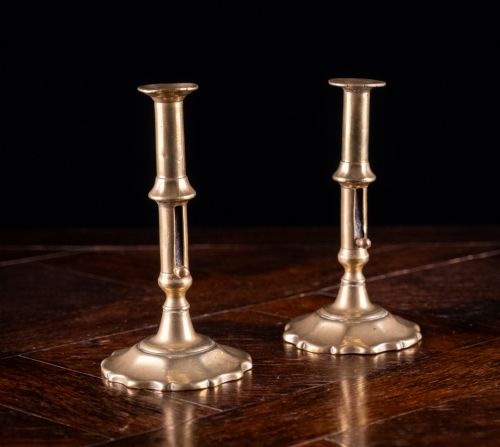
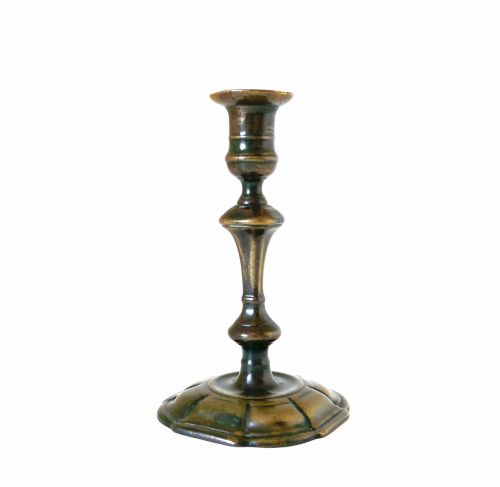
Mid 18th century candlesticks are domestic lighting pieces designed during the Georgian era, most frequently encountered in cast or seamed brass. They appear as single examples or matched pairs featuring baluster stems, petal bases, and distinct socket collars.
The selection includes examples from English workshops alongside pieces originating in Italy and the Low Countries. Forms range from standard table lighting with multi knopped stems to specialised chamber sticks fitted with ejector mechanisms.
Buyers focusing on mid 18th century candlesticks will notice variations in silhouette, from scalloped edges to plain turned columns. The materials extend beyond standard brass to include silver and paktong.
How they were made
Makers utilised molten brass poured into sand or metal moulds to form the heavy components of cast candlesticks. Individual parts such as the base, stem, and sconce were then turned on a lathe and joined together securely.
Seamed brass examples were constructed from rolled sheet metal joined down the vertical axis with a soldered or brazed seam. Paktong, a copper-nickel-zinc alloy, required specialised handling to shape its bright, silvery metal into durable lighting forms.
Listings feature brass, silver, and paktong across English, Italian, and Low Countries origins.
What varies in quality
The quality of these lighting pieces depends upon the crispness of the casting and the retention of original components. Sharp detail in the knops and petal bases indicates superior initial production and skilled lathe work.
Weight and balance distinguish finer examples from lighter utilitarian wares, as substantial metal thickness ensures stability on a surface. The presence of original patination and intact ejector mechanisms further elevates an individual piece.
The Mid 18th Century Candlesticks Glossary
- Baluster
- A moulded column shape with a bulbous lower portion tapering upward, commonly found supporting the candle sconce. It provides visual weight and ergonomic grip.
- Ejector
- A concealed internal mechanism operated by a thumbpiece to push the candle stub upward out of the socket. This practical addition facilitates easy removal after use.
- Paktong
- A Chinese alloy of copper, nickel, and zinc exported to Europe for high end decorative metalwork. It mimics the appearance of silver while offering robust durability.
- Petal base
- A moulded foot shape resembling outward spreading flower petals, typical of mid Georgian design. This form provides a wide footprint for stability.
Mid 18th Century Candlesticks: Frequently Asked Questions
How were these candlesticks used daily?
These candlesticks provided essential illumination across rooms before the advent of gas or electric lighting. Servants carried chamber sticks to light the way through dark corridors.
Pairs sat upon mantelpieces, dining tables, and sideboards to cast ambient light during evening hours. Candles were snuffed rather than blown out to preserve the wax and wick.
How do I clean antique brass?
Historic brass requires minimal intervention to preserve its accumulated surface patination and colour. Regular dusting with a soft, dry cloth is sufficient for routine maintenance.
Harsh chemical polishes strip away the aged layers that collectors value. Gentle cleaning with neutral soap and water should only occur if harmful residue builds up.
How do I spot a replacement part?
Inspect the joins under a strong glass to check for mismatched metal colour or modern solder. Original components show consistent wear patterns and uniform metallurgical composition across the entire object.
Threads on assembled stems should match Georgian standards rather than modern machine tooling. A mismatch between the base and the sconce often suggests a later marriage of parts.