
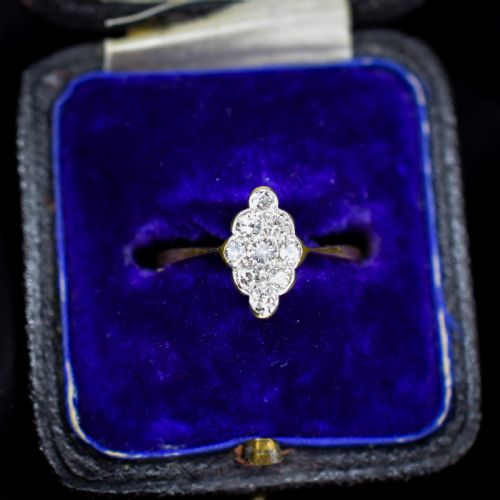
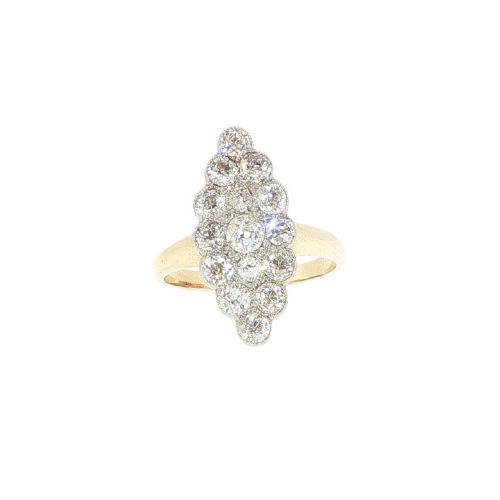


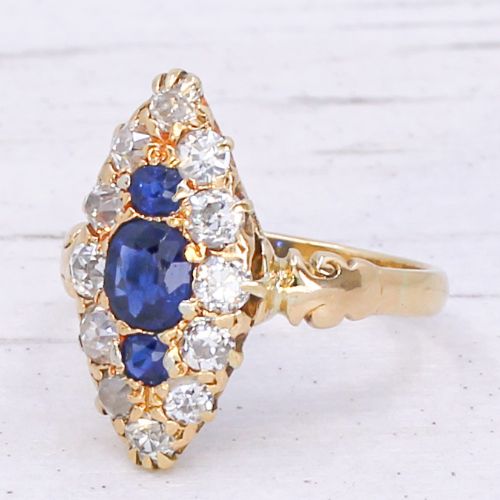


Marquise Shaped Diamond Ring
A marquise shaped diamond ring offers a distinctive boat-shaped silhouette that elongates the finger with unmistakable period elegance.
Marquise Shaped Diamond Ring
A marquise shaped diamond ring sits within a rich lineage of historical jewellery, encompassing terms like navette and boat shapes. When buyers search for this style, they encounter pieces spanning the Victorian, Edwardian, and Art Deco periods.
The most frequent examples on this page combine old cut diamonds with 18ct gold and platinum, often configured as clusters. These designs maximise visual presence through careful stone arrangement rather than sheer carat weight alone.
Makers across the late nineteenth and early twentieth centuries favoured this elongated form for its flattering geometry on the hand. Surviving specimens range from understated single-stone settings to elaborate gem-set cocktail rings.
How they were made
Goldsmiths constructed these rings using combinations of 18ct yellow gold, 18ct white gold, and platinum to support the stones securely. Platinum gained widespread favour during the Edwardian and Art Deco eras for its strength in delicate, lace-like settings.
Diamonds were predominantly old cut, shaped by hand to catch candlelight, and secured with meticulous claw or rubover settings. Master craftsmen integrated sapphires, rubies, and pearls as accents to complement the central diamond configurations.
Listings span the Victorian, Edwardian, and Art Deco periods, featuring diamonds paired with platinum, 18ct gold, sapphires, and rubies.
What varies in quality
Quality in these rings rests upon the harmony of the proportion and the integrity of the original metalwork. Finer examples maintain crisp edges on their navette galleries without thinning from decades of resizing or wear.
The choice of supporting gemstones and the matching of old cut diamonds dictate the upper tier of craftsmanship. Superior pieces display seamless integration between the mounting metals and the stones they hold.
The Marquise Shaped Diamond Ring Glossary
- Navette
- A French term meaning little ship, describing a pointed, boat-shaped cluster ring design. This silhouette forms the foundation of many Edwardian and Victorian multi-stone rings.
- Old cut
- A historical diamond cutting style characterised by a smaller table, higher crown, and open culet. These stones display a softer, chunkier sparkle under ambient light.
- Cluster
- An arrangement of multiple gemstones grouped closely together to create the visual impact of a larger single stone. In these rings, diamonds frequently surround a central sapphire or ruby.
- Cocktail ring
- A large, bold ring designed to catch the eye during evening wear, particularly popular during the Art Deco period. These pieces often feature prominent coloured gems alongside diamonds.
- Trilogy
- A three-stone ring configuration representing past, present, and future, frequently executed with old cut diamonds in gold mounts.
Marquise Shaped Diamond Ring: Frequently Asked Questions
How do I clean my ring?
Clean your ring using warm water, mild washing-up liquid, and a very soft brush to remove accumulated oils from beneath the stones.
Avoid harsh chemical dips or ultrasonic cleaners, particularly if the piece contains pearls or softer gems.
Can these rings be resized?
Most gold and platinum rings from these periods can be adjusted by a skilled jeweller without compromising the structural integrity.
Intricate navette galleries require careful handling so the shoulder proportions remain undisturbed during the alteration.
What is an old cut diamond?
An old cut diamond refers to stones shaped by hand before modern symmetrical standards were established in the twentieth century.
These diamonds feature distinctive hand-faceted planes that produce a warm, deep glow rather than modern brilliant scintillation.
How do I date my ring?
Dating relies on stylistic markers, such as the delicate platinum millegrain work of the Edwardian era or the geometric lines of Art Deco.
Assay office hallmarks and metal types further narrow the production period to specific decades.