


Marquise Ruby Dress Ring
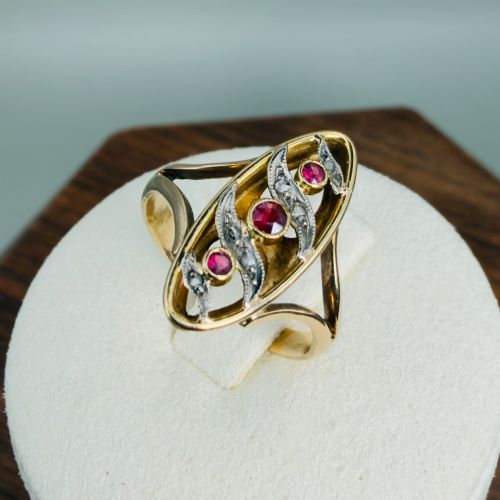
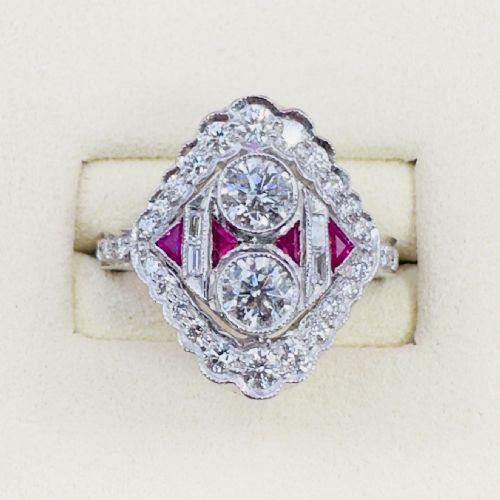
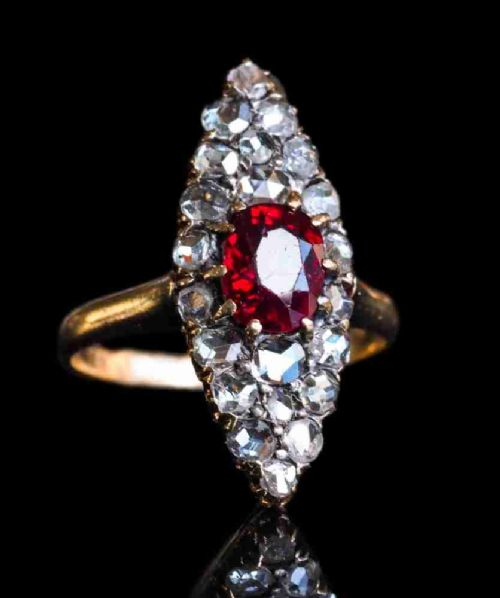
A marquise ruby dress ring commands the hand with a pointed silhouette set in gold alongside sparkling diamonds.
Marquise Ruby Dress Ring
A marquise ruby dress ring centres on a boat-shaped or navette silhouette flanked by diamonds, designed specifically for evening wear and formal occasions rather than daily betrothal. These pieces span Victorian, Edwardian, Art Nouveau, Art Deco, and mid-century twentieth-century periods, capturing diverse aesthetic movements from ornate scrolling to geometric symmetry.
The dominant forms on this page feature elongated navette clusters and crossover designs mounted in eighteen-carat yellow, white, or standard gold. Ruby and diamond combinations appear repeatedly across different eras, showcasing deep red stones framed by brilliant or old-cut diamonds.
Buyers encounter origins ranging from French workshops to British assay offices, each carrying distinctive hallmarks and local craftsmanship traits. The variety includes natural unheated stones and Burmese rubies paired with substantial diamond weights in classic dress ring formats.
Materials and construction methods
Goldsmiths utilise eighteen-carat yellow gold and eighteen-carat white gold for the mountings, occasionally pairing distinct gold bands with contrasting settings. Precious metals are shaped to support intricate navette and marquise clusters that house central rubies and surrounding diamond accents.
Stone setting techniques rely on precise claw or French-cut methods to secure rubies and old-cut or brilliant-cut diamonds tightly within the metal frame. Structural integrity is maintained through robust shank construction, sometimes evidenced by distinct regional hallmarks stamped into the metal.
Listings feature items spanning from the Victorian era through the Edwardian period and Art Deco movement into the late twentieth century.
Evaluating quality and execution
Quality rests upon the visual impact and saturation of the central ruby, alongside the clarity and cut of the accompanying diamonds. Superior examples display vivid red hues paired with clean diamond facets that catch the light effectively within the navette silhouette.
The refinement of the metalwork distinguishes finer workshops, visible in the precision of the cluster arrangement and the symmetry of the pointed marquise outline. Hallmark clarity and the original preservation of the gold mount further elevate the standing of an individual ring.
The Marquise Ruby Dress Ring Glossary
- Marquise
- A pointed, boat-shaped gemstone cut or mounting style designed to maximise perceived stone size and elongate the finger. This shape forms the core visual signature of the pieces gathered here.
- Navette
- Little ship in French, describing an elongated, boat-shaped ring cluster or setting style. It shares similarities with the marquise outline.
- Old-cut
- A diamond faceting style prevalent in nineteenth-century and early twentieth-century jewellery, characterised by a high crown, small table, and deep pavilion. These stones exhibit a softer candlelit sparkle compared to modern brilliant cuts.
- Crossover
- A ring design where the band splits or sweeps around the finger to meet or cross over the central stones. This configuration creates a dynamic, flowing silhouette on the hand.
- Hallmark
- An official stamp struck into precious metal indicating purity, origin, and assay office. These marks help verify the material composition and period of the gold mount.
Marquise Ruby Dress Ring: Frequently Asked Questions
How should I wear an antique dress ring?
Wear your dress ring on fingers where the elongated marquise shape sits comfortably without striking hard surfaces. Because these pieces incorporate older stones and delicate gold settings, reserve them for non-rigorous daily activities.
Pairing the ring with plain bands allows the intricate navette cluster and red and white colour contrast to remain the focal point of the hand.
How do I care for gold and ruby jewellery?
Clean your gold and ruby ring gently using warm water, mild soap, and a soft brush to remove everyday oils from beneath the stones. Avoid harsh chemical dips or ultrasonic cleaners, particularly if the piece contains unheated or treated natural stones.
Store the ring in a padded jewellery box away from harder gems like diamonds that might scratch the gold mount or the ruby surface.
How do I identify the period of a ring?
Examine the mounting style, stone cuts, and any metal stamps present on the inner shank. Victorian and Edwardian pieces often display hand-finished details and old-cut diamonds, while Art Deco examples favour geometric symmetry.
Assay office hallmarks and specific gold purity marks provide concrete clues to date the piece accurately within its historical context.