

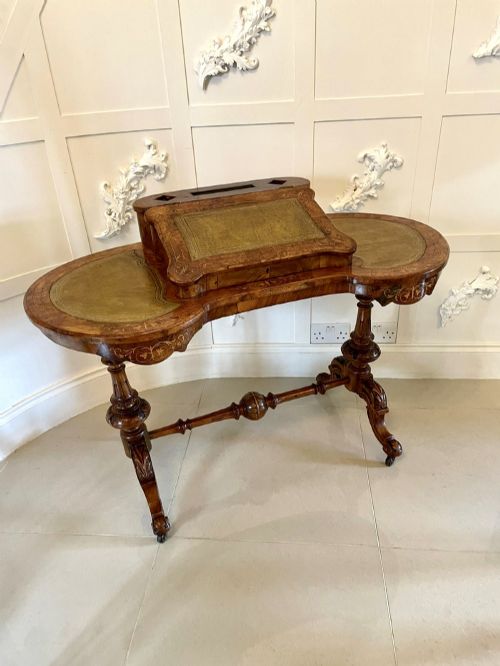
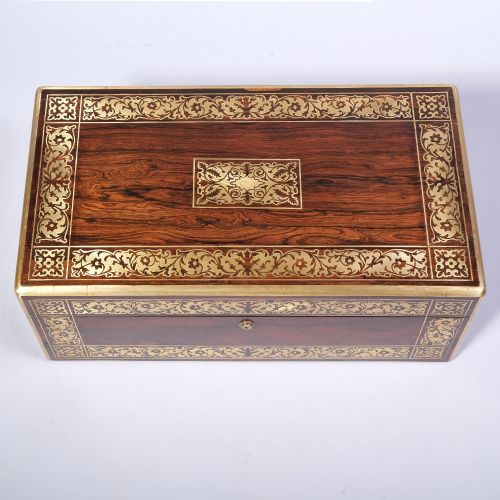
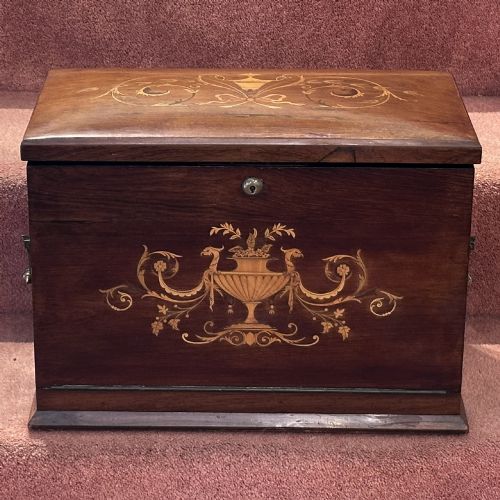


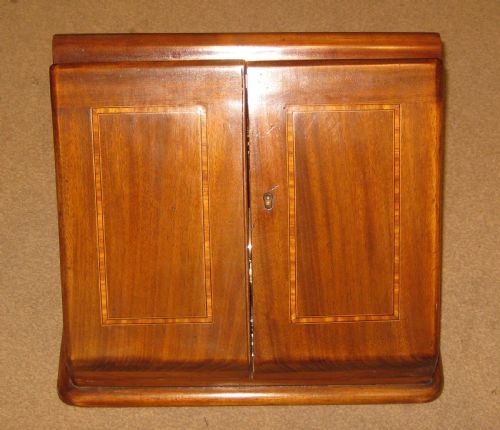
Marquetry Stationery Box
These marquetry stationery box examples are crafted timber containers designed to hold correspondence, emerging most commonly in Victorian and Georgian periods.
Marquetry Stationery Box
A marquetry stationery box is a timber desktop container designed to hold writing paper, envelopes, and letters, often taking the form of cabinets, chests, or slant-lidded boxes. When exploring this selection, buyers encounter pieces originating primarily from the 18th, 19th, and early 20th centuries, spanning Georgian, Regency, and Victorian eras.
The assortment includes related writing equipment such as correspondence chests, writing slopes, and letter holders alongside dedicated stationery cabinets. Walnut, mahogany, and rosewood serve as the primary foundational timbers for these desk accessories.
How they were made
Cabinet makers utilised dense hardwoods like mahogany, rosewood, and walnut as the foundational structures for these boxes, often selecting burr walnut veneers for figured grain patterns. Surface decoration relied on contrasting timber veneers, boxwood inlay, and brass work.
Inlay techniques involved precise insertion of different wood types into fitted recesses to create geometric or floral patterns. Tunbridge ware examples demonstrated specialised mosaic woodwork using numerous natural timber varieties to form intricate pictorial designs.
Marquetry Stationery Box Retail Price Guide 2026
Typical asking prices for marquetry stationery box among the pieces listed under this phrase on Sellingantiques today, from the lower quarter to the upper quarter. They describe what is for sale here now, not the wider market.
Periods represented in the selection range from the 18th century through the Victorian era to Edwardian times.
What varies in quality
Quality separates examples through the precision of the timber inlay and the selection of figured veneers such as burr walnut. Superior pieces display crisp alignment in brass stringing and boxwood details without gaps.
Construction methods determine longevity, with finer boxes utilising substantial hardwood carcases rather than thin secondary timbers. The complexity of the internal fittings, such as tiered letter partitions and integrated inkwell compartments, also distinguishes standard production from superior craftsmanship.
The Marquetry Stationery Box Glossary
- Marquetry
- Decorative veneer work forming pictures or patterns by assembling small pieces of coloured wood, shell, or other materials. This technique is applied to the exterior surfaces of cabinet furniture to create ornamental designs.
- Stationery box
- A specialised desk accessory built with internal partitions to organise letters, envelopes, and writing paper. These containers often feature hinged lids or fall-front doors.
- Writing slope
- A portable desk featuring an angled writing surface that typically opens to reveal storage compartments for pens and paper. Many examples include velvet or leather writing surfaces.
- Tunbridge ware
- Decorative woodwork characterised by mosaic designs composed of thousands of tiny tinted wood blocks. This regional craft originated in Kent and decorated small boxes and desk items.
- Parquetry
- Geometric mosaic woodwork used for floors and furniture decoration, formed by laying small strips or blocks of timber. It creates repeating patterns across box lids and panels.
Marquetry Stationery Box: Frequently Asked Questions
What is a marquetry stationery box?
A marquetry stationery box is a wooden desktop container decorated with patterned wood veneers, specifically built to hold letters and writing paper.
These pieces typically date from the Georgian, Victorian, and Edwardian eras, featuring fitted internal compartments for organisation.
How were stationery boxes used?
They were kept on desks to store writing paper, envelopes, and incoming correspondence in an organised manner.
Many designs included tiered dividers to separate different sizes of paper and slots for holding pens and stamps.
How do I date a stationery box?
Dating relies on identifying the primary timber, decorative style, and construction methods used by the cabinet maker.
Victorian pieces frequently employ walnut and brass inlay, while Georgian examples often feature mahogany and simpler boxwood stringing.
Where should I place a stationery box?
These boxes function well on top of desks, side tables, or bookshelves as both decorative objects and functional storage.
Direct sunlight and extreme temperature changes should be avoided to protect the delicate wood veneers and polish.