
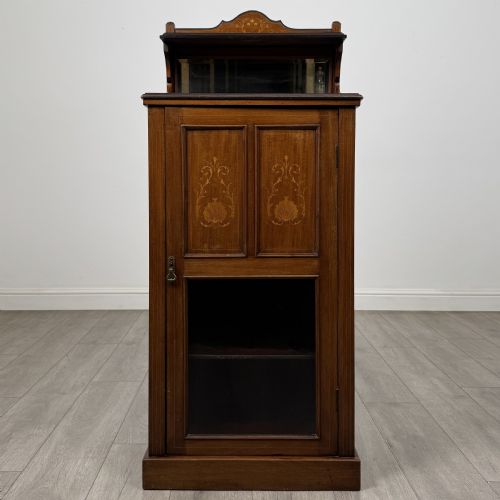
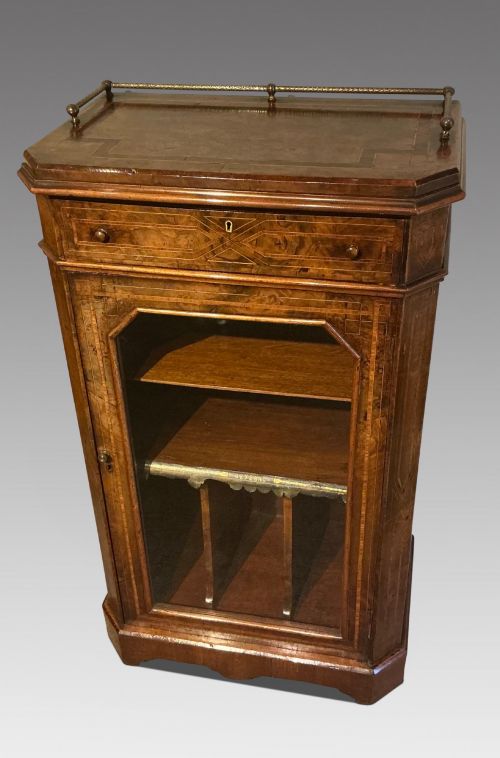


Marquetry Music Chest
These marquetry music chests are timber cabinets designed to hold sheet music, offering intricate inlaid decoration that appeals to collectors of period furniture.
Marquetry Music Chest
A marquetry music chest is a specialised storage piece built to house sheet music and scores. They appear in forms such as music cabinets, side cabinets, and sheet music cabinets.
The pieces on this page span the Victorian and Edwardian eras, alongside 19th Century Swiss examples. Buyers encounter cabinets constructed in mahogany, walnut, rosewood, and satinwood alongside musical boxes.
How they were made
Cabinet makers utilised dense hardwoods like mahogany, rosewood, and walnut as the primary carcass materials. These timbers provided a stable foundation for applied veneers and structural joinery.
Marquetry decoration involved fitting contrasting wood veneers, such as satinwood and burr walnut, into precise recesses to create ornamental patterns. Brass hardware and glass panels occasionally complemented the woodwork.
Listings feature woods like rosewood, walnut, satinwood, and mahogany, often paired with intricate marquetry and brass details.
What varies in quality
The intricacy and precision of the wood inlay determine the visual distinction between examples. Finer pieces demonstrate tight grain matching and complex botanical or geometric marquetry motifs.
The choice of cabinet timber shifts the overall weight and presence of the piece. Dense burr veneers and substantial hardwood construction signal a higher standard of manufacture.
Keeble London·Nicole Freres
The Marquetry Music Chest Glossary
- Marquetry
- Decorative veneer work applied to a furniture carcass to form pictorial or geometric designs. Artisans cut thin sheets of various woods and fit them together precisely.
- Carcass
- The main structural body or frame of a piece of furniture before drawers, doors, or decorative veneers are added. It provides the core stability for the cabinet.
- Veneer
- A thin slice of ornamental wood applied over a secondary timber base. This technique allows makers to display striking grain patterns without using solid costly lumber.
- Cylinder
- The rotating metal drum inside a mechanical music box that carries pins to pluck specific teeth on a comb. Its rotation determines the melody played.
Marquetry Music Chest: Frequently Asked Questions
What fits inside a music chest?
These cabinets were originally manufactured with shallow internal shelving specifically proportioned for folded sheet music and bound musical scores.
Today, owners utilise the tailored compartments for organising papers, documents, or small flat collections.
How do you date a cabinet?
Cabinet dating relies on identifying the prevailing stylistic traits of periods like the Victorian and Edwardian eras, alongside construction methods.
Examining the secondary timbers inside the drawers and the type of veneer used provides further chronological clues.
Where were music chests placed?
Victorian and Edwardian households positioned these chests in drawing rooms or parlours near a piano or music stand. Their compact footprint allowed them to sit against walls without dominating the room.
They functioned as both practical storage units and decorative surfaces for displaying small ornaments.
What is the difference between a cabinet and a box?
Music cabinets are vertical furniture pieces featuring doors or drop-fronts designed to hold paper scores on interior shelves. Musical boxes are smaller tabletop or freestanding mechanical devices housing a pinned cylinder and comb.
Some surviving examples combine cabinet storage with mechanical musical movements.