
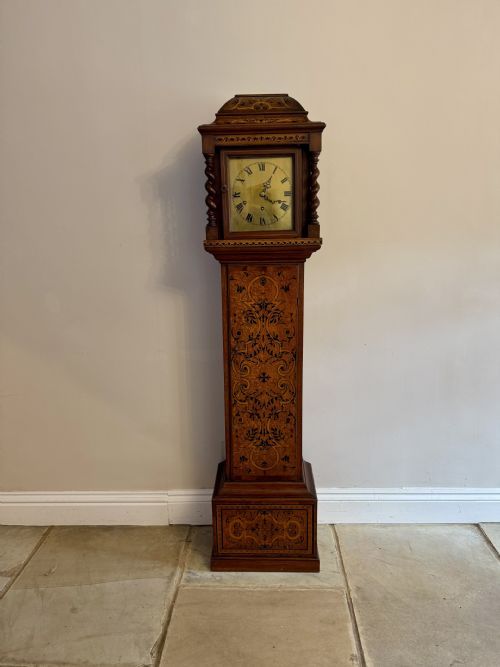


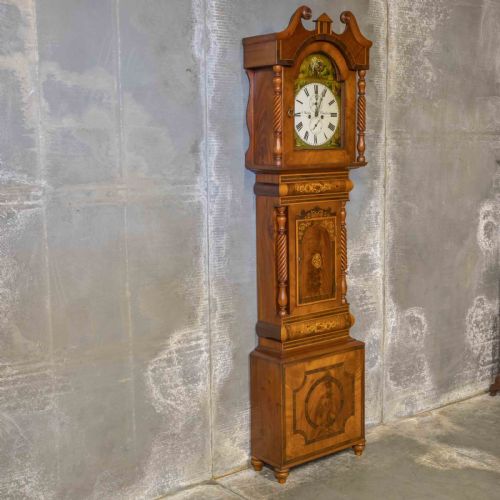


Marquetry Mahogany Floor Clock
A marquetry mahogany floor clock brings architectural presence and intricate woodwork into a room, offering both traditional timekeeping and decorative depth.
Marquetry Mahogany Floor Clock
When you search for a marquetry mahogany floor clock, you encounter tall timepieces spanning the Georgian, Victorian, and Edwardian periods, including Scottish Georgian and Sheraton Revival examples. These objects appear under various historical terms such as longcase clocks, grandfather clocks, and smaller grandmother clocks.
The pieces on this page heavily feature Edwardian and 19th Century craftsmanship, alongside earlier Georgian items. They incorporate forms with painted metal dials, moon dials, and musical movements housed in stately wooden cases.
Materials and Construction
These clocks are built primarily from mahogany, frequently enriched with satinwood and satinwood inlay to create detailed marquetry patterns across the tall wooden cases. Brass and glass components protect the dial faces and house the intricate mechanical movements within.
Makers integrated painted metal dials and specialised musical mechanisms alongside standard eight-day clockworks. Secondary timbers like oak and walnut also appear in the internal structure and casing of specific pieces.
Several clocks on this page chime melodies or track the moon, proving that early timekeepers were built to entertain as well as count the hours.
Distinctions in Quality
The refinement of the marquetry and the crispness of the satinwood inlay separate standard examples from finer works. Elaborate floral or geometric patterns demand high skill from the cabinetmaker.
David Morice of Auchtermuchty·William Warren Royston·Sam Robson
The Marquetry Mahogany Floor Clock Glossary
- Marquetry
- Decorative veneer work applied to furniture in patterns using different woods and materials. This technique forms the pictorial or geometric designs seen on the clock cases.
- Longcase clock
- A tall pendulum clock enclosed in a wooden case that rests upon the floor. These pieces are frequently referred to as grandfather clocks.
- Satinwood inlay
- Contrasting yellowish wood inserted into the primary mahogany surface to create decorative borders and motifs. It highlights the architectural lines of the clock.
- Moon dial
- A specialised clock face mechanism displaying the phases of the lunar cycle. These dials appear on select Scottish examples.
- Grandmother clock
- A smaller, more slender version of the traditional longcase clock developed during the Edwardian period. They offer a reduced height suitable for smaller rooms.
Marquetry Mahogany Floor Clock: Frequently Asked Questions
What is a marquetry mahogany floor clock?
It is a tall pendulum-driven timepiece housed in a wooden case decorated with contrasting wood veneers. These pieces range from grand Georgian examples to more compact Edwardian versions.
They combine cabinetmaking and horology, serving as both functional timekeepers and prominent decorative furnishings for the home.
How do I tell an Edwardian clock from a Georgian one?
Edwardian examples often feature Sheraton Revival styling, lighter marquetry work, and sometimes musical movements within more slender proportions. Georgian pieces tend to show earlier cabinetmaking traditions and distinct regional Scottish or English characteristics.
Examining the construction methods and dial design helps clarify the period of manufacture.
Where should I place a floor clock?
Floor clocks require a stable, level surface on a solid floor to ensure the pendulum swings accurately. Placing them away from direct sunlight and moisture protects the mahogany and delicate inlay.
They traditionally stand in hallways, living rooms, or stairwells where their height and chime can be appreciated.
What does an eight-day movement mean?
An eight-day movement requires winding approximately once a week to keep accurate time. This mechanical system uses weights suspended on cords or chains inside the trunk.
It represents a common standard of convenience for domestic clocks from the Georgian era onward.