
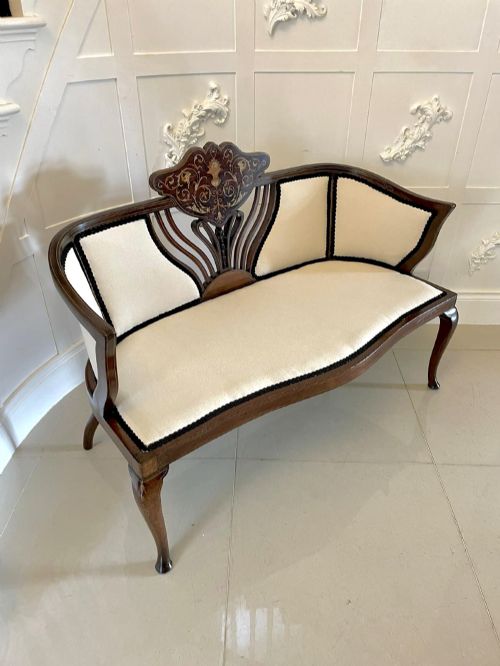
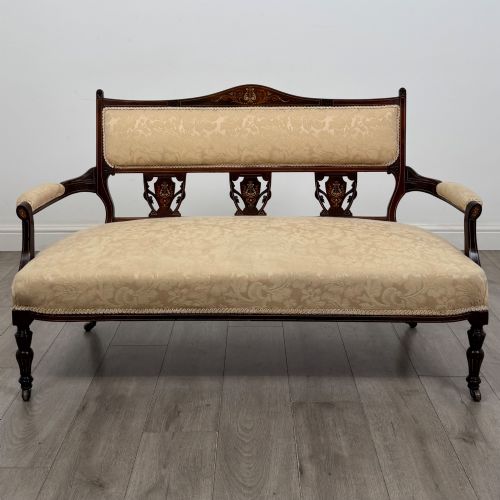
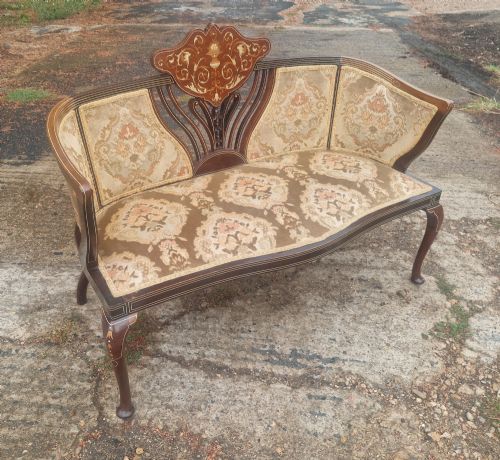


Marquetry Inlay Salon Sofa
A marquetry inlay salon sofa brings decorative refinement to a drawing room, offering structured seating shaped by period craft.
Marquetry Inlay Salon Sofa
A marquetry inlay salon sofa comprises Victorian and Edwardian examples shaped for formal entertaining and parlor settings. These pieces appear across periods spanning the nineteenth century into the early twentieth century, including Sheraton Revival, French Empire, Egyptian Revival, and Moorish Revival styles.
Buyers encounter settees, two-seat sofas, and larger salon suites paired with matching armchairs. Many examples function as parlour seating or bedroom end-of-bed furniture.
Origins stretch from late Victorian workshops to Edwardian production, incorporating rosewood, mahogany, and satinwood foundations.
Materials and technique
Construction relies upon dense hardwoods such as mahogany and rosewood, providing a stable frame for decorative surfaces. Cabinetmakers applied contrasting timbers like satinwood and boxwood inlay to create geometric and floral patterns.
Detailed embellishment often includes bone accents set within the timber veneer. Upholstery materials range from damask and velvet to plain fabric requiring re-upholstery.
Listings feature mahogany, rosewood, and satinwood frames, incorporating boxwood inlay and bone details across Victorian and Edwardian periods.
Quality differences
The standard of timber selection and inlay precision dictates the distinction between standard production and superior craftsmanship. Crisp execution of boxwood and satinwood details against mahogany or rosewood demonstrates greater cabinetmaking skill.
Frame rigidity and the integrity of the underlying woodwork separate well-preserved seating from pieces needing extensive structural intervention. The complexity of the chosen revival style, from simple Edwardian lines to French Empire or Egyptian Revival forms, also influences the character of the piece.
James Shoolbred
The Marquetry Inlay Salon Sofa Glossary
- Marquetry
- Decorative woodwork where pieces of veneer are fitted into a ground to form ornamental designs. This technique defines the surface patterns on the frame.
- Satinwood
- A durable, yellowish timber prized for its lustrous sheen and used extensively for contrasting inlay work. It appears frequently in Edwardian pieces.
- Settee
- A long upholstered seat with a back and arms, designed for multiple occupants. These form the primary seating category in parlor suites.
- Damask
- A reversible figured fabric traditionally woven from silk, wool, or linen, utilised for period upholstery. It provides a textured finish to the seating area.
Marquetry Inlay Salon Sofa: Frequently Asked Questions
What is a marquetry inlay salon sofa?
A marquetry inlay salon sofa is a formal upholstered seat decorated with fitted wood veneers, originating primarily from the Victorian and Edwardian eras. These pieces were designed for display and seating in reception rooms and parlours.
They combine hardwood frames in mahogany or rosewood with contrasting details like satinwood, boxwood, and bone. Many survive as individual settees or as part of larger matching parlour suites.
How do I date an inlaid salon sofa?
Dating relies on examining the timber, the revival style, and the structural characteristics of the frame. Victorian examples often feature heavier rosewood or mahogany builds with elaborate carving.
Edwardian pieces generally present lighter satinwood and mahogany proportions, reflecting changing interior tastes around the turn of the twentieth century. Stylistic cues like French Empire or Egyptian Revival elements also point to specific design movements.
Can I use these sofas daily?
These sofas suit everyday use provided the internal frame and upholstery remain sound. Many historical frames require professional restoration or re-upholstery to support regular sitting.
Placing the furniture away from direct sunlight and excessive heat protects the delicate marquetry veneers and inlaid boxwood or bone details from drying out.
What is the difference between a settee and a salon sofa?
The terms are often used interchangeably to describe upholstered seating built for multiple people during the nineteenth and twentieth centuries. A settee traditionally implies a lighter wooden framework with an upholstered back and seat.
Salon sofas often formed part of larger matched suites intended for formal entertaining rooms. Both categories feature decorative inlay and show stylistic influences ranging from Sheraton Revival to Moorish Revival.