




Marquetry Inlaid Server
A marquetry inlaid server brings deliberate surface pattern and timber warmth to a dining space, uniting utility with decorative refinement.
Marquetry Inlaid Server
A marquetry inlaid server functions primarily as a serving or storage surface within dining rooms and reception spaces, drawing on a long tradition of British cabinet making. When you search for a marquetry inlaid server, you encounter forms that span several centuries, with particular concentration in eighteenth, nineteenth, and early twentieth century expressions.
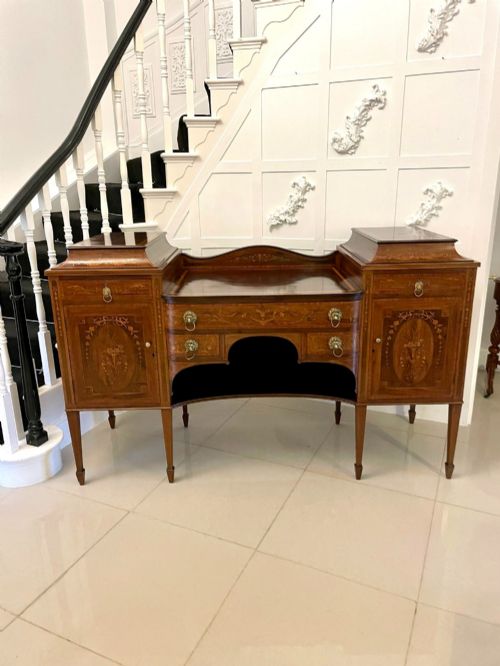
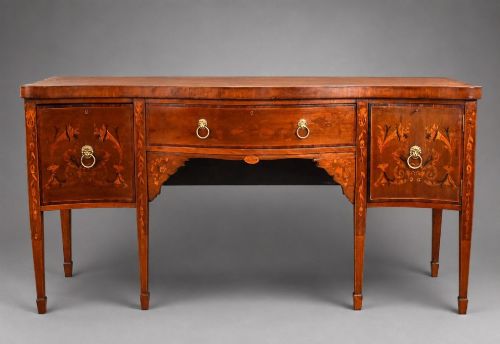
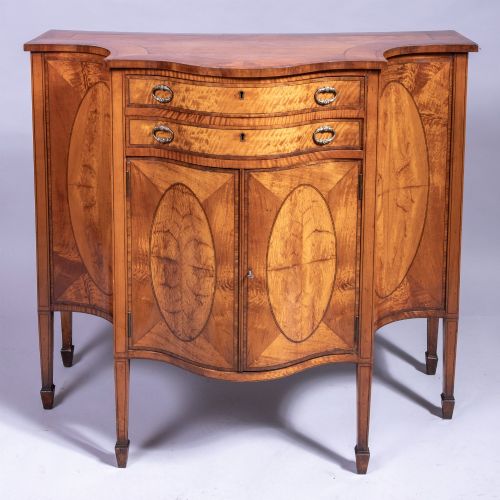
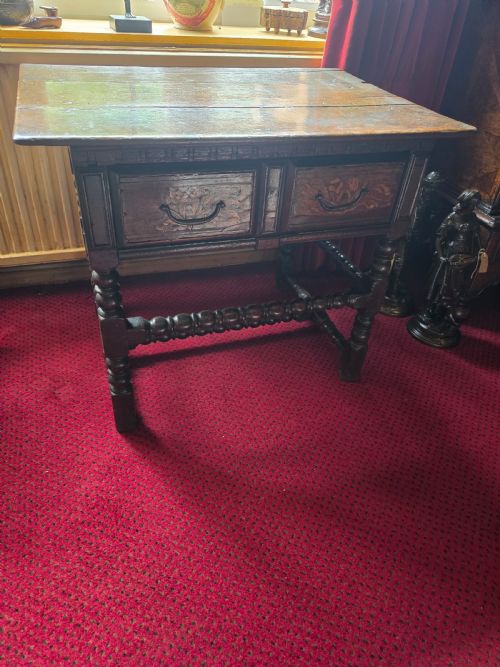
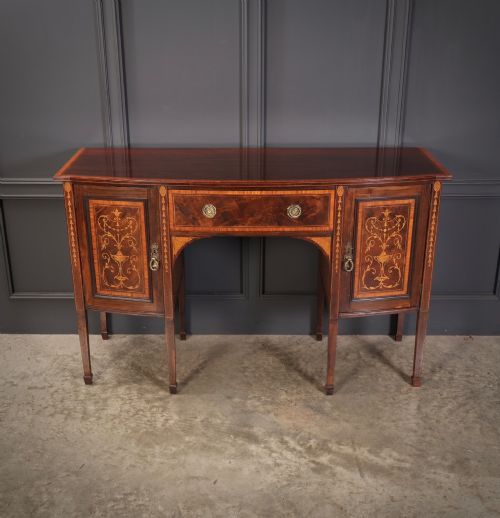
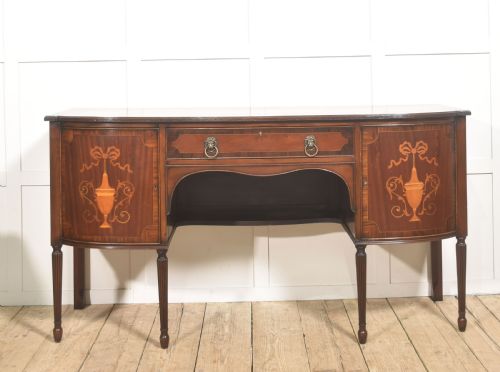
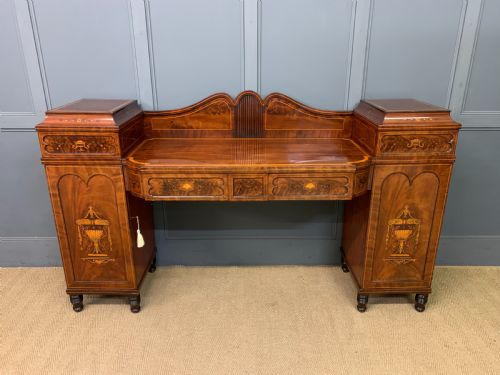
The pieces appearing on this page present as sideboards, side cabinets, and dresser bases, executed in forms ranging from serpentine fronts to breakfronts. Most examples rely on the vocabulary of the Georgian and Sheraton Revival periods, while others incorporate Edwardian lightness or Arts and Crafts robustness.
Makers utilised various secondary formats such as lowboys and side tables alongside standard sideboards, providing distinct scales for different room dimensions. These pieces share a reliance on figured timbers ornamented with contrasting botanical or geometric patterns set directly into the primary face.
Materials and construction methods
Cabinet makers built these pieces using solid and veneered timbers, predominantly mahogany, oak, walnut, and satinwood. These woods provided stable ground for complex decorative surfaces.
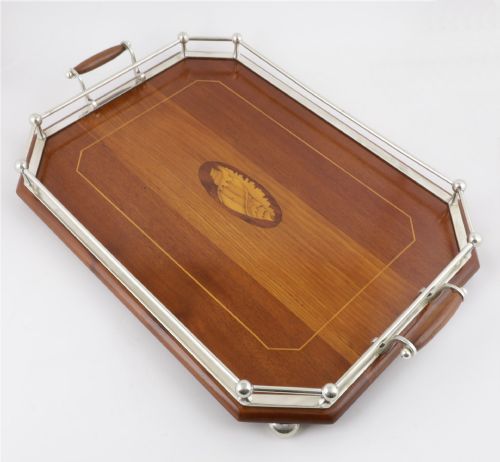
Surface ornamentation relied on marquetry and wood inlay, combining boxwood and various exotic veneers to create pictorial or symmetrical motifs. Craftsmen cut individual pieces of veneer and fitted them meticulously into prepared recesses within the carcase.
Secondary elements such as brass handles, glass panels, and occasional silver plate mounts complemented the primary woodwork. Structural framing remained traditional, utilising dovetailed drawer construction and tenoned joints to ensure longevity.
Several pieces include hidden drawers and secret compartments originally designed for silverware and family ledgers.
Distinctions in craftsmanship
Quality reveals itself in the precision of the veneer cutting and the tightness of the joinery where individual timber elements meet. Superior execution shows seamless integration between the marquetry panels and the surrounding carcase timber.
The choice of primary wood grain and the complexity of the inlay design separate standard production from exceptional studio output. Workshops known for high standards maintained consistent timber selection across both visible fronts and internal linings.
Hewetsons London·Shapland and Petter·Howard And Sons
The Marquetry Inlaid Server Glossary
- Marquetry
- Decorative veneer work assembled in intricate patterns or pictures on a timber ground. This technique uses contrasting woods to achieve pictorial depth.
- Serpentine
- A curved line that bows outward in the centre and curves inward toward the ends. This contour appears frequently on superior eighteenth and nineteenth century case furniture.
- Breakfront
- A cabinet front where the central section projects forward from the flanking wings. This architectural arrangement creates shadow and visual emphasis.
- Lowboy
- A small low table with drawers, commonly produced in walnut or oak during the eighteenth century. It served various domestic functions before evolving into larger sideboard forms.
- Satinwood
- A pale, lustrous timber utilised extensively during the Georgian and Sheraton Revival periods. Its fine grain takes polish exceptionally well.
Marquetry Inlaid Server: Frequently Asked Questions
What distinguishes a server from a sideboard?
Servers generally present a lighter, more compact scale intended specifically for presenting food or drinks during dining. Sideboards frequently incorporate larger storage capacity, including multiple drawers, cupboards, and occasionally mirror backs.
Historical usage placed servers close to dining tables for immediate service, whereas sideboards functioned as permanent architectural fixtures against dining room walls.
Where should I place a side cabinet?
Side cabinets suit dining rooms, hallways, and living spaces where surface display and concealed storage are required. Their shallow depth allows placement in narrow circulation areas without obstructing movement.
Pairing the timber tone with existing room furniture ensures visual cohesion while letting the marquetry surface remain a distinct focal point.
How do I care for marquetry surfaces?
Marquetry surfaces require stable environmental conditions away from direct heat sources and strong sunlight to prevent veneer lifting and timber drying. Regular dusting with a soft, dry cloth preserves the polished finish.
Occasional application of appropriate wax feed maintains the moisture content of both the primary wood and the intricate inlay details without building up heavy residues.