




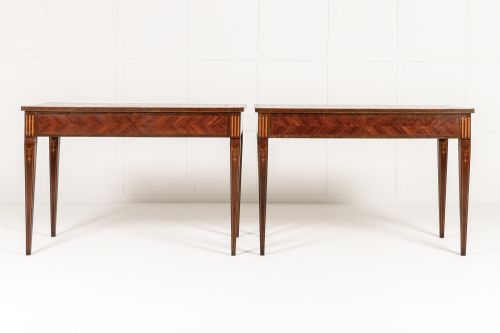


Marquetry Entry Table
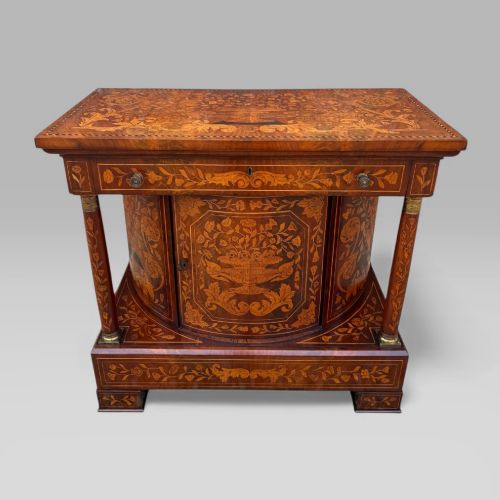
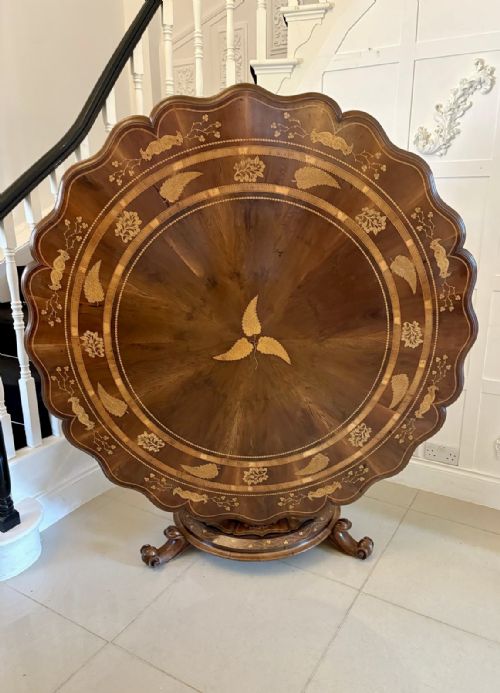
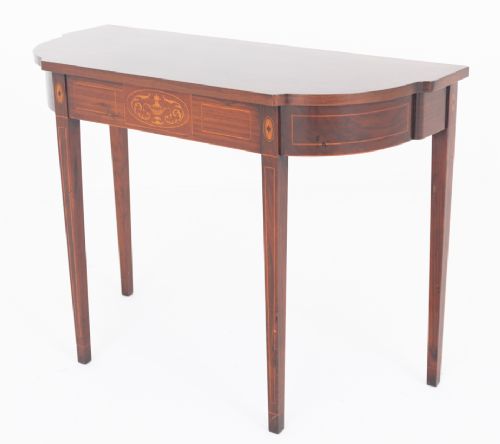
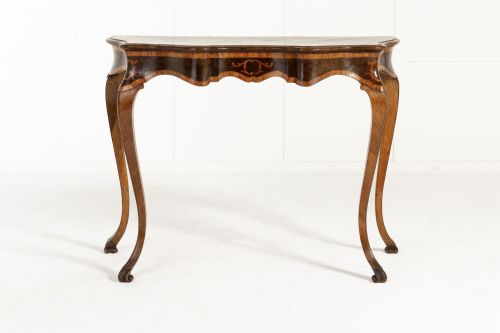
These marquetry entry table pieces bring floral wood-inlay and classical form straight to the hallway, offering a striking surface for any grand entrance.
Marquetry Entry Table
A marquetry entry table provides a functional and decorative surface in a hallway, drawing the eye with patterned wood veneers. You are most likely to meet 19th Century console tables and centre tables on this page, alongside earlier 18th Century Dutch and Italian examples.
How they were made
Cabinetmakers built these tables using sturdy timbers such as mahogany, walnut, and pollard oak for the primary structure. They applied delicate veneers of satinwood, kingwood, boxwood, and yew wood to create intricate marquetry inlay patterns across the tops and aprons.
Many of the grander examples feature inset marble tops in white or purple shades, resting securely within shaped wooden frames. Brass mounts and fine stringing lines frequently accent the edges and legs to complete the construction.
Pieces span from the 18th Century through the Georgian, Regency, and Victorian periods up to 1920.
What varies in quality
The standard of a marquetry entry table rests upon the precision of the wood-inlay and the choice of contrasting timbers. Pieces with rich botanical marquetry executed in diverse exotic woods display a higher level of workshop skill than simpler geometric veneers.
The inclusion of heavy inset marble tops and secondary woods like padouk or satinwood elevates the status of the piece. Attribution to known makers and workshops further separates standard utility furniture from exhibition quality items.
Egan Workshop·Edward and Roberts
The Marquetry Entry Table Glossary
- Marquetry inlay
- Decorative wood-inlay technique where thin slices of various coloured timbers are fitted together to form pictorial or floral designs on a surface.
- Console table
- A table designed to stand against a wall, historically supported by brackets or console legs rather than four independent vertical posts.
- Demilune
- A half-moon shape used for furniture designed to sit flush against a hallway wall, saving floor space while offering a display surface.
- Centre table
- A freestanding table intended to be viewed from all sides, often placed in the middle of a large entrance hall or saloon.
- Kingwood
- A dense, richly figured tropical timber prized by cabinetmakers for fine decorative veneers during the eighteenth and nineteenth centuries.
Marquetry Entry Table: Frequently Asked Questions
What is a marquetry entry table?
A marquetry entry table is a decorative surface placed in a hallway or foyer, featuring detailed wood-inlay patterns across the top and frame.
These tables serve both a practical purpose for holding keys or post and a visual role in welcoming visitors to a home.
Where should I place a console table?
Console tables are specifically designed to stand flat against an entrance wall, often positioned beneath a mirror or painting.
Because their backs are typically plain, they fit neatly into hallways without obstructing the main flow of traffic.
How do I care for antique wood veneer?
Antique wood veneer requires protection from direct sunlight and sudden changes in room temperature to prevent the delicate timbers from drying out.
Dust the surface gently with a dry cloth and apply a quality natural wax sparingly to maintain the polish.
What is the difference between a console and a centre table?
A console table sits flat against a wall and often relies on wall brackets or front legs for support. A centre table stands freely on its own four legs in the middle of a room.
Centre tables are finished on all sides so they can be admired from any angle.