




Marquetry Crossbanded Table
These marquetry crossbanded table pieces offer refined surfaces and classic timber work that anchor a traditional interior.

Marquetry Crossbanded Table
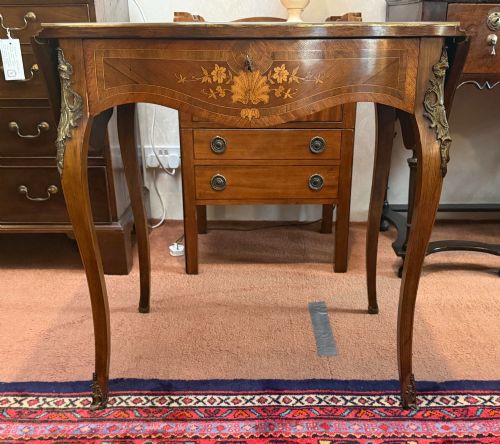
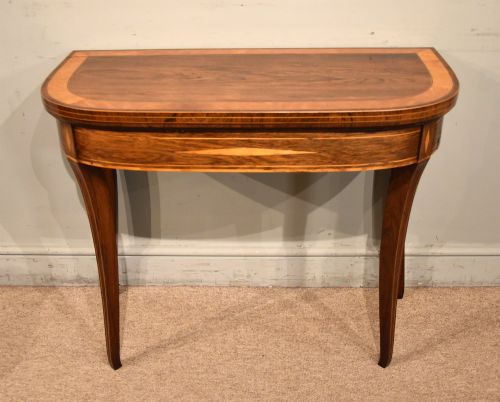
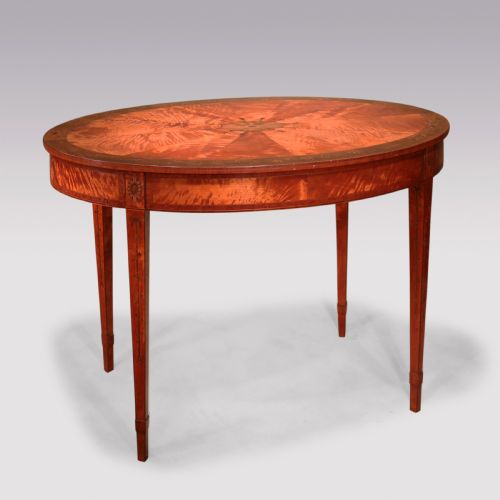
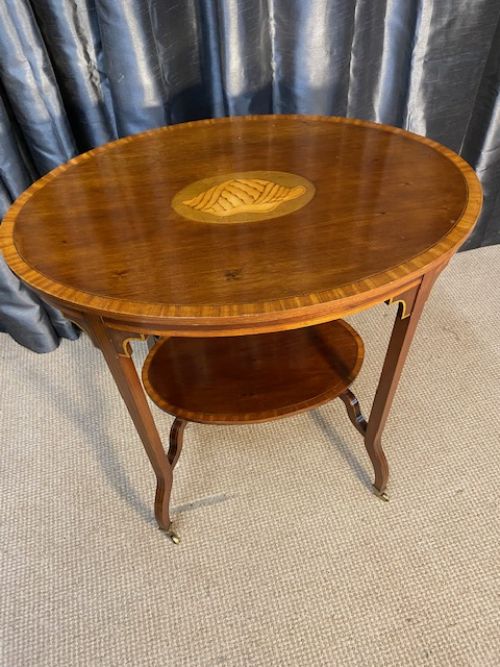
A marquetry crossbanded table brings together decorative veneer work and structural timber, taking forms such as card tables, occasional tables, and Pembroke tables. These surfaces combine contrasting woods like satinwood, mahogany, and rosewood arranged in geometric patterns.
The selection ranges from Georgian and Regency eras through to Victorian and Edwardian interpretations, including Sheraton Revival and Louis XV styles. Card tables, centre tables, and side tables dominate the offerings.
Buyers encounter variations spanning 18th century examples up to early 20th century pieces. The fundamental appeal lies in the integration of banded borders and pictorial or floral veneer details.
Materials and construction
Cabinet makers utilised foundational timbers such as mahogany and walnut, applying decorative veneers of satinwood, rosewood, and kingswood across the tops and borders. Boxwood and brass often supplied fine stringing or edge highlights.
Marquetry panels required precise hand-cutting of different wood species to create interlocking pictorial or geometric motifs. Crossbanding involved laying veneer strips with the grain running perpendicular to the main surface, framing the central design.
Some card tables hide secret spaces beneath their folding tops, ready for forgotten counters from a Georgian game.
Distinctions in quality
The sophistication of the veneer work dictates the tier of the piece, where intricate multi-wood marquetry and well-matched crossbanding distinguish finer examples from simpler bordered tops. The choice of timbers, such as figured satinwood or rich kingswood, elevates the visual depth.
Proportion and the handling of period styles, from George III through to Sheraton Revival, reflect the skill of the original workshop. Clean lines in structural forms like Pembroke and card tables complement the complexity of the surface decoration.
The Marquetry Crossbanded Table Glossary
- Crossbanding
- A border of veneer laid around the edge of a table top with the grain running perpendicular to the central panel. This technique frames the primary timber and protects vulnerable edges.
- Marquetry
- The art of creating decorative patterns and pictures by fitting together small pieces of coloured veneer. Craftsmen use varied woods to achieve pictorial depth without relying on paint.
- Satinwood
- A durable tropical timber with a lustrous, golden-yellow sheen prized in fine cabinet making. It serves as a bright background for darker inlay details.
Marquetry Crossbanded Table: Frequently Asked Questions
What periods do these tables cover?
The selection spans from the 18th century and Georgian periods through to Victorian, Edwardian, and early 20th century revivals.
Craftsmen across these eras adapted earlier Sheraton, Regency, and Louis XV designs using contemporary timber choices.
How were card tables used originally?
Card tables served polite society in the evening for gaming and social card play. Their folding tops allowed them to sit compactly against a wall when not in use.
Many incorporate hidden compartments or baize-lined playing surfaces designed specifically for this purpose.
How do I identify a Pembroke table?
A Pembroke table is defined by its drop leaves on two opposing sides, making it versatile for smaller spaces. They frequently include a drawer and tapered or turned legs.
Their marquetry tops often display distinct crossbanding around the main panel and leaves.
What distinguishes satinwood from mahogany?
Satinwood provides a pale, golden yellow surface with a natural shimmer that catches the light. Mahogany offers a deeper reddish-brown tone with prominent grain patterns.
Cabinet makers often combined both timbers to create high-contrast geometric borders and marquetry designs.