

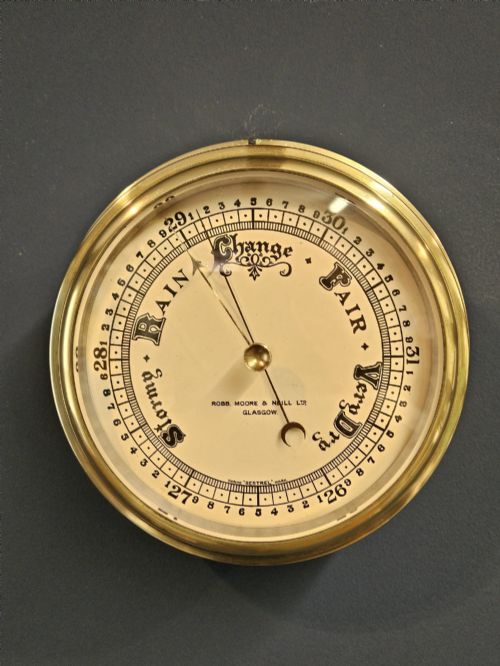


Marine Weather Instrument
These marine weather instrument selections offer the brass and mahogany precision required at sea, bringing functional maritime history into the home.
Marine Weather Instrument
A marine weather instrument is a specialised navigational device designed to monitor atmospheric pressure and conditions aboard a ship, encompassing stick barometers, aneroid barometers, sympiesometers, and bulkheads clocks. When searching for a marine weather instrument, collectors typically encounter Victorian stick barometers housed in sturdy woods alongside later bulkhead instruments from the early twentieth century. These objects served an essential nautical purpose, helping mariners anticipate changing weather at sea before finding a secondary life in domestic interiors.
The specimens recorded here span from the Georgian period through the Victorian era up to nineteen-thirty, representing the golden age of maritime instrumentation. Stick barometers and sympiesometers dominate the forms, frequently mounted on rosewood or mahogany backboards with exposed glass tubes and engraved ivory or bone verniers. Buyers will also encounter specialised devices such as the barocyclonometer, showing the technical evolution of meteorological tracking for sea voyages.
How they were made
Makers constructed these instruments using dense hardwoods like mahogany, oak, and rosewood to withstand the rigours of shipboard movement, paired with heavy brass fittings for gimbals andbezels. The cases often feature protective glass fronts enclosing enameled or silvered brass dials with fine calibrations, while delicate mercury tubes require meticulous glassblowing and sealing techniques.
Metal components such as chrome and brass were turned and polished to resist corrosive salt air, while recording surfaces utilised sharp enamel lettering or engraved bone scales. Master craftsmen built these devices to endure constant vibration and humidity at sea, ensuring structural integrity alongside extreme mechanical precision.
Marine Weather Instrument Retail Price Guide 2026
Typical asking prices for marine weather instrument among the pieces listed under this phrase on Sellingantiques today, from the lower quarter to the upper quarter. They describe what is for sale here now, not the wider market.
Some maritime barometers were built with such sturdy brass cases that they doubled as heavy cabin doorstops when the weather finally cleared.
What varies in quality
Quality in a marine weather instrument rests upon the reputation of the maker inscribed on the dial and the crispness of the engraved scales, where signed London names command greater attention. The choice of timber also dictates grade, with finely figured rosewood or flame mahogany marking out superior domestic variants compared to standard utilitarian oak.
The survival of original mercury tubes, gimbal mountings, and unbroken enamel dials separates an exceptional museum-grade survival from a heavily altered example. Superior instruments retain their complete mechanical assemblies and original mounting fixtures, reflecting the uncompromising standards demanded by nineteenth-century navigators.
Elliott Brothers·Bate of London·Charles Baker·Gowland London
The Marine Weather Instrument Glossary
- Sympiesometer
- A type of compact barometer that uses oil and gas rather than mercury to measure atmospheric pressure. Charles Baker of London produced notable examples of these sensitive devices during the early Victorian period.
- Stick barometer
- A vertical wall-mounted instrument featuring an exposed glass tube filled with mercury alongside a vernier scale. These long wooden instruments form the backbone of maritime weather recording.
- Aneroid barometer
- A barometer that measures pressure without liquid, using a flexible metal box that expands or contracts. Elliott Brothers produced notable aneroid instruments during the eighteen-seventies.
- Barocyclonometer
- A specialised meteorological instrument designed to detect approaching typhoons and tropical revolving storms. These complex devices incorporate calculating scales alongside standard barometric readings.
- Gimbal
- A pivoted support ring that allows a shipboard instrument to remain level regardless of the vessel's roll and pitch. This mechanical linkage is essential for accurate readings on rough seas.
Marine Weather Instrument: Frequently Asked Questions
What is a marine weather instrument?
A marine weather instrument is a mechanical device used aboard ships to measure atmospheric pressure, time, or humidity to predict meteorological changes at sea.
These pieces typically include stick barometers, aneroid dials, and sympiesometers housed in brass and hardwood cases designed for maritime conditions.
How were they used at sea?
Navigators read the barometric pressure daily to anticipate storms and gales before they struck the vessel, adjusting their course or reefing sails accordingly.
Instruments were often mounted on gimbals inside the captain's cabin to keep them level while the ship pitched and rolled on ocean swells.
How do I date a marine barometer?
Dating relies on the style of the wooden case, the typography of the maker's signature on the dial, and the materials used for the scale plates.
Victorian instruments often feature rosewood or mahogany backboards with bone verniers, while twentieth-century examples incorporate chrome and specialised storm-tracking dials.
Can these instruments still function?
Many aneroid and clock combinations remain operational once properly mounted, though mercury stick barometers require careful handling and re-calibration by specialists.
Living with these pieces involves appreciating their mechanical heritage and decorative presence rather than relying on them for daily weather forecasts.