

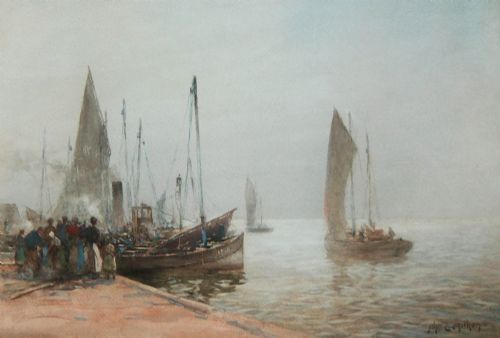



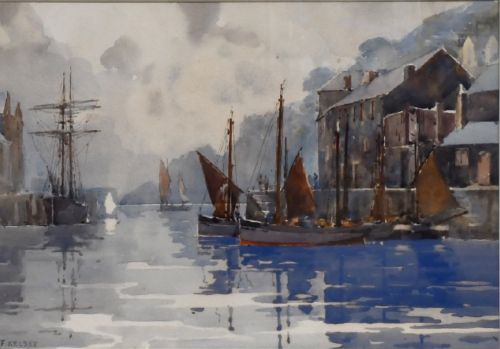


Marine Watercolour Scene
A marine watercolour scene captures coastal harbours, fishing fleets, and tidal rivers across Britain and beyond, offering a direct view into maritime history.
Marine Watercolour Scene
A marine watercolour scene depicts coastal harbours, fishing boats, and shipping activity, capturing the maritime atmosphere of the British coastline and European waters. These works typically take the form of framed paintings on paper, executed in watercolour pigment.
The selections available range from late Victorian dockyard views to Edwardian coastal studies and early twentieth-century harbour scenes. Many examples record specific locations such as Whitby, St Ives, and the River Thames.
Collectors encounter works attributed to known artists alongside initialed or unsigned paintings of the nineteenth and early twentieth centuries. The subject matter centres closely on working vessels, lighthouses, and tidal estuaries.
How They Were Made
Artists painted these works using watercolour pigment applied to paper, often combining washes with fine line work to delineate rigging, architecture, and water reflections. The medium demanded precision, as adjustments to dried pigment remained difficult.
Finished watercolours were housed behind glass within wooden frames, sometimes accented with gilt or hand-enamelled polychrome decoration to complement the palette of the painting.
Listings feature paper, watercolour pigment, glass, and gilt wood across Victorian and Edwardian periods.
What Varies in Quality
Quality in a marine watercolour scene rests upon the surety of the draughtsmanship and the artist's ability to render light, movement, and atmospheric conditions on paper. Stronger works convey the dynamic motion of tides and shipping with economy and confidence.
The preservation of the paper and the vibrancy of the pigments also distinguish individual pieces, alongside the originality of the contemporary framing.
James Orrock·James E Aitken·John E Aitken·William Banks Fortescue·Hector Caffieri·Frank Kelsey·Alfred George Morgan·Richard Harry Carter·William Lee Hankey·Fred Lawson·Thomas Bush Hardy·William Tuck·George Hamilton Constantine·Frederick William Hattersley·James Thomas Watts·Samuel Owen·Charles Harmony Harrison·Kate E Booth·Ernest F Hill·Frederick Stuart Richardson·Percy Brooke·Walter Duncan·William Tatton Winter·Rowland Henry Hill·Frank Wasley
The Marine Watercolour Scene Glossary
- Watercolour pigment
- The finely ground colour suspended in a water-soluble binder used by artists on paper.
- Lugger
- A traditional two-masted fishing vessel frequently depicted in coastal and harbour scenes.
- Gilt wood
- Wood coated with a thin layer of gold leaf or metallic paint, commonly utilised for period frames.
- Seascape
- A work of art depicting the sea, coastal views, ships, or maritime architecture.
Marine Watercolour Scene: Frequently Asked Questions
What periods do these watercolours date from?
The works span the nineteenth and early twentieth centuries, encompassing Victorian, Edwardian, and later periods up to the 1930s and 1940s.
Many pieces carry specific dates or reflect the distinct stylistic approaches of British Impressionism and traditional maritime recording.
Where are the depicted locations?
The scenes primarily focus on British coastal towns, fishing ports, and riverways, including Yorkshire harbours, Cornish docks, and the River Thames in London.
Selected works also record continental European locations such as Boulogne, Honfleur, and Venice.
How should I frame and display them?
These watercolours require protection behind glass to prevent atmospheric damage to the paper and pigments. Displaying them away from direct sunlight preserves the original tones of the painting.
Many retain their period wooden or gilt frames, which complement the age and character of the artwork.
How are different artists identified?
Identification relies on signatures, monograms, inscriptions on the front or reverse, and documented exhibition records. Some pieces remain attributed through stylistic comparison or archival research.
Works by prominent figures often feature clear signatures alongside titled locations within the composition or margin.