

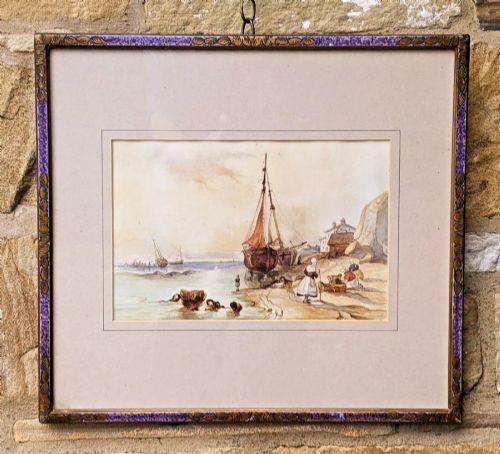
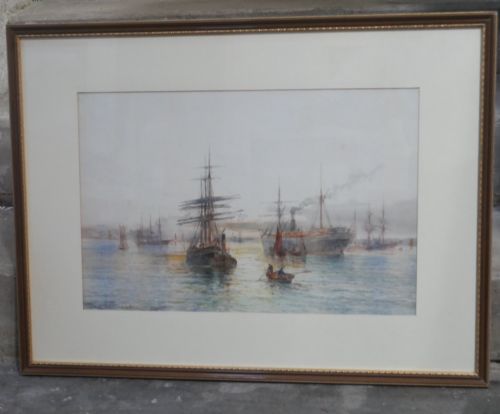
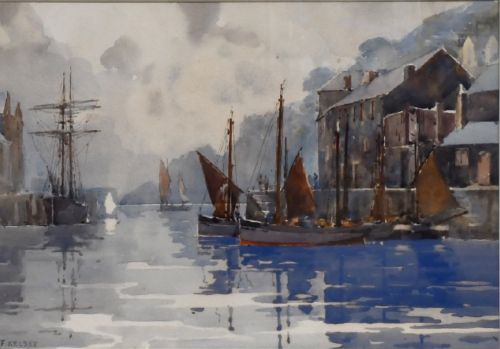
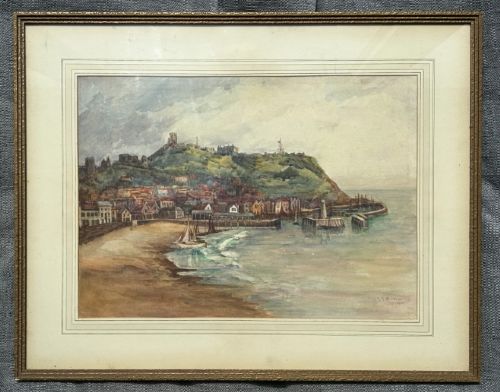


Marine Harbour Watercolour
A marine harbour watercolour captures the salt, stone, and bustle of historic coastal ports in pigment on paper.
Marine Harbour Watercolour
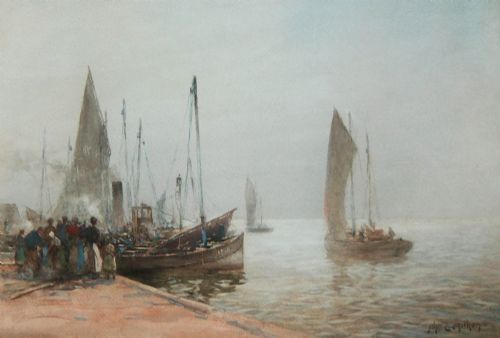
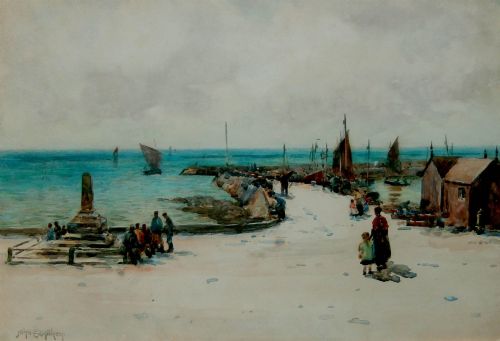
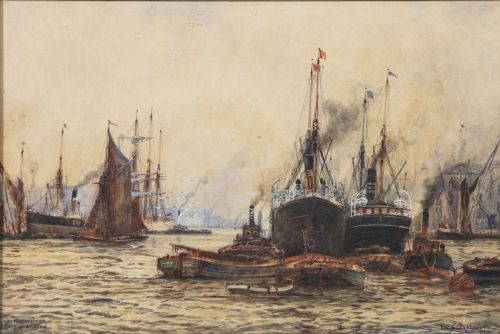
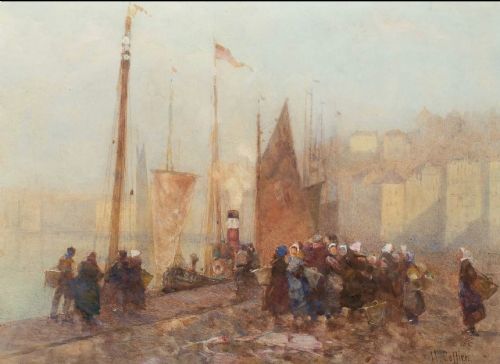
A marine harbour watercolour depicts coastal inlets, fishing docks, and tidal basins recorded from the nineteenth century through the mid-twentieth century. These works document specific locations such as Whitby, St Ives, Scarborough, and the Pool of London.
The most common examples on this page date from the Edwardian era and the early decades of the twentieth century. Painters of this period favoured detailed topographical views of working ports alongside atmospheric impressions of shipping.
The subjects range from tranquil river moorings and local fishing luggers to dramatic scenes of vessels entering harbour and crews landing their catch. Such paintings reflect a maritime heritage deeply tied to British coastal communities.
How they were made
These works rely on watercolour pigment applied to paper, sometimes supported by wood or framed behind glass within wood and gilt wood surrounds. Artists used transparent washes to capture changing coastal light and opaque touches to pick out rigging and foam.
The technique requires precise control, as the white of the paper often serves as the highlights for breaking waves and whitewashed cottages. Hand-enamelled polychrome frames occasionally complement the painted surface.
A French warship towed by a steam tug proves that even enemy vessels needed a helping hand into port.
What varies in quality
Quality rests on the artist's command of maritime atmosphere and architectural accuracy within the harbour setting. Stronger works balance the meticulous rendering of rigging and stonework with loose, expressive washes for water and sky.
Provenance and legibility of signature also distinguish the range, alongside the condition of the paper free from severe foxing or fading. Original framing choices, such as period gilt wood, further set apart the more accomplished examples.
James E. Aitken·John E. Aitken·William Banks Fortescue·Frank William Scarbrough·Hector Caffieri·Frank Kelsey·F A Roylance·Alfred George Morgan·Commander Eric Tufnell·Richard Harry Carter·William Lee Hankey·Fred Lawson·Thomas Bush Hardy·Ernest Dade·Tom Clough·William Tuck·Fred Waugh·James Thomas Watts·Samuel Owen·Kate E Booth·Ernest F. Hill·William Wyld·Frederick Stuart Richardson·Alfred Robert Quinton·Percy Brooke
The Marine Harbour Watercolour Glossary
- Watercolour
- A paint consisting of pigment suspended in a water-based solution, applied to paper to create transparent or opaque passages.
- Lugger
- A traditional two-masted fishing vessel carrying lug sails, frequently seen depicted in nineteenth and early twentieth-century coastal scenes.
- Gilt wood
- Wood that has been coated with a thin layer of gold leaf or gilt paint, commonly used for period picture frames.
- Newlyn School
- An art colony based in Cornwall that produced plein-air paintings of local fisherfolk and coastal life from the late nineteenth century onwards.
- Provenance
- The documented history of ownership and origin for a work of art, establishing its authenticity and past exhibition.
Marine Harbour Watercolour: Frequently Asked Questions
What periods do these watercolours cover?
The works span from the nineteenth century through the Edwardian period and into the mid-twentieth century. Most examples cluster around 1900 to 1930.
This era encompasses traditional Victorian maritime painting as well as British Impressionism and the Newlyn School.
Which harbours are most commonly depicted?
Yorkshire and Cornish ports appear frequently, including Whitby, Scarborough, St Ives, Polperro, and Mousehole. London river scenes also feature prominently.
Artists frequently recorded working ports, fish docks, and tidal inlets across the British coastline.
How should I frame and hang these watercolours?
These works require framing behind glass with acid-free mounts to protect the delicate pigment on paper from moisture and light damage. Original gilt wood frames often accompany the pieces.
Display them away from direct sunlight to prevent the watercolour pigments and paper from fading over time.
How do I identify different maritime painting styles?
Victorian works generally lean towards precise topographical detail and narrative clarity in depicting shipping. Later twentieth-century pieces adopt looser brushwork associated with Impressionism.
Examining the handling of water, sky, and vessel rigging reveals the stylistic shift across periods.