



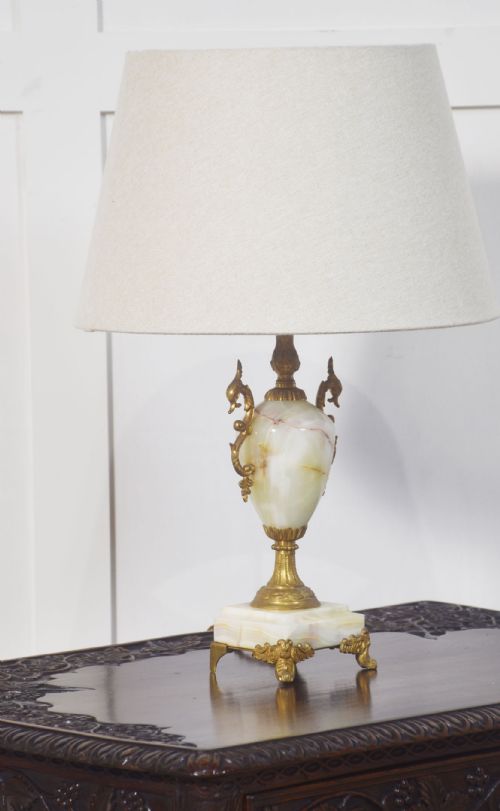


Marble Urn Bedside Lamps
Marble urn bedside lamps bring classical proportion and rich mineral warmth to a room, functioning as sculptural bedside lighting.
Marble Urn Bedside Lamps
Marble urn bedside lamps take the classical form of the ancient burial vessel and adapt it for domestic illumination. These pieces bridge the gap between antiquity and daily utility, serving as both functional light sources and sculptural objects. The designs frequently draw upon Neoclassical and Louis XVI traditions, translating architectural motifs into smaller scale furnishings suitable for a bedroom.
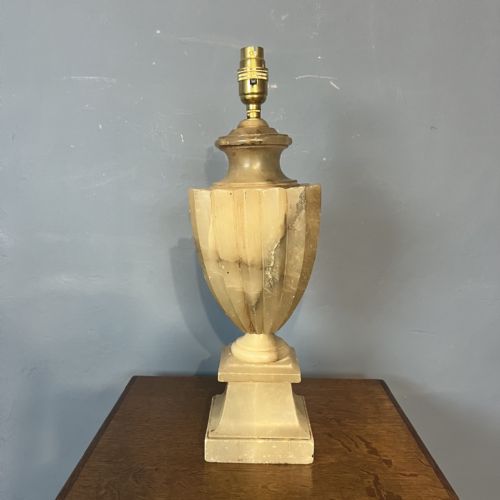
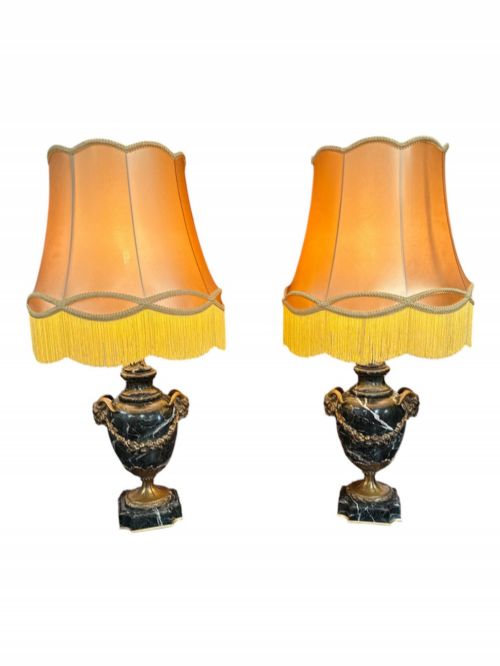
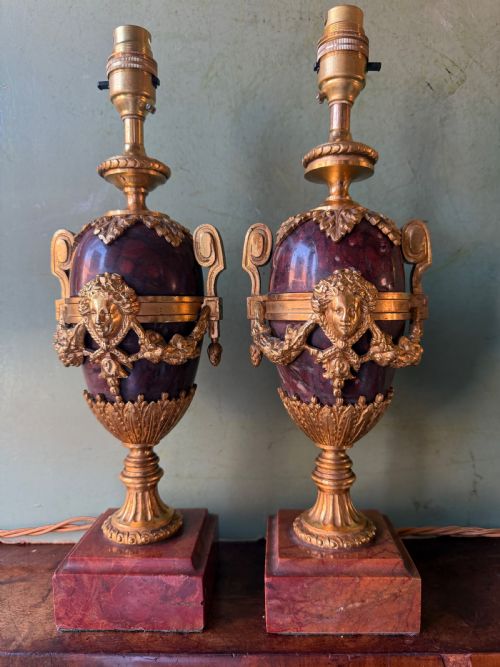
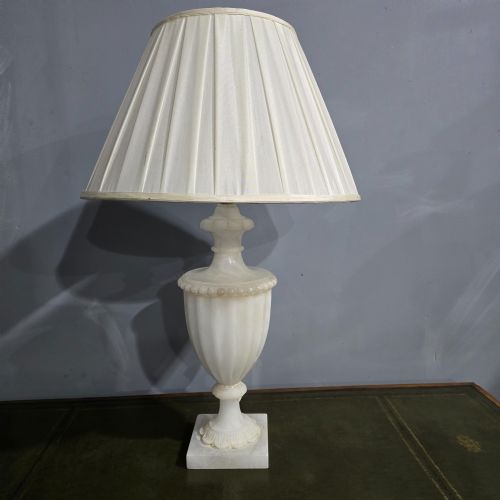
The selections available here lean heavily towards French and Italian manufacture, spanning the Victorian era through the early twentieth century. Buyers encounter single items as well as balanced pairs, often incorporating metal mounts, gilt bronze, or ormolu. The primary bodies utilise various stones, including rouge marble, green marble, onyx, and white alabaster.
Alongside standard table lamps, the inventory incorporates related forms such as cassolettes and small stands that share the same material vocabulary. These objects reflect successive revivals of classical taste across the nineteenth and early twentieth centuries. Each piece demonstrates how makers repurposed traditional urn silhouettes to suit the domestic lighting requirements of later periods.
Materials and technique
The construction of these lamps relies on the turning and carving of dense stone, principally marble, alabaster, and onyx. Artisans shaped these mineral blocks on lathes or worked them by hand to achieve the slender neck, full belly, and footed base characteristic of an urn. The resulting stone bodies possess varied natural veining and colouration, making each carved section distinct.
Metal components such as brass, gilt bronze, ormolu, and spelter provide structural mounts, handles, and collars. These metal elements were typically cast, chased, and occasionally gilded to contrast with the polished stone surfaces. Makers assembled the stone and metal sections using internal threaded rods, securing the combined structure beneath a fabric shade.
Materials range from classic white alabaster and rouge marble to cast ormolu, brass, and patinated bronze.
The measure of quality
Quality in these lamps rests primarily on the character of the stone and the crispness of any metal mounts. Finer examples display carefully selected marble with lively, uninterrupted veining and precise, hand-chased ormolu rather than plain cast brass. The weight and stability of the piece also indicate standard, as solid turned stone requires careful engineering to support upper electrical fittings safely.
The relationship between the urn body and its decorative mounts reveals the maker's hand. Superior pieces show seamless integration where metal collars and handles follow the exact contours of the stone without gaps or crude fixings. The depth of patination on the bronze or gilt surfaces and the purity of the alabaster further separate standard production items from more ambitious decorative works.
The Marble Urn Bedside Lamps Glossary
- Ormolu
- Gilded bronze, where a gold-mercury amalgam is applied to a bronze base and heated to leave a thin gold layer. This technique creates a rich, matte finish frequently found on French classical mounts.
- Cassolette
- A decorative vase or urn with a reversible lid that functions either as a closed vessel or as a burner. In lighting adaptations, the form is pierced or fitted to hold electrical components.
- Alabaster
- A fine-grained, translucent stone often resembling white marble but softer and capable of diffusing light. It appears frequently in early twentieth-century lighting for its warm glow.
- Spelter
- A zinc alloy used as a less expensive substitute for bronze in decorative metalwork. It was often painted or bronzed to simulate more costly materials on nineteenth-century pieces.
- Neoclassical
- A style reviving the architectural and decorative forms of ancient Greece and Rome. It dominates the design vocabulary of these urn lamps through symmetrical lines and classical motifs.
Marble Urn Bedside Lamps: Frequently Asked Questions
How do I wire an antique lamp safely?
Rewiring involves replacing old perished flex and lamp holders with modern British standard components while retaining the original body intact. A qualified electrician can thread modern wire through the central channel of the stone without altering the antique structure.
Buyers should ensure the internal threaded rod and base remain stable to support the weight of contemporary shades. Modern inline switches and LED compatibility allow these historic objects to function safely beside a bed.
How do I clean marble and alabaster?
Dusting with a dry, soft microfibre cloth prevents the accumulation of grime within the natural pores of the stone. Moisture should be kept to a minimum, particularly with alabaster, which is softer and more porous than marble.
Harsh chemical cleaners or abrasive pads will strip the polished surface and ruin the patina. If stubborn marks occur, a lightly dampened cloth with mild soap, followed immediately by drying, is the safest approach.
What is the difference between marble and onyx?
Marble is a metamorphic rock formed from recrystallised carbonate minerals, displaying dense and varied veining patterns. Onyx is a banded variety of microcrystalline quartz that often exhibits a degree of translucency when exposed to light.
In lighting, onyx items tend to transmit light more readily through their translucent layers compared to opaque marble. Both materials offer distinct tactile qualities and visual weights suited to bedside placement.
Are these lamps sold as pairs?
Many listings present matching pairs that were manufactured together to flank a bed, mantelpiece, or sideboard. Symmetrical pairs share identical stone coloration, turning profiles, and metal mount details.
Single lamps also appear for use on smaller bedside tables where a balanced pair would crowd the surface. Checking the dimensions and height ensures proper scale relative to the bedhead and mattress.