




Marble Top Wall Brackets
Marble top wall brackets bring ornate stone surfaces to vertical spaces, offering a striking display ledge for decorative objects.
Marble Top Wall Brackets
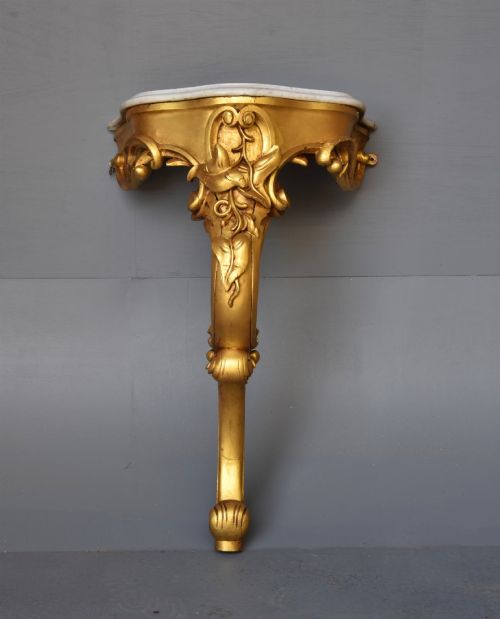
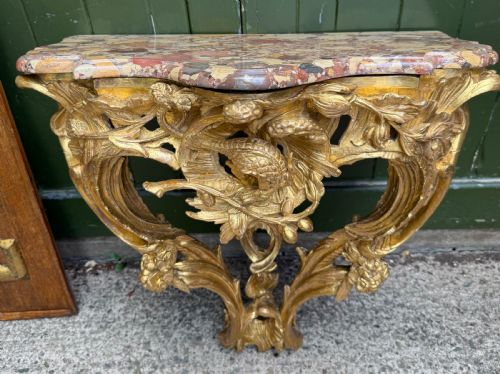
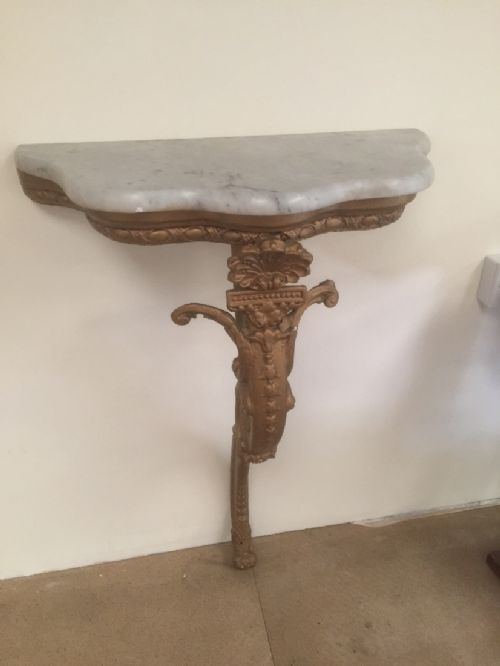
When you search for marble top wall brackets, you are looking at architectural ledges and console tables designed to anchor against a room perimeter. These pieces combine heavy stone surfaces with supporting structures built in wood, gesso, and giltwood.
The selections available here lean heavily into nineteenth-century production alongside eighteenth-century roots. You will frequently encounter wall consoles and console tables reflecting French Rococo Revival, Baroque, and Neoclassical design influences.
Forms range from compact nineteenth-century wall fixtures to larger console tables that mimic fully grounded furniture while maintaining a bracket profile. Walnut and gilded surfaces dominate the physical evidence, establishing a formal aesthetic.
How they were made
Carved wood provides the primary structural framework, utilising walnut, painted timber, and softwood foundations shaped into complex curves and supports. Artisans applied gesso over the wood substrate to build up crisp relief details before applying gold leaf.
The stone elements feature shaped marble tops, including figured varieties such as breche d'alep, cut to follow the serpentine or rectilinear contours of the wooden frame below. Gilding techniques combined gold leaf with burnished and matte finishes to catch interior light.
Marble Top Wall Brackets Retail Price Guide 2026
Typical asking prices for marble top wall brackets among the pieces listed under this phrase on Sellingantiques today, from the lower quarter to the upper quarter. They describe what is for sale here now, not the wider market.
Listings feature periods spanning from the eighteenth century through the nineteen-thirties, with walnut, giltwood, and marble appearing consistently.
What varies in quality
The depth and crispness of the carving separate standard joinery from superior sculptural execution, particularly where figures like eagles or intricate acanthus leaves emerge from the wood. Hand-carved elements display a fluidity and undercut depth that mechanical shaping cannot replicate.
The quality of the marble top and its integration with the supporting apron dictate overall refinement. Thick, richly figured stone fitted precisely to the wooden carcass indicates higher workshop standards.
The Marble Top Wall Brackets Glossary
- Giltwood
- Wood that has been covered with a thin layer of gold leaf. This finish was standard for formal interior furnishings across the eighteenth and nineteenth centuries.
- Gesso
- A plaster-like mixture applied to wood surfaces as a base for gilding and paint. It allows craftsmen to carve sharp, intricate details before applying gold leaf.
- Console table
- A table supported by wall brackets or console legs rather than four independent freestanding posts. These pieces were traditionally designed to sit flush against a wall.
- Serpentine
- A curved line that is convex at the ends and concave in the middle. This undulating shape frequently defines the front edge of eighteenth and nineteenth-century marble tops.
- Breche d'alep
- A specific type of figured marble featuring brecciated patterns of varied tones. It appears on select French tables of the period.
Marble Top Wall Brackets: Frequently Asked Questions
How were marble top wall brackets used?
These pieces functioned primarily as decorative ledges in formal reception rooms and parlours. They held urns, clocks, and porcelain figures without occupying floor space.
Larger console versions stood against walls beneath mirrors, completing a coordinated interior decorative scheme.
How do I secure a heavy wall bracket?
Wall brackets require robust fixing into masonry studs or solid brickwork due to the combined weight of the timber frame and stone top. Professional installation is essential to bear the downward load safely.
Standard picture hooks or light screws will not support the substantial weight of marble and carved wood.
How do I tell Rococo Revival from Baroque pieces?
Rococo Revival pieces feature asymmetric C-scrolls, shell motifs, and lighter, flowing ornamentation. They embrace playful curves derived from mid-eighteenth-century French taste.
Baroque items display heavier symmetrical forms, muscular carving, and dramatic architectural elements such as eagles and bold cornices.
Can these brackets support heavy objects?
While the stone tops are durable, weight capacity depends entirely on the wall fixings and the structural integrity of the wooden backplate. They are designed for standard decorative ornaments rather than heavy statuary.
Care should be taken not to overload the outer edge of the cantilevered projection.