




Marble Pendulum Mantle Clock
These marble pendulum mantle clock pieces bring together heavy stone and precise French or Victorian engineering to anchor a room.
Marble Pendulum Mantle Clock
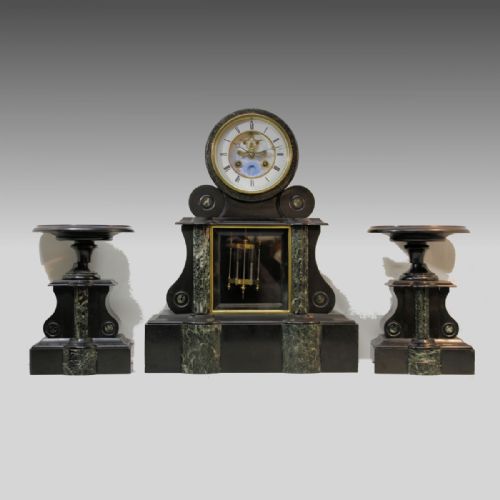
When searching for a marble pendulum mantle clock, collectors encounter heavy stone timepiece forms spanning the Victorian era and the eighteenth century. These pieces range from simple architectural blocks to elaborate garniture sets accompanied by side ornaments.
Most examples found here originate from French workshops or British Victorian importers, utilising dense black marble, variegated stone, and slate. Forms include portico clocks, lyre mystery clocks, and monumental architectural garnitures designed for prominent display on a mantelpiece.
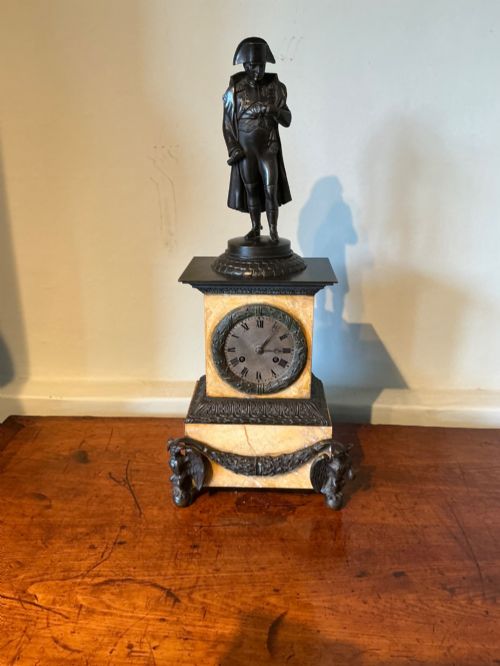
The selection leans heavily towards nineteenth-century production, incorporating classical revival styles alongside Napoleon III and Louis XVI designs. Buyers will find both austere architectural shapes and sculptural pieces featuring bronze figures.
How they were made
The construction relies on heavy slabs of marble or black slate cut and polished to form architectural housings, porticos, and block bodies. These stone bodies frequently incorporate cast or chased ormolu mounts, brass bezels, and bronze figural elements.
Timekeeping is driven by mechanical movements behind enamel dials, protected behind glass doors or bezels. Ormolu mounts are pinned or screwed directly into the stone substrate, while garniture sets often include matching side pieces cast in similar metals.
What varies in quality
Quality separates simple production pieces from exceptional works through the crispness of the bronze casting and the depth of the marble polishing. Superior examples display finely chased ormolu mounts and complex dial work such as penny moon phases.
The architectural ambition of the housing also dictates standing, with portico clocks and multi-piece garniture sets requiring greater sculptural skill than basic rectangular blocks. Integrated figural bronzes and inlaid marble work elevate the distinction of individual items.
Baby and Jannings
The Marble Pendulum Mantle Clock Glossary
- Garniture
- A set comprising a central clock flanked by matching decorative side pieces such as urns or candelabra. These matched assemblies were designed to sit symmetrically on a mantelpiece.
- Ormolu
- Gilded bronze used extensively for decorative mounts, feet, and bezels on French and Victorian clocks. The technique involves applying a gold amalgam to bronze.
- Portico clock
- A timepiece suspended within an architectural frame supported by four or more columns. This neoclassical form became popular during the Directoire and nineteenth century periods.
- Mystery clock
- A timepiece where the drive mechanism is concealed or appears improbable, such as a lyre clock with suspended swinging movements. These complex designs showcase advanced horological skill.
- Enamel dial
- A clock face made by fusing powdered glass onto a metal plate at high heat, yielding a smooth, glossy white surface. Numbers are typically painted in black Roman or Arabic numerals.
Marble Pendulum Mantle Clock: Frequently Asked Questions
How do I wind a marble clock?
Most of these clocks utilise an eight day movement requiring a key inserted into the winding holes on the enamel dial. Turning the key clockwise tensions the mainspring until resistance is felt.
Care must be taken not to overwind the movement, as this can damage the internal springs. Pendulums should be secured or removed if the clock is relocated.
What is a clock garniture?
A garniture is a decorative set consisting of a central mantel clock accompanied by matching side ornaments, typically urns or vases. These pieces were manufactured together to create a unified display on large fireplaces.
The side pieces mirror the materials of the clock, incorporating matching marble, slate, and ormolu mounts. They complete the symmetrical arrangement favoured in nineteenth-century interiors.
How do I identify a portico clock?
Portico clocks feature a distinct architectural silhouette defined by vertical stone columns supporting a prominent entablature. The pendulum swings openly within the central opening between the pillars.
Originating in the late eighteenth and early nineteenth centuries, these classical forms highlight the influence of Greek and Roman architecture on clock design.
Why is the marble so heavy?
These clocks use solid blocks of natural stone, black slate, or heavy marble to provide a stable housing for mechanical movements. The dense material absorbs the vibrations of the ticking escapement.
This substantial weight means two people are often required to lift and position larger garniture sets safely on a mantelpiece.