
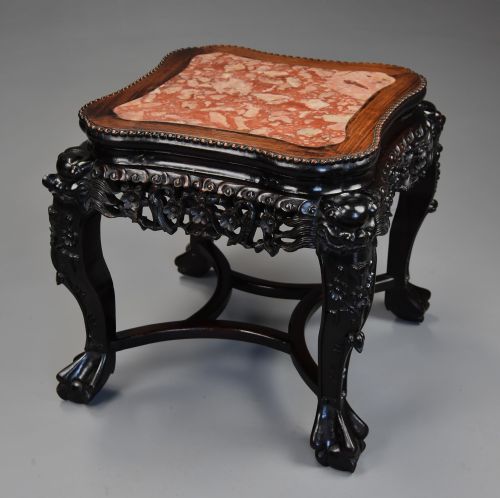
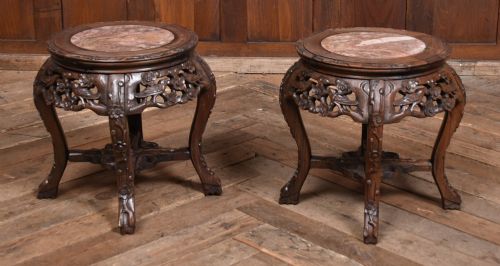


Marble Inset Display Stand
These marble inset display stand pieces offer sturdy surfaces for plants and urns, bringing carved timber and stone into the room.
Marble Inset Display Stand
A marble inset display stand serves primarily as a plant stand, jardiniere stand, or low table to elevate decorative items in a room. You will frequently encounter nineteenth-century Chinese examples alongside French Empire interpretations.
The form ranges from compact vase stands to tall plant stands and side tables designed with inset stone surfaces. Most pieces on this page originate from the nineteenth century, spanning Victorian and Qing Dynasty styles.
Makers utilised various exotic timbers to frame the stone centres, creating versatile furniture designed for display. These objects function equally well as lamp tables or urn stands in traditional and eclectic interiors.
Materials and construction
Cabinetmakers worked with dense tropical hardwoods including padouk, hongmu, rosewood, and mahogany to support the weight of the stone centres. Ebonised finishes and painted treatments also appear across the selection.
The distinct centrepiece consists of smooth marble, sometimes specified as rouge marble, fitted precisely into a carved wooden frame. Artisans applied intricate carving techniques around the skirts and legs, reflecting Qing Dynasty and Meiji Period aesthetics.
Listings feature nineteenth-century items spanning the Victorian era, Qing Dynasty, and Meiji Period, constructed from mahogany, padouk, hongmu, and rosewood.
Assessing quality in construction and stone
Quality rests in the depth and crispness of the carving across the hardwood frame, where sharper hand-chiseled details distinguish superior examples. The snugness of the marble fit within the timber rebate matters just as much.
The choice of dense timber such as hongmu or padouk rather than standard softwood dictates longevity and structural integrity. Grain pattern consistency and the absence of clumsy repairs elevate certain items above simpler production.
The Marble Inset Display Stand Glossary
- Hardwood
- Dense timber derived from broadleaved trees such as mahogany, rosewood, and padouk. These heavy woods resist dents and provide strong frames for stone inserts.
- Hongmu
- A traditional Chinese term translating to red wood, used for dense and heavy exotic hardwoods. It forms dark, durable furniture structures.
- Jardiniere
- A large ornamental pot or stand for holding plants and flowers. These pieces often feature water-resistant marble tops to handle damp pots.
- Rouge marble
- A decorative limestone variety featuring deep red and reddish-brown tones with white or grey veining. It provides a striking contrast against dark carved timbers.
- Qing Dynasty
- The final imperial dynasty of China, lasting from sixteen forty-four to nineteen twelve. Pieces from this era display distinct traditional carving styles and motifs.
Marble Inset Display Stand: Frequently Asked Questions
What were these stands originally used for?
These tables supported heavy ceramic planters, jardiniere bowls, and decorative urns inside nineteenth-century homes. The stone surface protected the timber frame from spilled water and moisture.
They also served as lamp tables or pedestals for displaying prized art objects and vases at a convenient height.
How do I care for the marble top?
Clean the stone surface regularly with a soft, damp cloth and dry it immediately to prevent water marks. Avoid acidic household cleaners that can etch the polished surface.
Condition the surrounding hardwood frame occasionally with appropriate furniture wax to keep the timber nourished.
Are these stands suitable for modern living rooms?
Their compact footprints make them ideal for corners, beside seating, or as lamp tables in contemporary spaces. The mix of carved timber and smooth stone adds texture to a room.
They function well as independent display surfaces for sculptures, lamps, or potted houseplants without dominating the floor plan.
How do I distinguish Chinese export styles from European ones?
Chinese export and Qing Dynasty pieces typically feature dense Asian hardwoods like padouk, hongmu, or rosewood paired with deep, traditional floral or geometric carving. French Empire examples rely on mahogany and brass details.
Examining the joinery and timber species usually clarifies the geographic origin and period of manufacture.