



Marble Clock Garniture Set
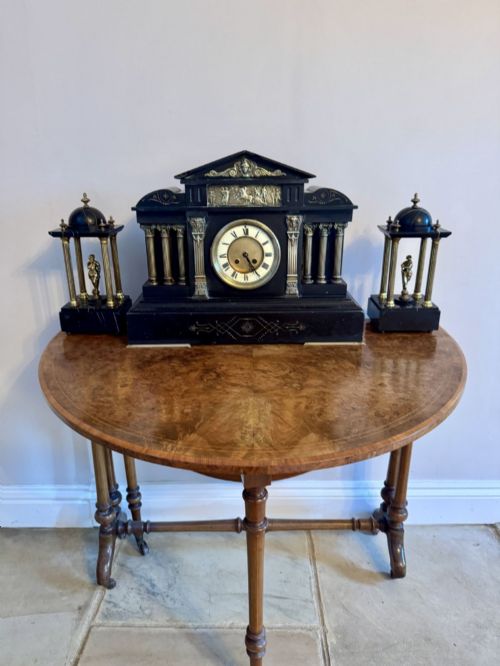
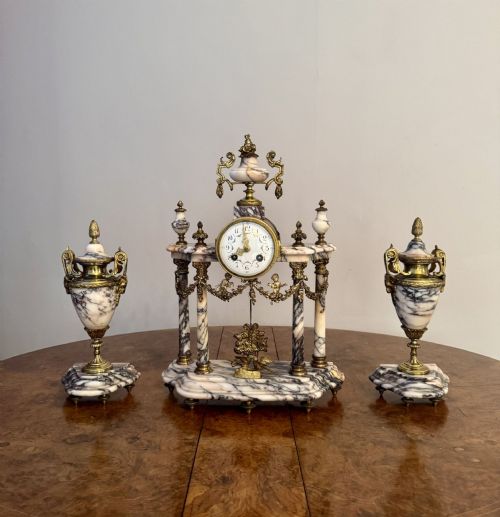
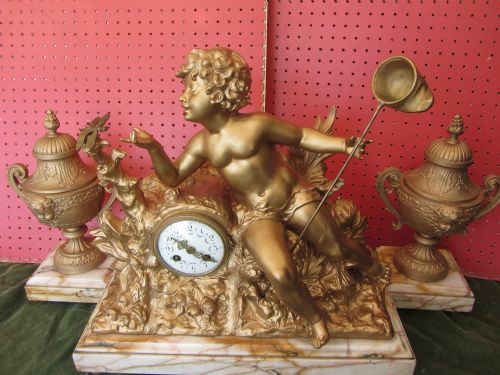
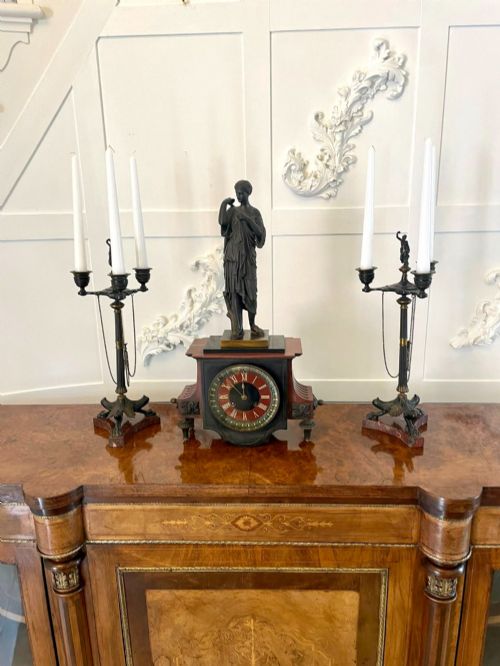
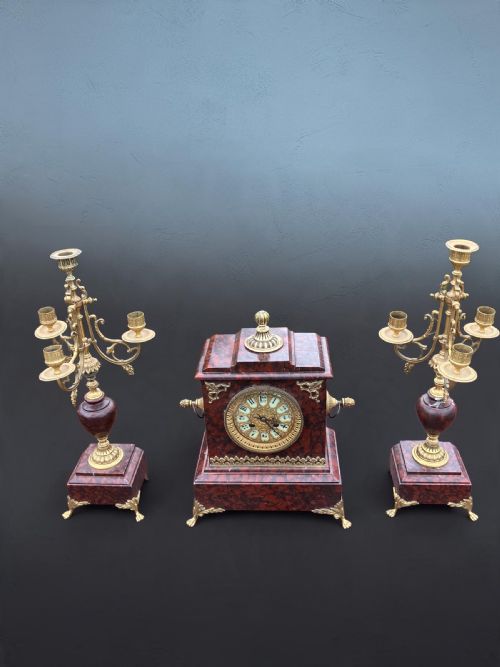
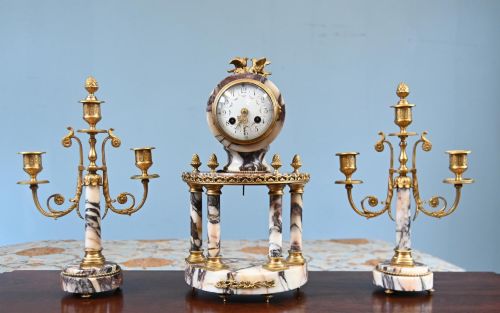
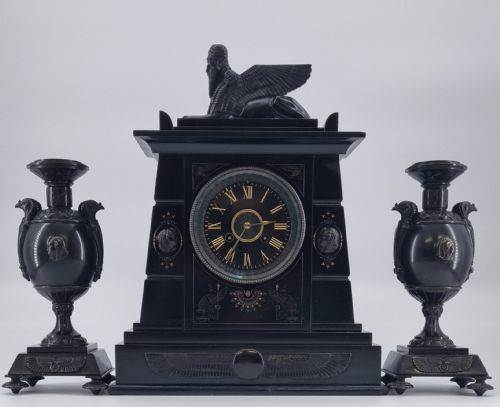
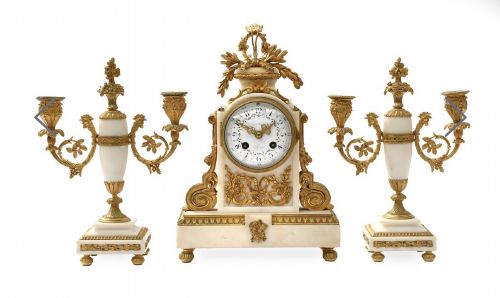
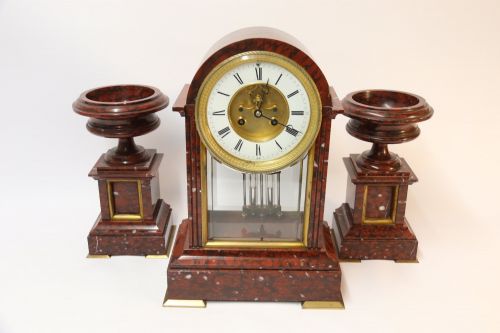
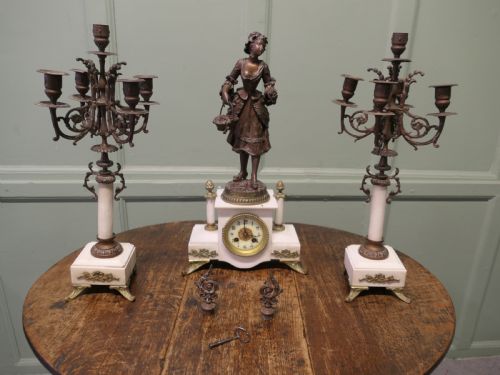
These marble clock garniture set examples bring heavy architectural presence and matched side pieces to a mantelpiece.
Marble Clock Garniture Set
A marble clock garniture set combines a central mantel clock with a pair of matching side pieces such as urns or figurative vases. You will most frequently meet 19th century French examples made during the Victorian period, often following Louis XVI styles.
The form spans several decades of design, moving from ornate classical bronze mounts through to geometric Art Deco creations featuring greyhounds or elephants. The matching side ornaments complete a symmetrical decorative scheme intended for a principal room.
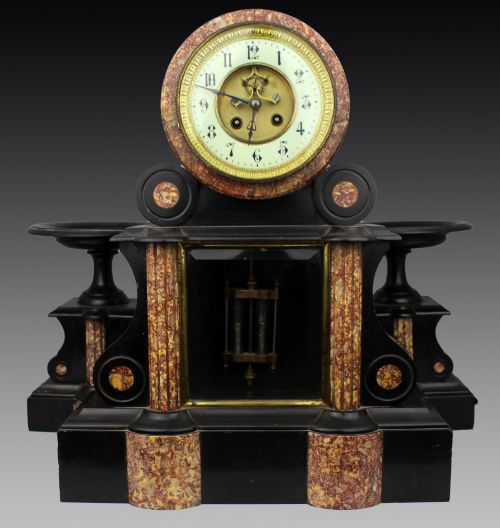
Makers and workshops across France and Britain produced these sets in black marble, white marble, and slate, pairing the stone with contrasting metallic finishes.
How they were made
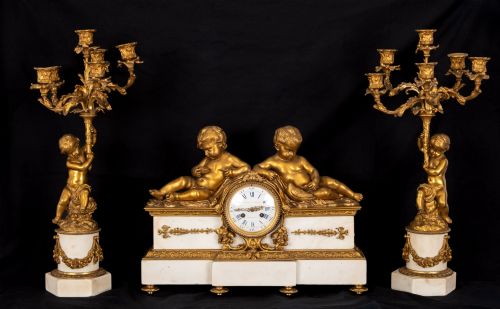
Craftsmen built these sets using heavy blocks of natural marble or black slate, shaped and polished to form the main bodies of the clock and garnitures. Metals such as ormolu, gilt bronze, and brass were cast and chased to create decorative mounts, cherubs, and architectural details.
Enamel dials were fitted to display the time, driven by mechanical movements designed to run for eight days with striking mechanisms. Glass protected the dial faces while securing the delicate hands and numerals.
Marble Clock Garniture Set Retail Price Guide 2026
Typical asking prices for marble clock garniture set among the pieces listed under this phrase on Sellingantiques today, from the lower quarter to the upper quarter. They describe what is for sale here now, not the wider market.
Some Art Deco sets swap traditional classical urns for matching metal greyhounds and elephants.
What varies in quality
The refinement of the cast bronze or ormolu mounts distinguishes standard production from exceptional pieces, with sharper chiselling and deeper gilding marking out superior work. The quality of the marble itself, from uniform black slate to figured white varieties, dictates the visual weight of the set.
Signatures on the clock movements or dials by established makers like Japy Frères, Samuel Marti, or H Luppens elevate a set's standing. Complete matching garniture pairs that retain their original glass and mercurial gilding represent the upper tier of the range.
Japy Freres·Samuel Marti·H Luppens Paris
The Marble Clock Garniture Set Glossary
- Garniture
- A set of ornamental objects designed to match a central piece such as a clock for display on a mantelpiece.
- Ormolu
- Gilded bronze produced by applying a finely ground high-carat gold-mercury amalgam to a bronze object.
- Japy Frères
- A prominent French clockmaking firm known for producing reliable mechanical movements during the nineteenth century.
- Louis XVI Style
- A neoclassical design movement featuring classical motifs, symmetry, and restrained architectural lines.
- Slate
- A fine-grained metamorphic rock used as a dark, uniform alternative to marble for nineteenth-century clock bodies.
Marble Clock Garniture Set: Frequently Asked Questions
What is a marble clock garniture set?
A marble clock garniture set consists of a central mantel clock accompanied by two matching ornamental side pieces designed for display together.
These three-piece arrangements were created to sit symmetrically on a fireplace mantel or sideboard as a unified decorative ensemble.
How do I wind these clocks?
Most of these mechanical clocks use a key inserted into winding holes on the enamel dial to tension the internal springs.
Care must be taken not to overwind the movement, and eight-day models require attention roughly once a week to keep accurate time.
How do I identify a Louis XVI style set?
Louis XVI style sets display neoclassical architectural elements, symmetrical mounts, and classical motifs cast in ormolu or bronze.
They draw inspiration from eighteenth-century French design principles, favouring straight structural lines and balanced proportions over excessive curves.
How do I live with a heavy marble clock?
These pieces require a sturdy, level surface capable of supporting considerable weight from the solid stone bodies and metal mounts.
Positioning them away from direct heat sources and moisture helps protect the marble polish and the delicate internal mechanical movement.