



Marble and Brass Urns
Marble and brass urns combine stone and metal in formal decorative pieces designed to elevate a mantelpiece or table.
Marble and Brass Urns
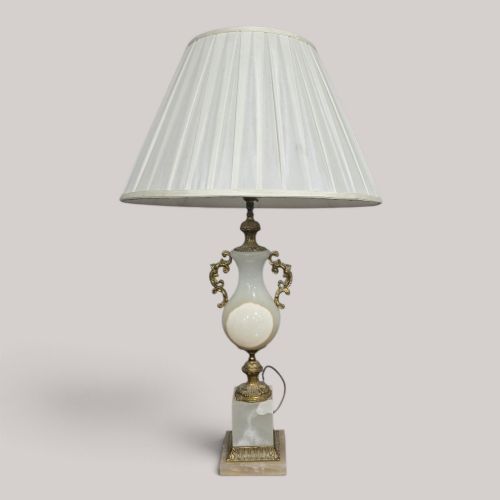
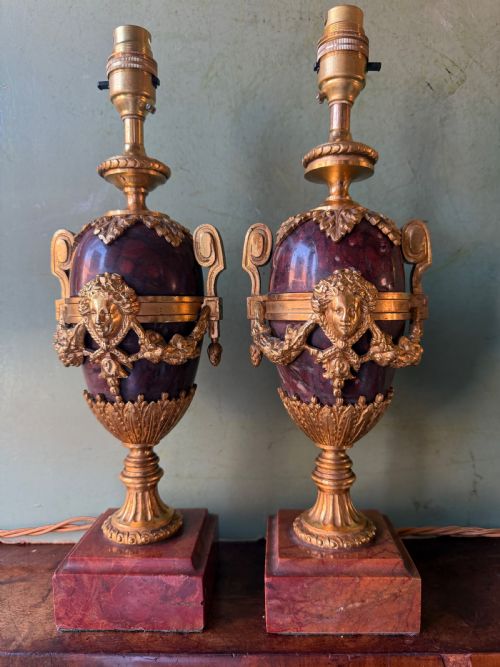
When buyers search for marble and brass urns, they encounter ornamental objects and functional pieces adapted from classical forms, frequently taking the shape of decorative urns, table lamps, and clock garnitures. These items originate predominantly from the nineteenth century and the early decades of the twentieth century, reflecting enduring European tastes in interior decoration.
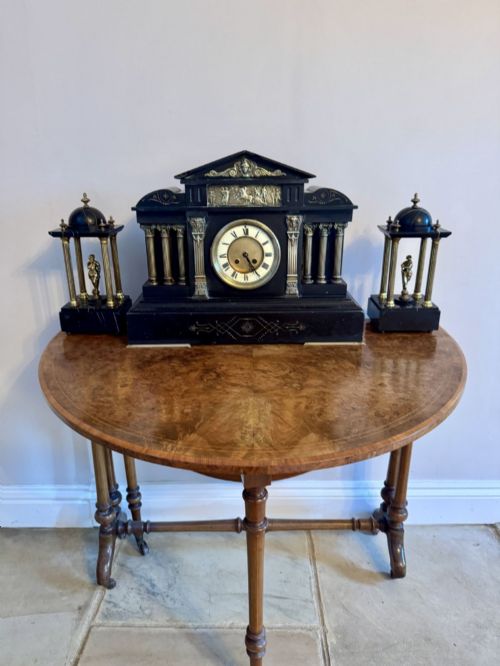
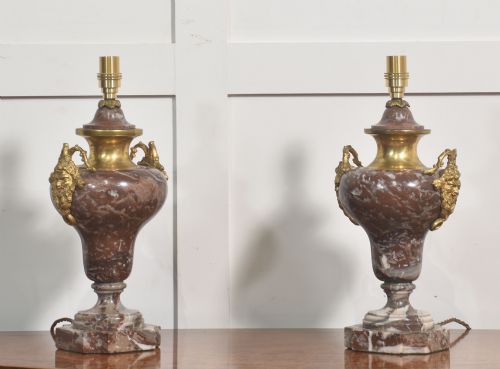
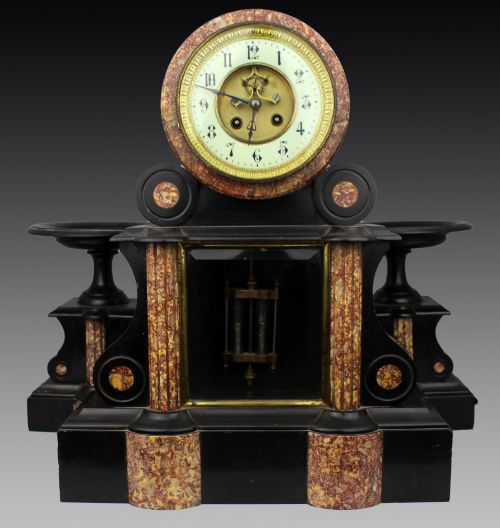
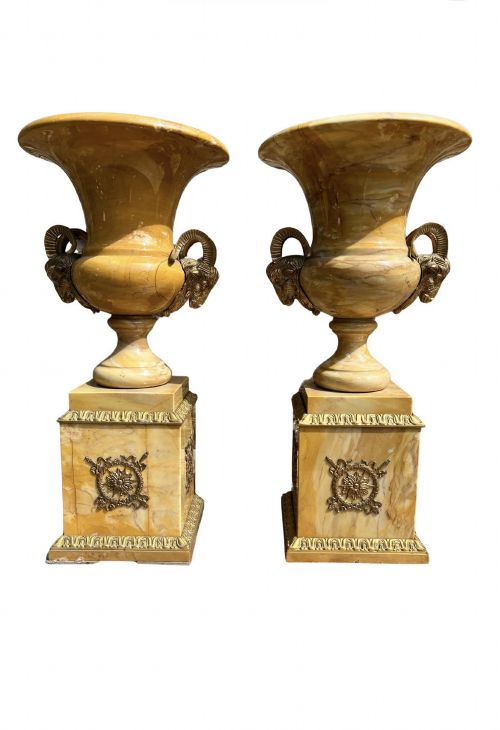
The most common examples on this page include French and Italian table lamps and mantel clock sets that pair carved stone bodies with cast metal mounts. Makers often utilised contrasting materials such as rouge marble, Sienna marble, and white marble alongside brass, ormolu, and gilt bronze to achieve decorative impact.
Stylistic influences lean heavily toward Neoclassical, Louis XVI Revival, and Empire designs, drawing on ancient Greek and Roman vocabularies. Such pieces serve as focal points in a room, maintaining a symmetrical and architectural presence whether configured as standalone decorative vessels or parts of multi-piece garnitures.
How they were made
The construction of these objects relied upon the combined skills of stonemasons and metalworkers who shaped heavy mineral blocks and cast fine metallic components separately. Marble bases, columns, and urn bodies were turned on lathes or hand-carved, then polished to a smooth finish that highlighted the natural veining of the stone.
Mounts, handles, and decorative collars were produced by casting brass, bronze, or ormolu, often utilising lost-wax or sand-casting methods before receiving hand-chasing and gilding. These metal elements were then mechanically fitted to the stone bodies using threaded rods, pins, or adhesives, creating secure joints between disparate materials.
Marble and Brass Urns Retail Price Guide 2026
Typical asking prices for marble and brass urns among the pieces listed under this phrase on Sellingantiques today, from the lower quarter to the upper quarter. They describe what is for sale here now, not the wider market.
Materials recorded across the inventory include rouge marble, Sienna marble, white marble, onyx, brass, ormolu, and gilt bronze.
What varies in quality
Quality in these pieces is dictated by the crispness of the metal chasing and the selection of the stone. Superior examples display sharply defined acanthus leaves, bead-and-reel mouldings, and figurative mounts on the bronze or ormolu elements, whereas lesser pieces show soft, generalised casting details resulting from worn production moulds.
The choice and preparation of the marble also set tiers of craftsmanship apart, with dense, evenly coloured Sienna or richly figured rouge varieties commanding greater artisanal effort than plain white or simulated stone surfaces. Furthermore, the precision with which the metal mounts fit the contours of the carved stone reveals the maker's underlying standard of assembly.
Japy Freres·James Ritchie And Son
The Marble and Brass Urns Glossary
- Ormolu
- Gilded bronze used extensively for decorative mounts on furniture and stone objects during the eighteenth and nineteenth centuries. This technique involved applying a mercury and gold amalgam to a bronze base before heating it to vaporise the mercury.
- Clock garniture
- A set comprising a central mantel clock accompanied by matching side pieces such as candelabras or decorative urns. These ensembles were designed to create a balanced display across a fireplace mantel.
- Sienna marble
- A yellow-brown decorative limestone quarried in Italy, characterised by dark purple or grey veining. It was highly favoured for neoclassical ornamental objects.
- Cassolette
- A decorative vase or urn with a reversible lid that could function either as a closed vessel or as a burner for scented substances. Nineteenth-century makers frequently adapted this form into table lamps.
- Portico clock
- A mantel clock featuring a architectural case supported by columns reminiscent of classical porticos. They often combined white or black marble with gilt bronze mounts.
Marble and Brass Urns: Frequently Asked Questions
What is a clock garniture?
A clock garniture is a matching set composed of a central mantel clock and two flanking decorative objects, such as urns or candelabras. These sets were designed to sit together on a fireplace mantel to create a balanced decorative arrangement.
In period interiors, they provided a unified aesthetic across a room's primary focal point. Individual pieces from broken sets sometimes appear independently on the market today.
How do I identify Louis XVI revival style?
Louis XVI revival pieces draw on late eighteenth-century French design, featuring strict symmetry, straight lines, and classical motifs like fluted columns, laurel wreaths, and ribbons. The aesthetic rejects the asymmetry of earlier rococo work in favour of architectural restraint.
On these items, you will often spot geometric mounts, urn shapes, and friezes cast in brass or ormolu against smooth marble surfaces.
Were these urns originally electric lamps?
Most of these urns and vases started as decorative ornaments, clock components, or oil lamps before being converted to electricity later in their lives. The conversion process typically involved drilling through the stone or mounting wiring through existing apertures.
When examining a piece, look for how the electrical fittings integrate with the historic metal mounts and whether the original internal structure remains intact beneath modern wiring.
How do I care for antique marble?
Antique marble requires gentle cleaning with a soft, dry cloth or a slightly damp sponge using mild, neutral soap. Avoid acidic cleaners, vinegar, or harsh abrasives, as these substances will etch and dull the polished stone surface.
Because nineteenth-century marble is often mounted to brass or gilt bronze elements, keep moisture away from the metal joints to prevent oxidation and staining of the stone.