


Mantelpiece Clock Garniture Set
A mantelpiece clock garniture set brings a disciplined symmetry to a room, pairing a central timepiece with matching decorative side pieces.
Mantelpiece Clock Garniture Set
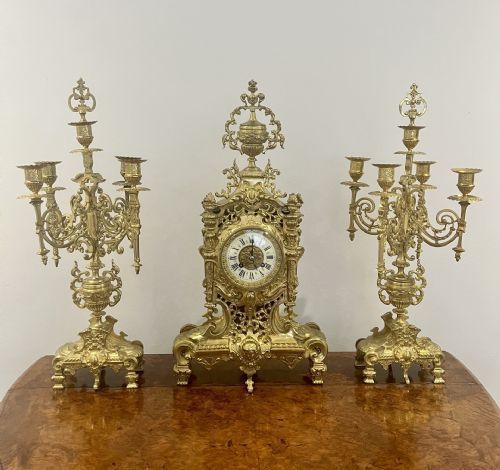
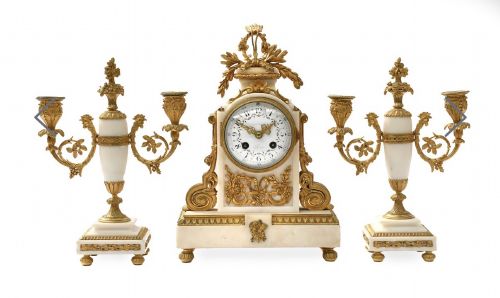
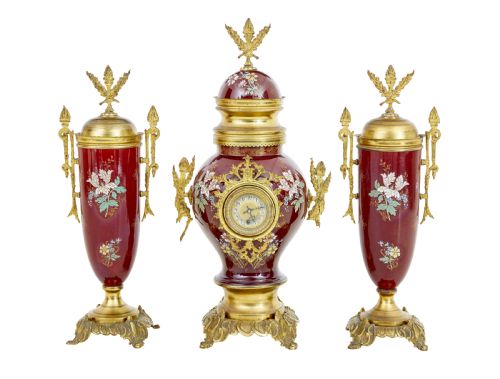
A mantelpiece clock garniture set comprises a central clock flanked by matched ornamental objects such as candelabras, urns or vases. When you search for this phrase on this page, you encounter pieces predominantly from the nineteenth century, including Victorian examples and the 1900 period.
The dominant origin across the inventory is French, expressed through styles like French Empire, Louis XVI, Rococo Revival and Napoleon III. These compositions frequently pair a functional timepiece with symmetrical side companions designed to anchor a mantelpiece or console table.
Forms range from white, pink, green and sienna marble bodies to portico designs, portico clocks and porcelain-mounted housings. The matching side pieces complete a unified decorative scheme conceived as a single ensemble.
How they were made
Gilt bronze, ormolu, brass and gilded metals provide the structural and decorative framework for the majority of these sets, shaped through casting and chasing techniques. Enamel dials, visible pendulums and glass components integrate with the metalwork.
Natural stones such as marble, onyx and alabaster form substantial architectural bodies, often combined with porcelain elements including Sevres style panels, Imari porcelain, and cloisonne work. The integration of ceramic and stone with metal mounts defines the fabrication method.
Listings feature 19th Century, Victorian, 1900, 1880, 1890, 1860, 1920 and 1870 periods.
What varies in quality
The refinement of the casting and the depth of the chasing in the ormolu or gilt bronze separate standard productions from superior examples. Crisp detailing on figures, foliage and architectural mounts indicates skilled hand finishing.
Finnigan Manchester·Meissen·Japy Freres·Etienne Maurice Falconet
The Mantelpiece Clock Garniture Set Glossary
- Garniture
- A matching set of ornamental objects designed to be displayed together, typically consisting of a central clock and two side pieces such as urns or candelabras.
- Ormolu
- Finely ground high-carat gold applied to a bronze base using a mercury amalgamation process, yielding a rich golden finish characteristic of French decorative arts.
- Portico clock
- A timepiece housed within a architectural frame supported by four or more columns, frequently executed in marble or alabaster during the nineteenth century.
- Cloisonne
- An ancient technique for decorating metalwork objects using enamel held within raised strips of wire or metal soldered to the base.
- Candelabra
- Branched candlesticks designed to hold multiple candles, commonly utilised as the matching side pieces in a garniture set.
Mantelpiece Clock Garniture Set: Frequently Asked Questions
How were garniture sets used historically?
These sets served as the visual centrepiece of a room's fireplace arrangement in nineteenth-century homes. They provided both the practical function of telling time and a display of household status.
The flanking pieces were positioned symmetrically around the clock to frame the mantelpiece. Together, the ensemble established the decorative tone of a drawing room or parlour.
How do I style a clock garniture set?
Place the central clock firmly in the middle of the mantelpiece to create an anchor point. Position the matching side pieces symmetrically on either side to maintain visual balance.
Ensure there is adequate clearance above the mantel and keep the surrounding decor minimal so the ensemble remains the focal point. Avoid overcrowding the shelf with unrelated objects.
How do I identify French nineteenth-century styles?
Look for distinct design markers such as the restrained symmetry of Louis XVI Revival or the elaborate scrolling and natural motifs of Rococo Revival. Materials like gilt bronze, ormolu and marble point directly to this era.
Examine the dial inscriptions, cast mounts and overall proportions. Maker names or retailers marked on the dial or movement can also help confirm the period and origin.