

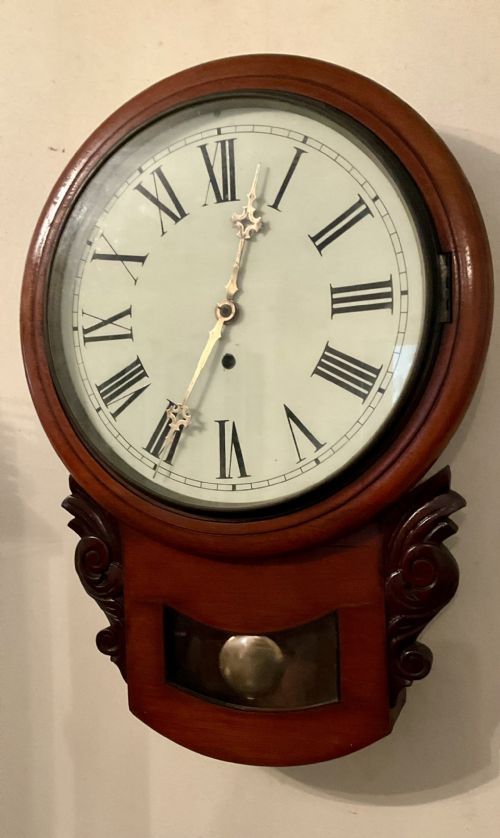


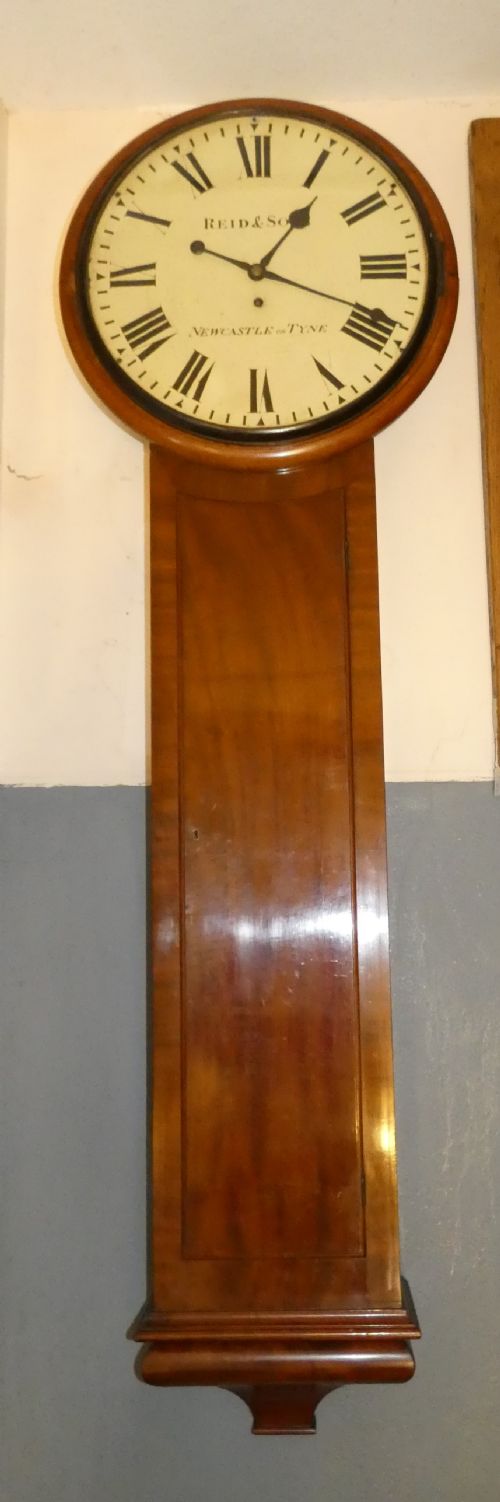


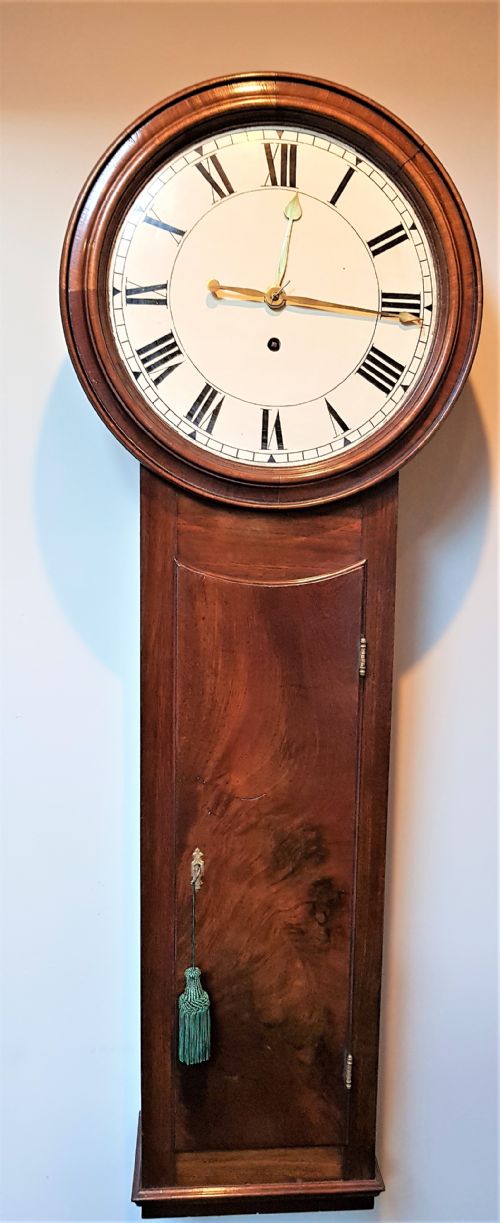


Mahogany Trunk Wall Clock
A mahogany trunk wall clock brings architectural presence and reliable timekeeping to a room, offering the classic appeal of a dial mounted above a glazed case.
Mahogany Trunk Wall Clock
When you search for a mahogany trunk wall clock, you are looking at timepieces built primarily during the nineteenth century, with Victorian examples appearing most frequently on this page alongside Regency, Georgian and later twentieth-century pieces.
Originating largely from English workshops and London makers, these clocks served functional roles in public spaces, railway stations and domestic halls before becoming sought-after decorative fixtures.
How they were made
Cabinetmakers constructed the cases using solid mahogany and flame mahogany veneer, occasionally incorporating oak or brass details to reinforce the structural housing.
Dial construction varied between painted iron, enamel, and carved wood, protected behind hinged glass doors set within a brass or wooden bezel.
Mechanisms relied on precision engineering, utilising single or double fusee movements and eight-day gear trains to maintain consistent tension and accurate timekeeping.
Mahogany Trunk Wall Clock Retail Price Guide 2026
Typical asking prices for mahogany trunk wall clock among the pieces listed under this phrase on Sellingantiques today, from the lower quarter to the upper quarter. They describe what is for sale here now, not the wider market.
The archive records simple timepiece drop dials alongside complex double fusee regulator cases.
What varies in quality
The sophistication of the movement sets the standard, distinguishing straightforward timepieces from complex double fusee regulator cases and striking mechanisms.
Cabinetwork execution separates ordinary production from superior pieces, evident in the choice of figured flame mahogany veneer and the crispness of carved wooden details.
The integrity of the dial and signature engraving reflects the original maker's standing, with signed London dials carrying distinct historical weight.
Joseph Mansfield·John Walker·R. Roberts·John Thwaites·J.W. Enock·Webb of Frome·C. Coleman·Mark Bartley·Halliday and Rich
The Mahogany Trunk Wall Clock Glossary
- Fusee
- A conical pulley used in clock movements to maintain even force on the gear train as the mainspring unwinds. This mechanism ensures consistent timekeeping across the entire eight-day run.
- Drop dial
- A wall clock design featuring an extended lower wooden trunk beneath the circular dial. This drop case accommodates the swing of the pendulum.
- Regulator
- A high-precision clock designed for exact time measurement and used as a standard for setting other timepieces. These often feature extended cases and fine mercury or wooden rod pendulums.
- Bezel
- The metal or wooden ring that holds the glass door protecting the clock face. It usually opens on a hinge to allow hand adjustment.
- Chisel bottom
- A specific lower case termination shape ending in a sharp, angled point rather than a traditional scroll or box base.
Mahogany Trunk Wall Clock: Frequently Asked Questions
How do I wind a fusee wall clock?
Use the appropriate winding key on the dial arbor, turning it gently clockwise until resistance indicates the mainspring is fully tensioned. Take care not to overwind older movements.
Ensure you support the key evenly to avoid putting lateral pressure on the winding square, which can wear the brass surrounding the pivot hole over time.
Where should I hang a trunk wall clock?
Mount the clock on a sturdy internal wall using a secure fixing directly into brick or a substantial wall stud. Avoid exterior walls subject to dampness or temperature swings.
Keep the clock away from direct sunlight and heavy foot traffic that might cause vibrations and disturb the delicate balance of the pendulum.
Why does my clock need beating evenly?
An even tick ensures the pendulum swings with equal arc to the left and right, which keeps the escapement working correctly and prevents the clock from stopping.
Adjust the case mounting or the crutch wire inside if the beat sounds uneven, aiming for a steady, rhythmic tick-tock cadence.
How do I identify a nineteenth-century movement?
Examine the backplate and pillars of the mechanism for hand-cut brass work, signature engraving, and the absence of mass-produced stamped components found in later factory eras.
Look for maker signatures inscribed directly onto the dial face or movement plates, which often tie the piece to documented London or provincial clockmakers.