
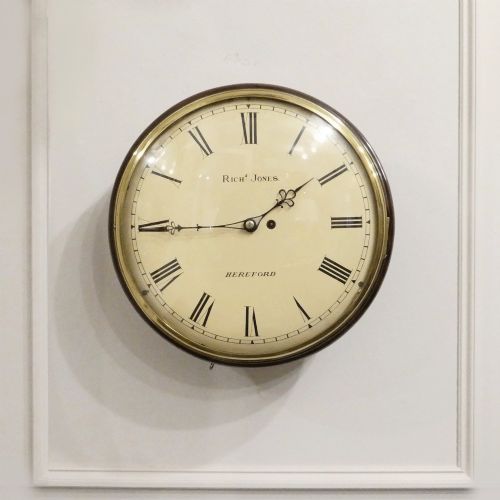
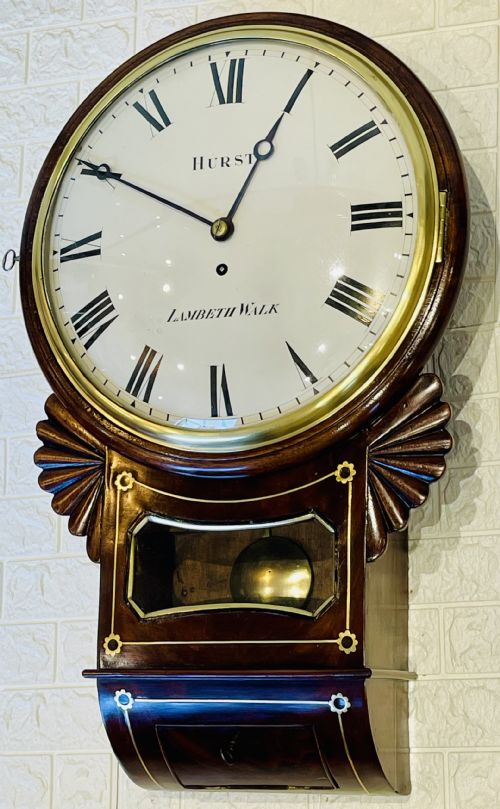
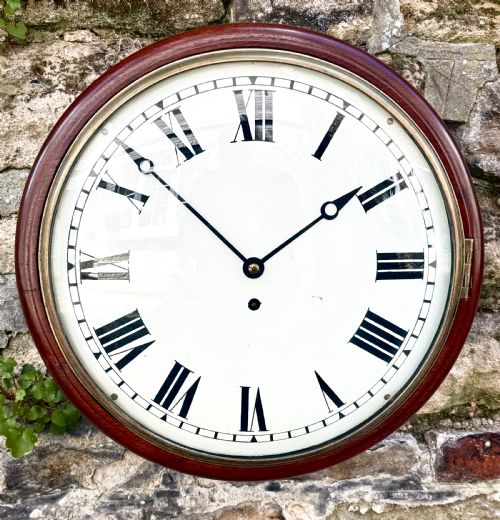
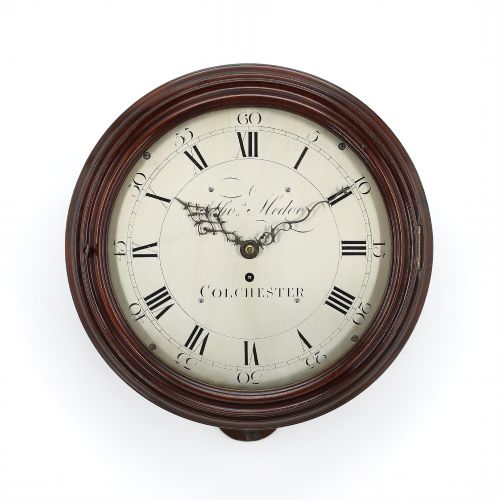
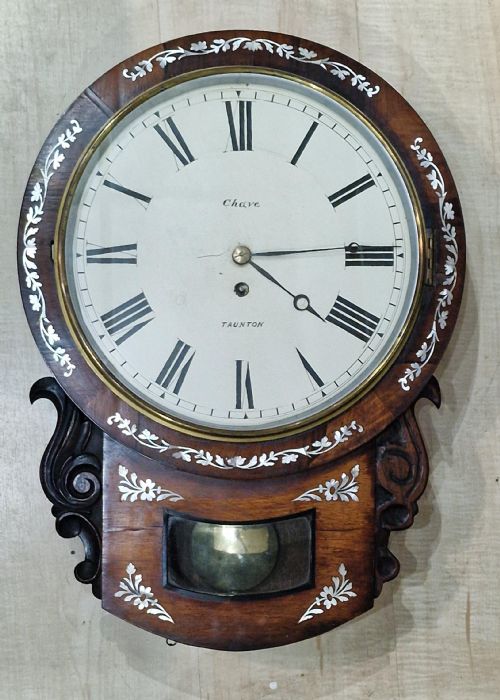


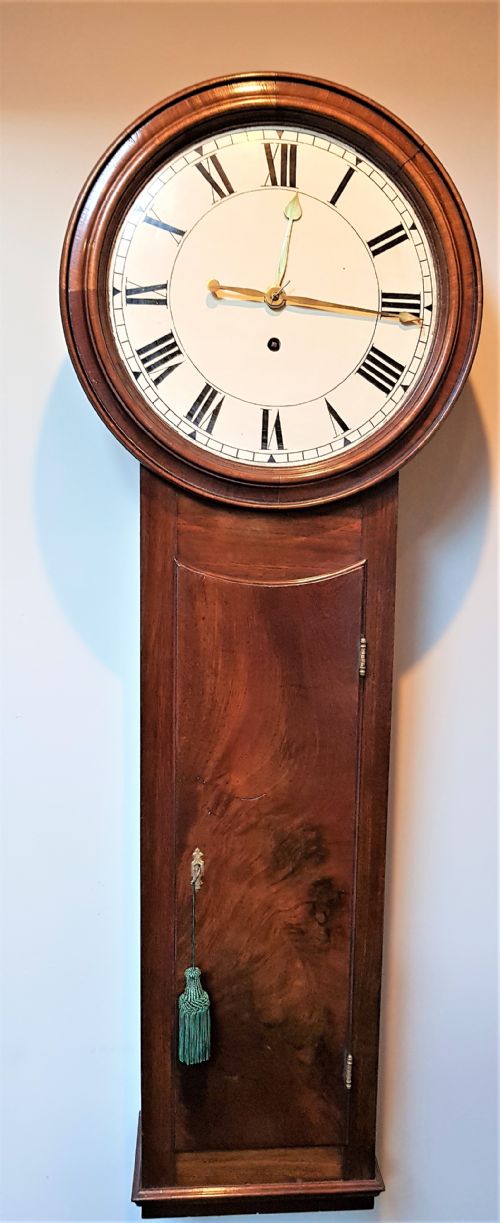

Mahogany Tavern Clock
A mahogany tavern clock is a substantial wall-mounted timekeeper designed for public spaces, combining rich timber cases with clear dials.
Mahogany Tavern Clock
A mahogany tavern clock provides a commanding wall presence through its architectural timber case and prominent dial. These pieces span Georgian, Regency, and Victorian periods, with origins rooted in public houses and coaching inns where patrons needed to read the time from a distance.
The form typically combines a glazed lower door for accessing the pendulum with a circular dial above. Pieces range from grand proportions with flame mahogany veneer to smaller, more restrained examples housed in oak and mahogany.
Makers from provincial towns and London alike produced these dials, employing wooden faces, painted metal, or brass alongside traditional fusee and weight-driven movements.
What separates the examples
The sophistication of the timber veneer and the crispness of the dial lettering set the better examples apart from standard workshop production. Flame mahogany cases with well-matched grain and inlaid detailing reflect a higher tier of cabinetmaking.
Movement quality and the preservation of original components, from the brass bezels to the hands, determine the integrity of the piece. Dials retaining clean hand-painted numerals and high-grade fusee movements indicate superior original manufacture.
Listings feature mahogany, oak, brass, and rosewood across Georgian and Victorian wall clock examples.
Richard Jones of Hereford·Thomas Hedge of Colchester·Samuel Chave Taunton·Robert Salmon·J. Beckett of London·Thomas Field of Bath·Smith and Sons of Walton·Walker and Hughes
The Mahogany Tavern Clock Glossary
- Fusee
- A conical pulley used in clock movements to ensure even power delivery as the mainspring unwinds. This mechanism helps the clock maintain consistent timekeeping throughout its run.
- Drop dial
- A clock case featuring an extended lower section below the main dial to accommodate the swing of the pendulum. This shape defines many traditional tavern and wall clocks.
- Flame mahogany veneer
- A sliced layer of timber cut from the fork of the mahogany tree to create a distinctive, swirling flame-like grain pattern. It was favoured for high-status furniture and clock cases.
- Act of Parliament clock
- A large dial wall clock associated with a tax levied on clocks and watches in the late eighteenth century, which encouraged public houses to display a clock for patrons. The name is often used interchangeably with tavern clock.
- Brass bezel
- A hinged metal ring that holds the glass cover securely in front of the clock dial. It provides both protection for the hands and access for setting the time.
Mahogany Tavern Clock: Frequently Asked Questions
Where were tavern clocks originally hung?
These clocks were traditionally positioned in the public rooms of inns, taverns, and coaching houses where many people needed to check the hour simultaneously. Their large dials and clear markings made them practical for busy commercial environments.
They also appeared in official offices and large domestic halls during the Georgian and Regency periods. The secure wall mounting kept the mechanism safe from busy foot traffic below.
How do fusee movements work?
A fusee movement uses a conical pulley connected to the mainspring via a cord or chain. As the spring unwinds and loses tension, the chain moves to a wider part of the cone, maintaining steady force on the gear train.
This clever design prevents the clock from losing or gaining time as the power source gradually runs down between windings.
Are wooden dials older than painted ones?
Wooden dials appear frequently on eighteenth-century and early nineteenth-century tavern clocks, often featuring dark backgrounds with gilt numerals or white paint on wood. Painted metal dials became more widespread as production methods evolved.
Both materials were used concurrently depending on the maker's preference and the regional style of the workshop.
How do I wind a tavern clock?
Winding requires inserting a key into the winding hole on the dial face and turning it carefully until the spring reaches full tension. Weight-driven variants require pulling the chain or cord to lift the internal weights back to the top of the case.
Careful handling ensures the movement and dial surround remain undamaged during routine maintenance.