
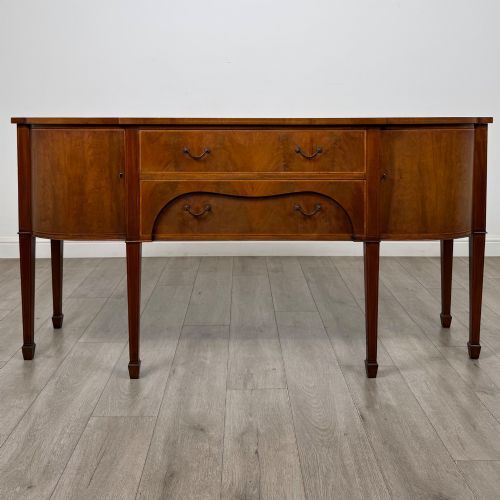
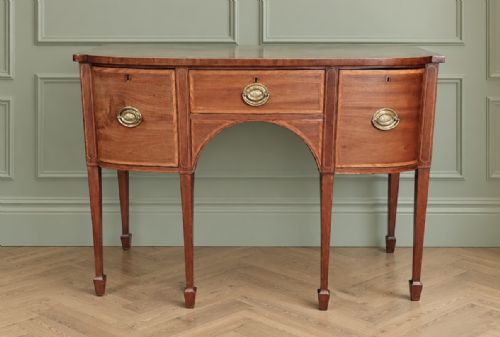
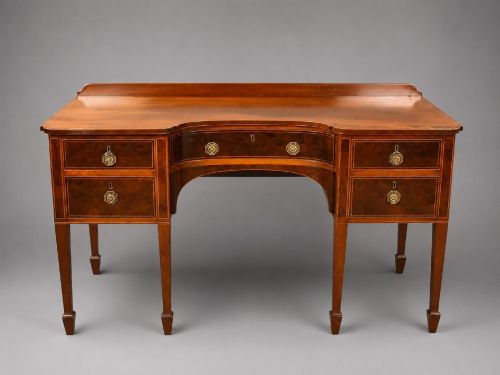
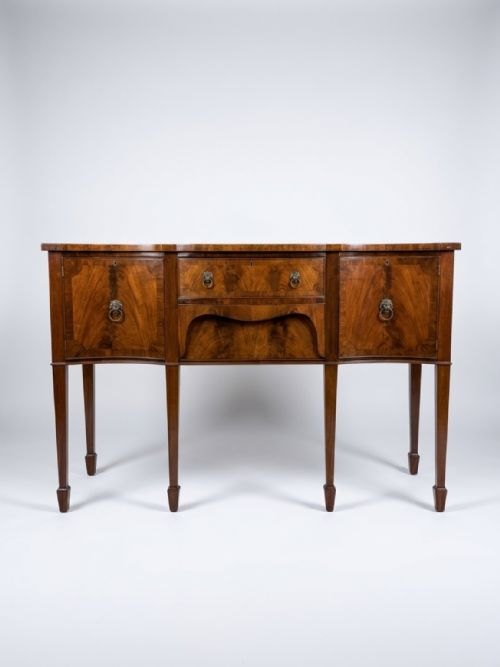
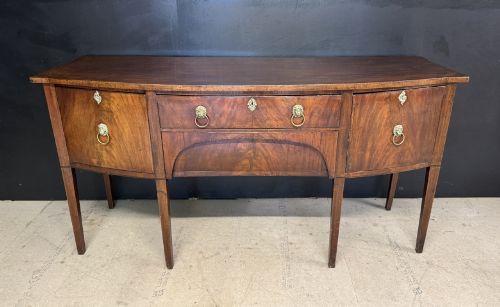
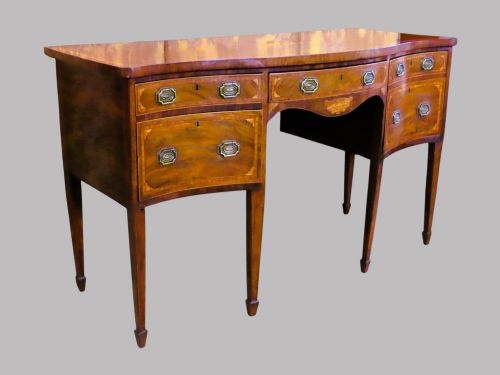
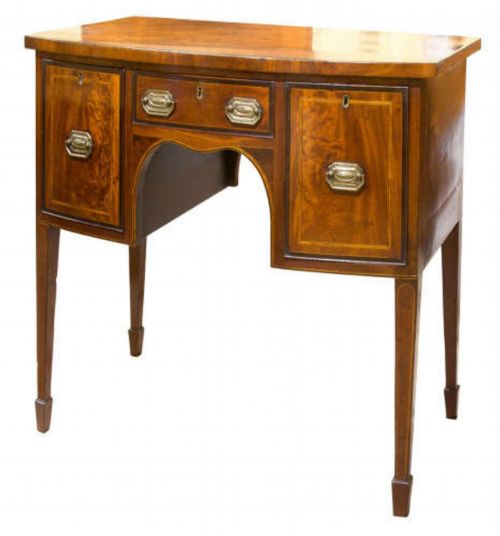
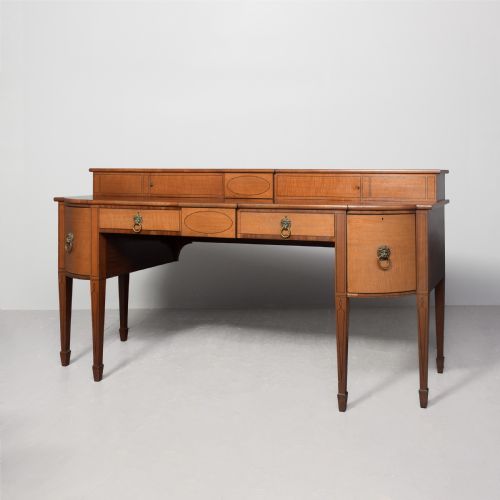

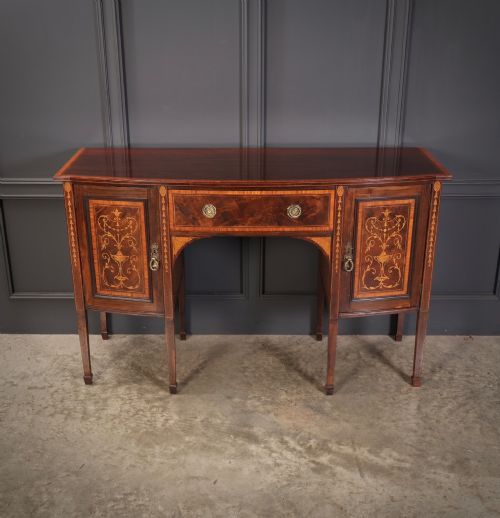
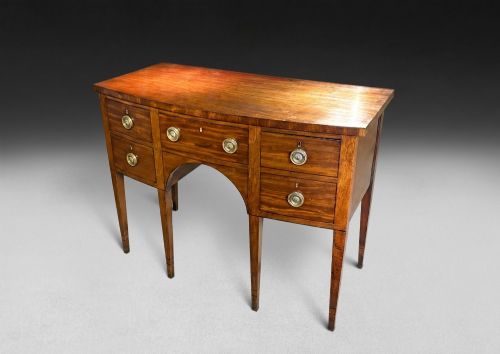
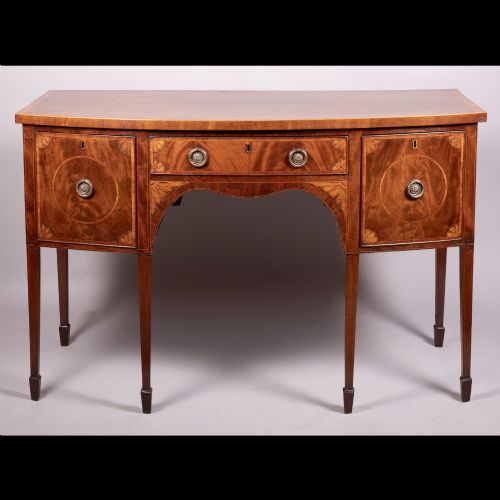

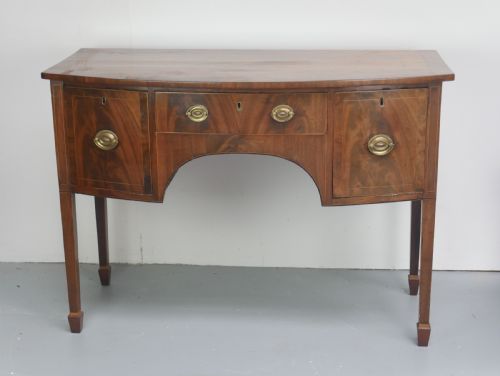


Mahogany Tapered Leg Buffet
Mahogany tapered leg buffet pieces are formal dining room servers designed to hold silver and china.
Mahogany Tapered Leg Buffet
A mahogany tapered leg buffet groups together formal dining room server forms, including sideboards and side tables originating across the eighteenth and nineteenth centuries. The listings show a heavy concentration of Georgian, George III, and Regency periods alongside later Sheraton Revival and Edwardian interpretations.
Buyers will most frequently encounter bow-front and serpentine silhouettes among these examples. The forms rely on rich timber grain combined with stringing and crossbanding to articulate the frontal elevation.
Regional variations appear in pieces originating from Scottish workshops alongside standard English forms. Server types span standard credenzas, stage-back configurations, and compact proportions suited to smaller domestic spaces.
Materials and construction methods
Cabinet makers utilised solid mahogany timbers and flame mahogany veneer applied to carcases. Secondary woods provide structural stability behind the primary show surfaces.
Inlay work incorporates contrasting timber species including satinwood and boxwood. Boxwood stringing defines drawer borders and panel outlines on refined examples.
Scottish workshops occasionally added stage-backs to accommodate extra silverware.
Markers of distinction in construction and design
The sophistication of the timber figure dictates visual presence, particularly where highly figured flame mahogany veneer covers large expanses. Crispness in the execution of boxwood and satinwood inlay separates standard work from accomplished cabinet making.
Proportion and silhouette control the overall grace of a piece, with complex serpentine curves demanding higher joinery skill than straight or bow fronts. The integration of banded edges and restrained stringing demonstrates deliberate restraint rather than excessive ornamentation.
The Woodworkers Ltd Kilkenny
The Mahogany Tapered Leg Buffet Glossary
- Bow-front
- A convex curved front elevation popular in eighteenth and nineteenth-century case furniture. This shape softens the corners of a dining room server while maximising internal storage capacity.
- Serpentine
- A horizontally undulating front that curves inward at the centre and outward at the ends, or vice versa. It represents a more complex joinery challenge than a standard straight or bow front.
- Crossbanding
- A border of veneer laid around the perimeter of a surface with the grain running perpendicular to the central panel. This technique frames the primary timber figure.
- Stringing
- Thin inlaid lines of contrasting wood set into channels cut into the solid timber or veneer. Boxwood stringing is frequently seen on Georgian and Sheraton pieces.
- Stage-back
- An elevated superstructure rising behind the main surface of a sideboard. It provides additional tiers or ledges for displaying serving vessels.
Mahogany Tapered Leg Buffet: Frequently Asked Questions
What is a mahogany tapered leg buffet used for?
These servers function primarily in dining rooms for holding porcelain, cutlery, and serving dishes during meals. They provide surface space for food presentation alongside enclosed storage compartments.
Historically, larger variations accommodated specific dining rituals and the management of heavy silver services.
How do I distinguish George III from Victorian pieces?
George III examples generally exhibit lighter proportions, finer boxwood stringing, and hand-cut dovetails characteristic of eighteenth-century workshops. Timber selection leans toward native mahogany figures.
Victorian iterations often display heavier carcases, broader veneers, and mass-produced internal hardware reflecting industrial manufacturing shifts.
Where were these dining servers made?
English cabinet makers produced the majority of these pieces, particularly within regional workshops and London metropolitan hubs. Scottish makers also contributed distinct regional interpretations.
Design influences span classic Georgian proportions through to late nineteenth-century Sheraton Revival revivals.
How should I care for a mahogany surface?
Maintain timber surfaces by dusting with a dry lint-free cloth and avoiding silicone-based polishes. Keep pieces away from direct heat sources and strong sunlight to prevent veneer drying.
Periodic application of traditional wax preserves the natural lustre of the mahogany grain.