


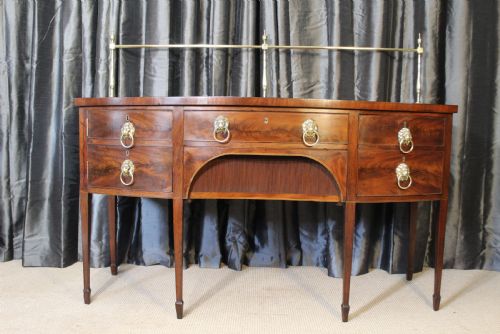


Mahogany Rail Sideboard
These mahogany rail sideboard examples combine rich timber and brass galleries, offering both traditional server utility and striking dining room presence.

Mahogany Rail Sideboard
A mahogany rail sideboard provides a substantial serving surface alongside structural back rails or brass galleries designed to keep items secure. These items appear across Georgian, Regency, Victorian, and later revival periods.
Buyers encounter serpentine fronts, bowfront shapes, and pedestal forms constructed from rich timber. The selection spans formal 18th-century pieces through to 19th-century interpretations and later revivals.
How they were made
Cabinet makers utilised dense mahogany as the primary timber, frequently adding satinwood and boxwood inlay for decorative contrast. Brass fittings such as galleries and rails provide structural support and a metallic accent against the dark wood.
Construction techniques include curved serpentine and bowfront framing, alongside pedestal configurations. Artisans shaped solid and veneered timbers to achieve the characteristic profiles of the period.
Mahogany Rail Sideboard Retail Price Guide 2026
Typical asking prices for mahogany rail sideboard among the pieces listed under this phrase on Sellingantiques today, from the lower quarter to the upper quarter. They describe what is for sale here now, not the wider market.
Brass galleries ensured heavy silver platters stayed put while guests enjoyed multiple courses.
What varies in quality
The sophistication of the timber grain and the precision of the boxwood or satinwood inlay distinguish finer examples from standard production. Cabinetmakers achieved varying degrees of fluidity in serpentine and bowfront curves.
The integration and casting quality of the brass rail or gallery affect the overall balance of the piece. Superior proportions and restrained decorative details separate master workshops from simpler regional furniture.
Robson & Sons·H Mower & Stephenson
The Mahogany Rail Sideboard Glossary
- Serpentine front
- A furniture front curving inward centrally and outward at the sides, creating a fluid serpentine line. This shape demands precise woodworking skill.
- Bowfront
- A convex curved front that projects outward in a smooth arc. It appears frequently on dining room servers and credenzas.
- Brass gallery
- A metal rail system fitted to the rear top surface of a sideboard. It held serving dishes securely in place during dining.
- Satinwood inlay
- Contrasting blonde timber inserted into the darker mahogany surface. It forms decorative geometric borders or fan motifs.
Mahogany Rail Sideboard: Frequently Asked Questions
What is a brass rail sideboard?
A brass rail sideboard is a dining room serving piece featuring a metal gallery attached to the back edge. This rail originally prevented serving platters from sliding off the surface.
These forms appear primarily in Georgian and Regency periods, continuing into later revival eras with similar functional designs.
How do I identify a Georgian sideboard?
Georgian examples display classic proportions, hand-cut mahogany veneers, and occasionally serpentine or bowfront shapes. Cabinetmakers of this era focused on structural harmony and understated classical details.
Many of these pieces also incorporate fine boxwood or satinwood stringing around the drawer edges and borders.
Where were sideboards placed?
Sideboards stood against dining room walls to hold food, glassware, and silver during meals. They served as central staging areas for large household dining.
Their substantial timber presence also functioned as a decorative display focal point within formal rooms.