

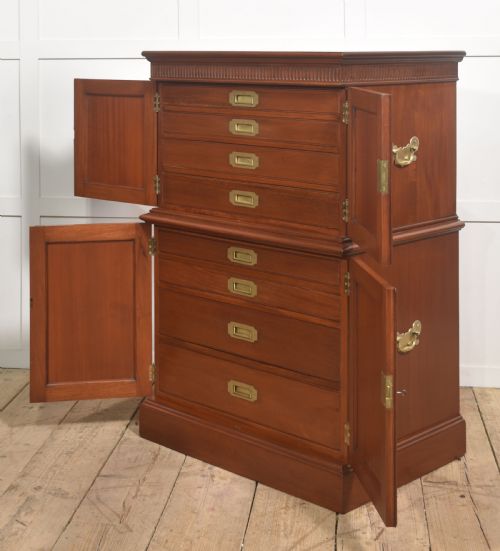


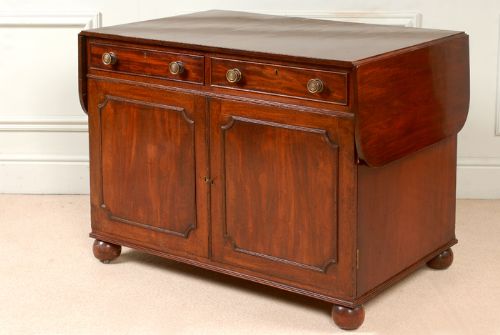


Mahogany Plan Chest
A mahogany plan chest offers sturdy storage with wide, shallow drawers designed to hold large sheets.
Mahogany Plan Chest
A mahogany plan chest is a practical storage piece designed originally for architects, cartographers and designers to keep large drawings flat and protected. The listings here encompass robust examples from the eighteenth, nineteenth and early twentieth centuries, including pieces built for workshops, offices and studies.
The format typically involves a series of wide, shallow drawers arranged in sections or stacked banks to accommodate maps, folios and architectural plans without folding them. Variations span from George III floor standing folio cabinets to Victorian solicitors chests and industrial workshop drawers.
Buyers seeking a mahogany plan chest will find both multi-drawer upright configurations and low library tables designed for sorting documents. These items combine utility with dense timber surfaces suited to contemporary interiors.
How They Were Made
Construction relies heavily on solid mahogany and flame mahogany veneer over secondary timbers, chosen for stability and strength across wide drawer spans. Cabinetmakers utilised precision dovetail joints on the drawer boxes to withstand the constant pull of heavy contents.
Drawer pulls and campaign handles are fashioned from brass, often paired with brass drop handles or recessed campaign mounts on modular sections. Selected pieces incorporate decorative details such as boxwood inlay or satinwood accents to frame the drawer fronts.
Mahogany Plan Chest Retail Price Guide 2026
Typical asking prices for mahogany plan chest among the pieces listed under this phrase on Sellingantiques today, from the lower quarter to the upper quarter. They describe what is for sale here now, not the wider market.
Several pieces include dedicated egg cabinets and cartographer tables designed for precise, specialised storage.
What Varies in Quality
The grade of timber and the choice of veneer dictate the visual depth of the exterior, ranging from plain mahogany boards to heavily figured flame mahogany. Drawer construction reveals craftsmanship through the tightness of the dovetailing and the smoothness with which wide drawers glide within their runners.
Hardware integrity and original maker stamps elevate certain examples, distinguishing standard utilitarian workshop storage from finely detailed pieces commissioned from known cabinetmakers.
Edwards & Roberts·Shapland & Petter·Gillows
The Mahogany Plan Chest Glossary
- Flame mahogany
- A veneer cut from the fork of the mahogany tree, producing a distinctive leaping flame pattern across the wood grain. It was favoured for high-status cabinet fronts during the Georgian and Victorian eras.
- Boxwood inlay
- Narrow strips of pale boxwood set flush into contrasting darker wood surfaces to create geometric borders or decorative stringing lines. This technique highlights drawer outlines and panel edges.
- Folio cabinet
- A tall cabinet specifically proportioned to store large paper folios, prints and unbound maps vertically or flat on internal shelves and shallow trays. These pieces often feature panelled doors enclosing sliding trays.
- Satinwood
- A lustrous, hard timber with a golden yellow colour used for contrasting stringing and banding details on refined furniture. It provides a bright accent against dark mahogany.
Mahogany Plan Chest: Frequently Asked Questions
What were mahogany plan chests originally used for?
These chests served architects, mapmakers, and artists who needed flat storage to protect large paper sheets from curling or damage.
Over time, their wide, shallow drawers made them practical for organising prints, documents, and textiles in professional offices.
How do I date a mahogany plan chest?
Dating relies on construction methods, timber selection, and hardware styles, moving from eighteenth-century dovetailed drawer construction to industrial nineteenth and twentieth-century sectional formats.
Maker stamps and specific brass pull designs also help narrow down the period of manufacture.
Can I use a plan chest in a modern living room?
The low profile and deep timber top make these chests suitable for use as sideboards, media consoles, or coffee tables.
The wide drawers provide concealed storage for household items while maintaining a clean surface on top.
Are all plan chests made of solid mahogany?
While many feature solid timber frames and drawer construction, others utilise flame mahogany veneers over secondary structural woods for decorative exterior surfaces.
Internal drawer linings often consist of secondary timbers chosen for durability.