
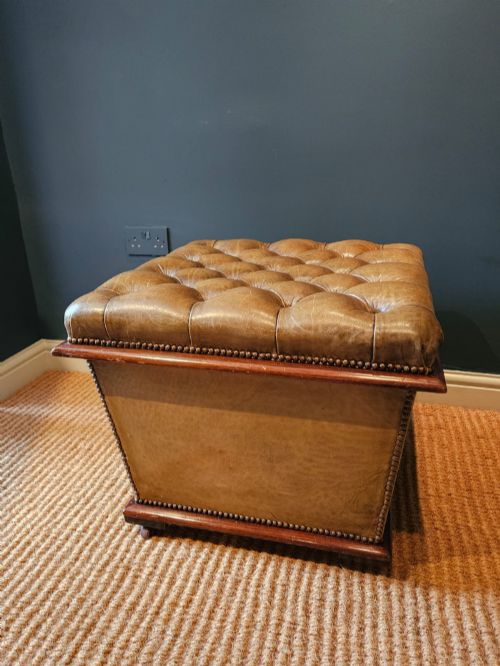


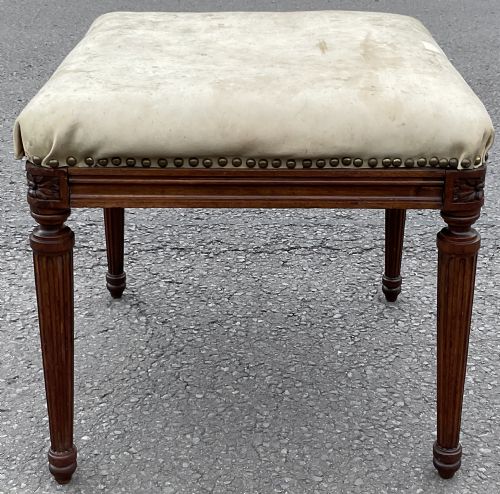
Mahogany Leather Footstool
A mahogany leather footstool is a sturdy timber and hide seating piece that anchors a traditional room while resting tired feet.
Mahogany Leather Footstool
When a buyer searches for a mahogany leather footstool, they are looking at a practical seating piece built from dark timber and upholstered in hide. These forms serve variously as dressing stools, piano stools, gout stools, and long ottomans depending on their specific period design.
The versions most likely to meet a buyer on this page belong to the Victorian and Edwardian eras, alongside Regency and Georgian pieces. Makers shaped these domestic furnishings to sit before armchairs, beside pianos, or at the foot of beds.
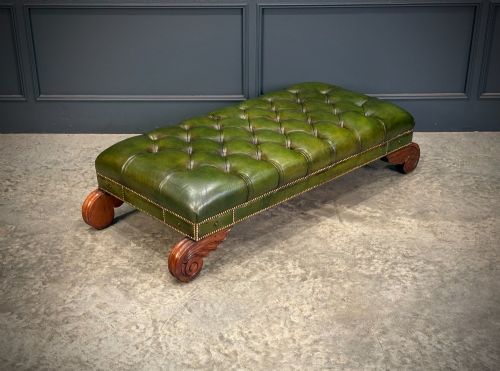
Object types span simple footstools and benches to large ottomans and reclining library reading combinations. Each variation retains the core combination of a wooden frame and a leather surface.
How they were made
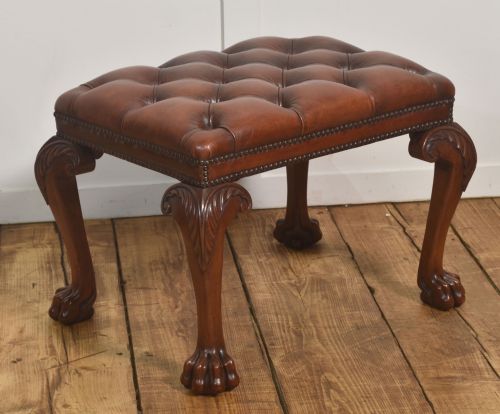
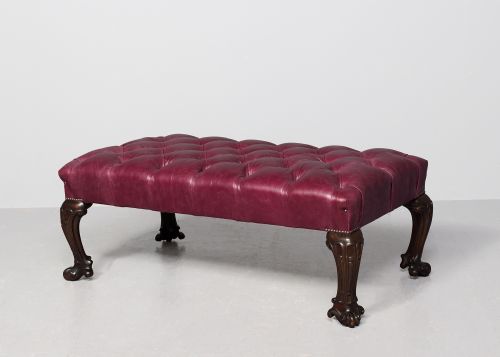
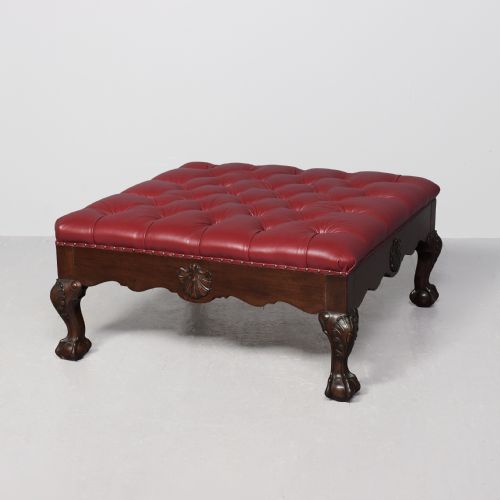
Frames are constructed from solid mahogany, sometimes shaped into cabriole legs or serpentine rails, and frequently paired with brass details. The timber provides a dense, dark structure capable of supporting regular weight over generations.
Upholstery relies on leather - often described as hide in red, green, burgundy, or tan - secured with brass-studded edging. Buttoning appears across many examples to hold the internal stuffing firm beneath the leather top.
What varies in quality
The separation between standard and superior pieces lies in the crispness of the timber carving and the calibre of the leather hide. Substantial frames with deep buttoning and rich grain patination represent the upper tier of the range.
Proportion and scale also dictate worth, as exceptionally large ottomans or matched pairs require superior timber selection and joinery than small single stools. Details like brass studwork and metamorphic mechanical actions further distinguish finer examples.
The Mahogany Leather Footstool Glossary
- Cabriole leg
- A furniture leg that curves outward at the knee and tapers inward toward the foot, often ending in a pad or claw shape. This form draws inspiration from animal limbs and appears frequently on 19th-century frames.
- Buttoned leather
- Upholstery pulled into regular indentations by twine secured with buttons, creating a padded and patterned surface. This technique holds internal stuffing firmly in place.
- Metamorphic
- Describing a piece of furniture designed to transform into another form, such as a stool shifting to accommodate a gout sufferer. These mechanical pieces require careful engineering.
- Serpentine
- A furniture line or front that curves outward in the centre and inward at the sides, resembling a snake's movement. This shape demands precise woodworking skill.
- Hide
- The natural skin of an animal, dressed and treated for upholstery. In these pieces, it provides a durable, smooth upper surface.
Mahogany Leather Footstool: Frequently Asked Questions
How do I date a mahogany leather footstool?
Dating relies on observing the structural style, such as Regency curves, Georgian proportions, or Victorian buttoning. Timber colour and leg forms also point toward specific decades between the Georgian and Edwardian eras.
Examining the underside and the method of leather attachment helps confirm whether a piece belongs to the 19th century or a later revival period.
Were these stools used for pianos?
Several pieces are designated specifically as piano stools from the Edwardian period. They provided stable, adjustable, or fixed seating for musicians.
Their proportions matched the height and style required for keyboard performance.
What is a gout stool?
A gout stool is a specialised metamorphic footstool designed to elevate and support a foot afflicted by pain. They often included adjustable angles to relieve pressure.
Victorian and Edwardian households utilised these pieces for specific medical and comfort needs.
How do I care for the leather top?
Leather upholstery benefits from regular dusting and occasional conditioning to prevent the hide from drying out. Avoiding direct sunlight helps preserve the red, green, burgundy, or tan colouring.
Gentle cleaning maintains the natural patina developed over the centuries.