
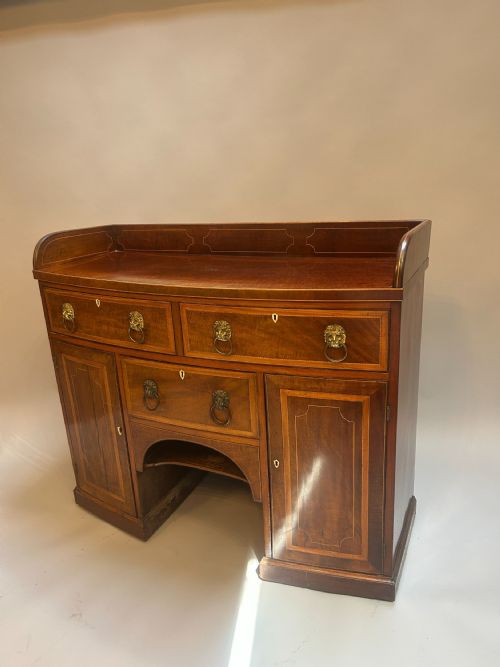


Mahogany Gallery Back Sideboard
A mahogany gallery back sideboard brings architectural presence and practical surface space to a dining room, combining rich timber with a protective upstand.
Mahogany Gallery Back Sideboard
When you search for a mahogany gallery back sideboard, you are looking at substantial dining furniture designed to hold serving dishes and tableware. These pieces span from the Georgian and Regency eras through to the Victorian period, reflecting evolving tastes in domestic storage and display.
The most common examples you will meet on this page are generous sideboards, serving tables, and chiffoniers fitted with tiered shelves or raised brass rails at the back. These upstands served the practical purpose of protecting dining walls and preventing items from sliding off the rear surface.
Forms vary across the periods represented here, ranging from bowfront server layouts to kneehole dressing tables and kitchen dressers equipped with gallery surrounds. Each style demonstrates how cabinetmakers adapted the basic utility of a serving piece to suit formal dining rooms and private chambers alike.
Materials and construction methods
Makers relied heavily on solid mahogany and flame mahogany veneer to give these serving pieces their characteristic deep reddish-brown tone and striking grain patterns. The use of carefully matched veneers allowed craftsmen to create dramatic visual movement across large drawer fronts and cabinet doors.
Structural details frequently incorporate boxwood stringing for subtle linear contrast alongside polished brass galleries and fixtures. These contrasting elements highlight the precision of the joinery and provide functional metalwork that supports the raised back sections.
Many a Victorian sideboard secretly harbours a deep drawer designed originally to chill wine bottles directly against blocks of ice.
Judging the standard of execution
Quality in these pieces is dictated by the selection of the timber and the fluency with which the grain is arranged across the front. Finer examples display symmetrical flame mahogany veneers that have been chosen with clear intention by the cabinetmaker.
The refinement of the gallery structure itself separates standard utility furniture from more ambitious commissions. Whether executed in carved mahogany or fitted with slender brass rails, a well-proportioned upstand integrates harmoniously with the proportions of the base.
The Mahogany Gallery Back Sideboard Glossary
- Gallery
- A raised railing, shelf, or upstand affixed to the rear surface of a piece of furniture. It prevents items from sliding backward and provides a tier for small display objects.
- Chiffonier
- A low cabinet derived from the sideboard, typically featuring a two-shelf back and enclosed cupboard storage below. This form became particularly popular during the Regency and Victorian periods.
- Flame mahogany veneer
- A thin slice of timber cut from the point where a branch joins the main trunk, producing a distinctive flickering, flame-like pattern. Craftsmen prized this figure for principal display surfaces.
- Bowfront
- A convex, curved cabinet front that projects outward in a smooth arc. This shape softens the corners of a room and requires advanced woodworking skill to construct accurately.
- Kneehole
- A recessed central space beneath a desk or dressing table designed to accommodate the user's legs. It is flanked by banks of small drawers.
Mahogany Gallery Back Sideboard: Frequently Asked Questions
What is a gallery back sideboard?
A gallery back sideboard is a large dining room serving piece featuring a raised wooden upstand, shelf, or brass rail along the rear edge.
This design feature protects walls from spills and provides additional display space for plates or serving silver.
How do I date a mahogany sideboard?
Dating relies on observing the overarching style, construction methods, and hardware choices characteristic of periods like the Georgian, Regency, and Victorian eras.
Earlier pieces often display cleaner classical lines and boxwood stringing, while later Victorian examples tend to be heavier in proportion with more robust mouldings.
Were these pieces used only in dining rooms?
While primarily designed as serving tables and buffets for the dining room, many smaller variants such as chiffoniers and side cabinets functioned in sitting rooms and libraries.
They served as general storage for books, writing materials, and decorative objects depending on the room's domestic purpose.
What is the difference between a sideboard and a chiffonier?
A sideboard is typically a longer, heavier piece intended specifically for dining room service with extensive cupboard and drawer capacity.
A chiffonier is generally smaller and more compact, distinguished by its signature tiered shelves above the main surface.