







Mahogany Folding Room Divider
These mahogany folding room divider pieces offer functional elegance and versatile privacy, bringing classic Victorian and Edwardian craftsmanship directly into your interior.
Mahogany Folding Room Divider
A mahogany folding room divider is a hinged screen designed to partition spaces, manage light, or create private dressing areas within a large interior. When buyers search for this phrase, they encounter multi-panel wooden frames configured to fold neatly when not in use.
The most common versions on this page date from the nineteenth and early twentieth centuries, spanning the Regency, Victorian, and Edwardian eras. These range from modest three-panel dressing screens to large country house dividers featuring four or five leaves.
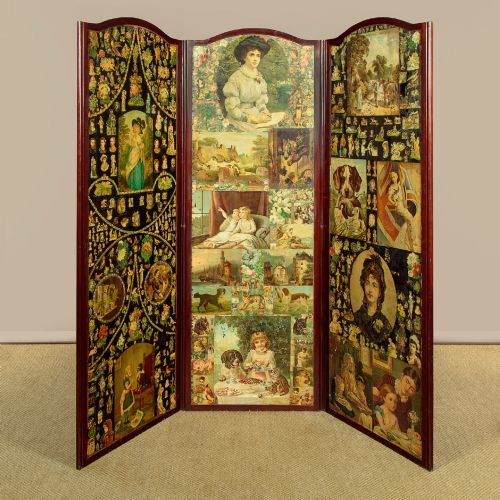
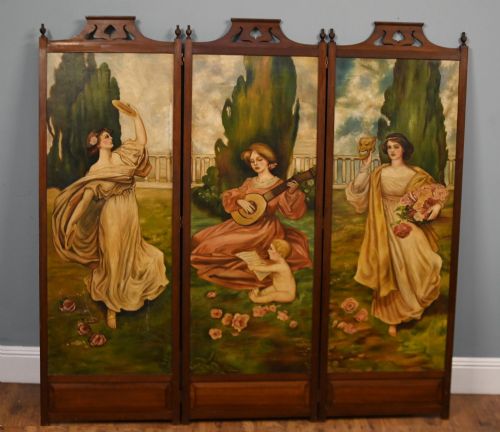
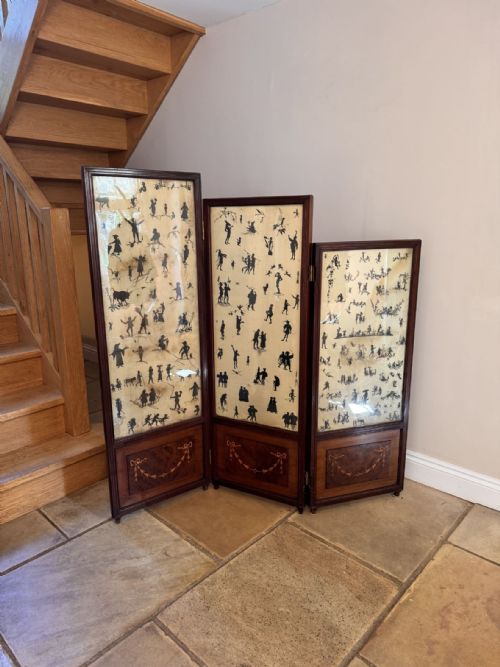
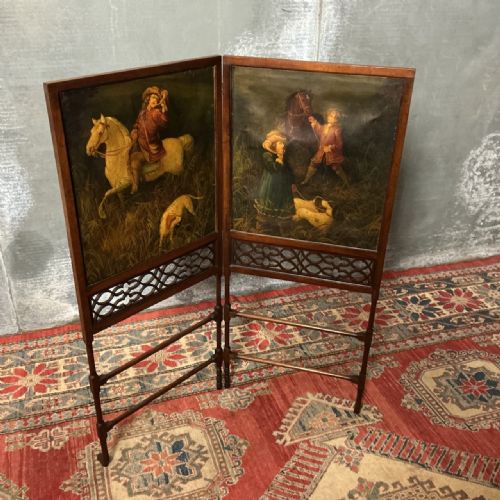
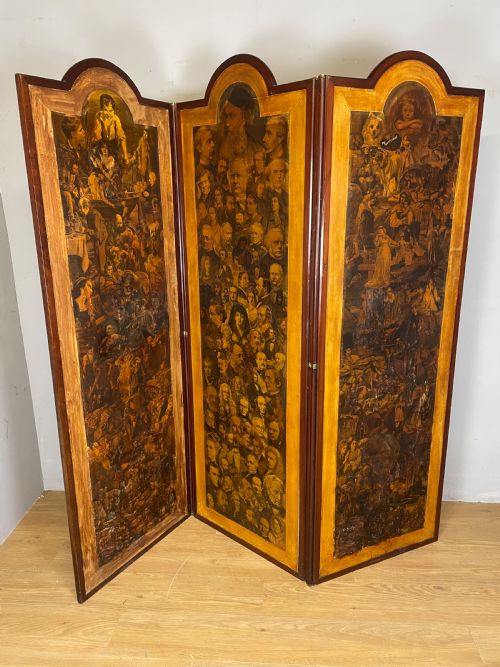
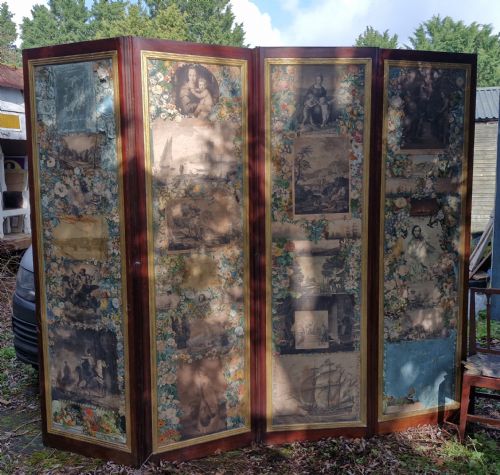
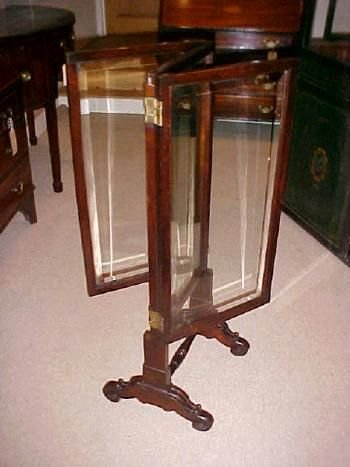
Panel inserts vary widely across the surviving examples, incorporating glazed panels, hand-painted oil canvases, needlepoint textiles, decoupage, and scrap work. Such variety reflects how these screens served as both practical room partitions and decorative canvases for domestic craft.
How they were made
The structural framework relies on solid mahogany timbers, joined with traditional techniques to withstand the constant movement of folding leaves. Brass hinges connect the panels, allowing them to swing through wide angles while supporting heavy inset materials.
Infill materials demand diverse artisan skills, from delicate glass installation to complex needlepoint embroidery and oil painting on canvas. Simpler utilitarian versions utilise paper or fabric stretched within the polished timber frame, whilst decorative country house examples employ elaborate decoupage and layered scrap work.
Mahogany Folding Room Divider Retail Price Guide 2026
Typical asking prices for mahogany folding room divider among the pieces listed under this phrase on Sellingantiques today, from the lower quarter to the upper quarter. They describe what is for sale here now, not the wider market.
Some Victorian screens preserve historical scrap work that doubles as a permanent paper gallery of forgotten nineteenth-century ephemera.
What varies in quality
Quality reveals itself in the calibre of the mahogany timber and the precision of the joinery linking the folding leaves. Superior examples maintain structural rigidity and smooth articulation across four or five panels without sagging at the hinges.
The artistic merit of the infill panels distinguishes standard production from exceptional work. Hand-painted oil canvases, finely executed needlepoint, and well-preserved glass panes elevate a utilitarian screen into a sophisticated decorative object.
The Mahogany Folding Room Divider Glossary
- Mahogany
- A durable tropical hardwood prized for its rich reddish-brown hue and stability in furniture construction. It provides the robust structural frames for these folding dividers.
- Decoupage
- The art of decorating a surface by applying paper cutouts and sealing them with layers of varnish. This technique appears on decorative Victorian room dividers.
- Needlepoint
- A type of canvas work embroidery stitched by hand to create dense, patterned textile panels. It frequently forms the decorative privacy insert within nineteenth-century frames.
- Scrap work
- A Victorian craft involving the arrangement and pasting of printed paper scraps onto a backing surface. Screens decorated in this manner capture popular domestic imagery of the late nineteenth century.
Mahogany Folding Room Divider: Frequently Asked Questions
How do I use a room divider in a modern home?
These screens create flexible zones within open-plan living spaces, sectioning off a home office area or softening a bare corner.
They also function as traditional dressing screens in bedrooms or serve purely as decorative wall-sized artwork when placed flat against a partition.
How many panels do these screens usually have?
Most surviving examples feature three or four folding leaves, though larger country house versions sometimes incorporate five panels.
Each leaf is joined by hinges that permit both forward and backward folding depending on the desired configuration.
What materials are found inside the mahogany frames?
Panel inserts vary considerably, ranging from glazed glass and hand-painted oil canvases to textile needlepoint and paper decoupage.
Simpler utility screens utilise plain fabric or canvas stretched across the timber framework to provide privacy.
How do I distinguish Regency screens from Edwardian ones?
Regency and early nineteenth-century examples often display restrained classical lines with heavy needlepoint or fabric panels designed for formal country houses.
Edwardian pieces tend to be lighter in construction, frequently incorporating inlaid mahogany woodwork, glass panes, or vanity mirror sections.