
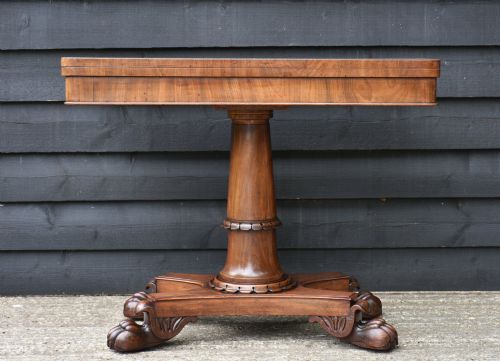
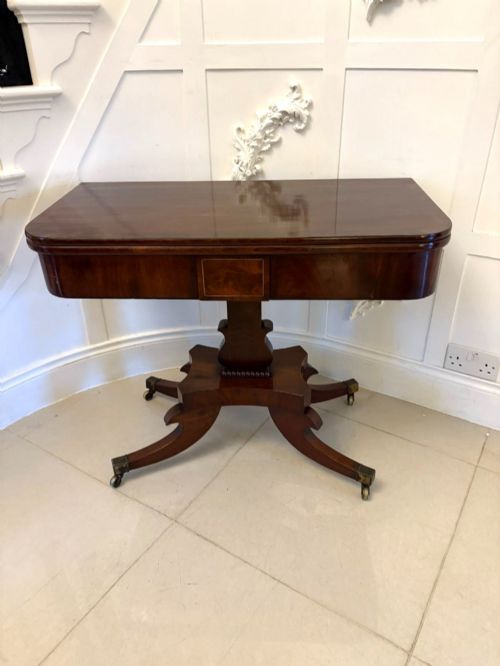
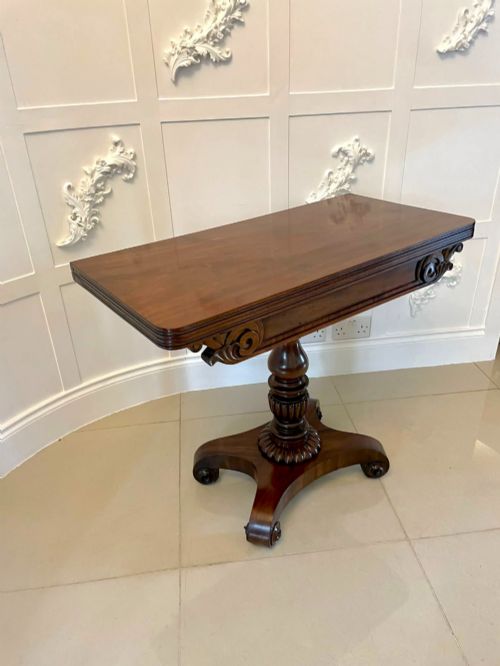
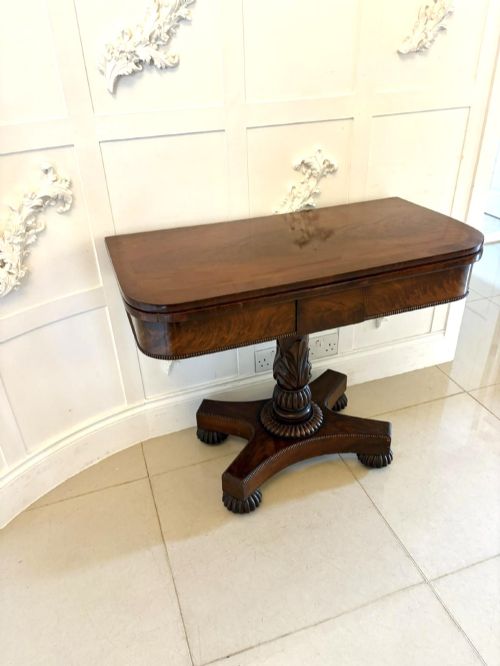

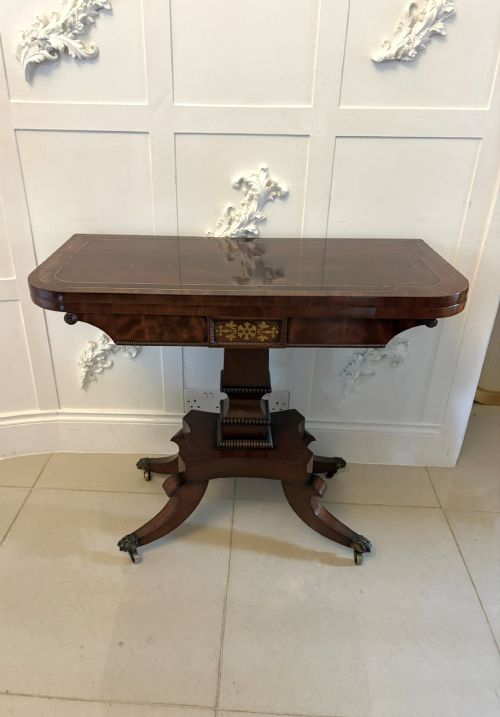
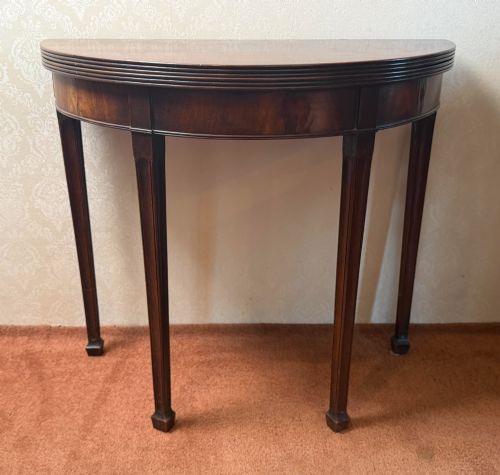
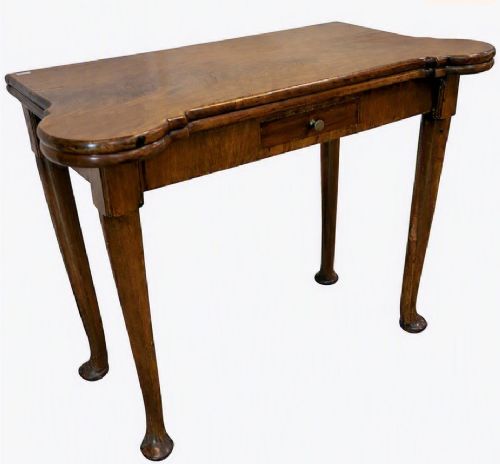
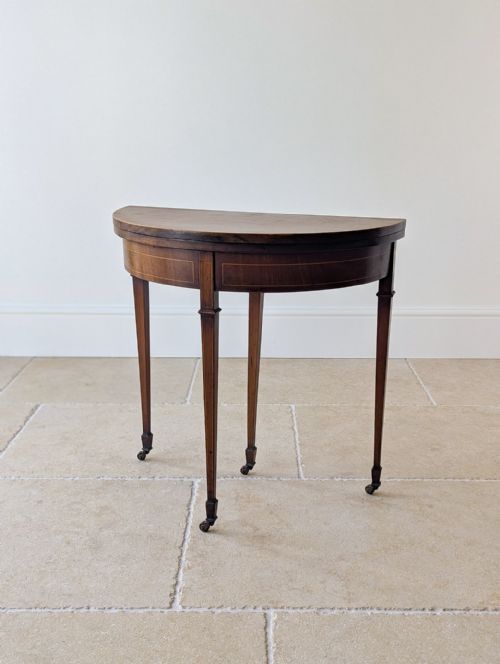
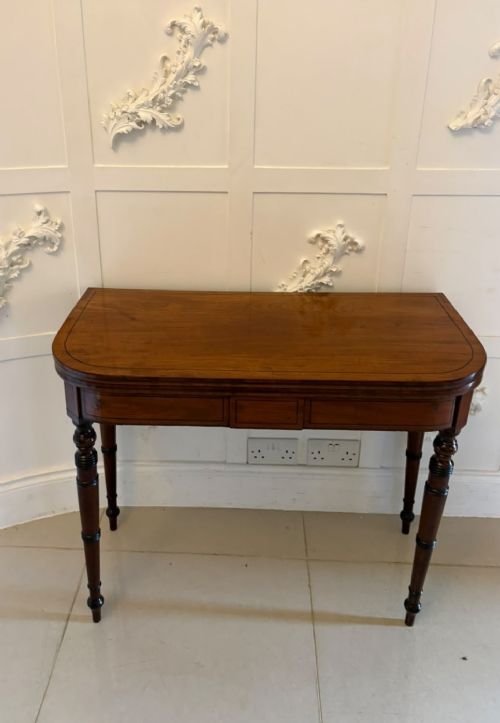
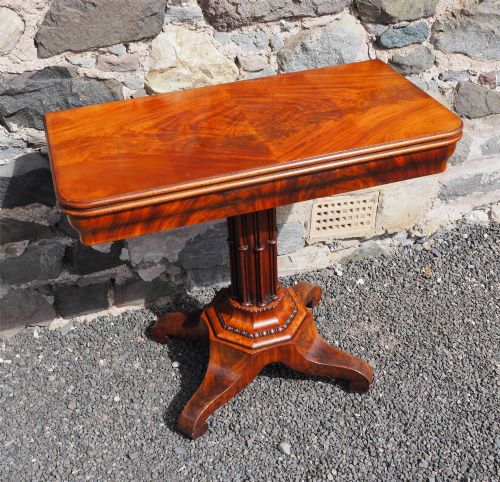
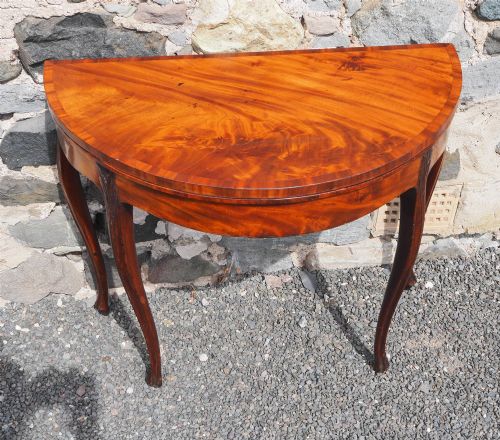
Mahogany Fold Over Console Tables
Mahogany fold over console tables are adaptable English furnishings designed to expand for dining or games before folding back against a wall.
Mahogany Fold Over Console Tables
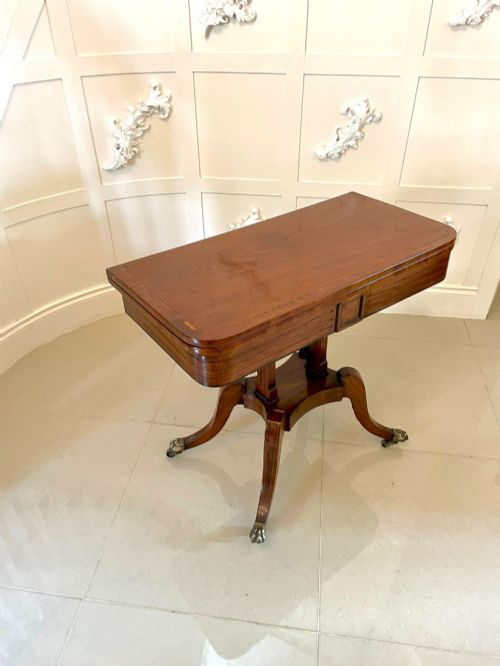
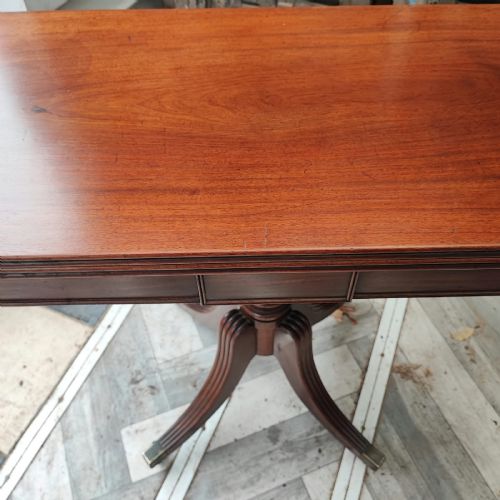
When you search for mahogany fold over console tables, you encounter versatile multi-functional furniture originating across the eighteenth and nineteenth centuries. These pieces function primarily as compact side or console surfaces that open via a hinged top to reveal a larger area intended for tea, cards or general use.
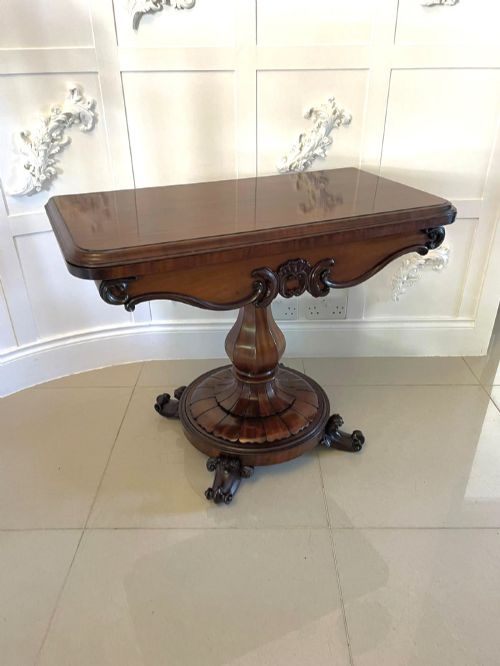
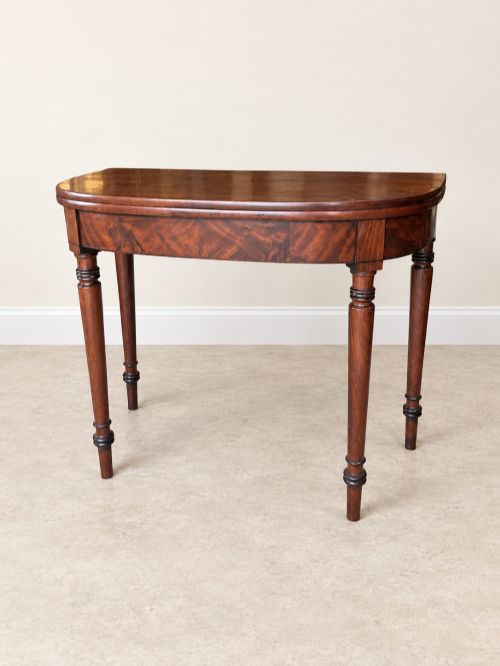
The versions most commonly met on this page span the Georgian, Regency and Victorian eras, alongside Edwardian examples. They take various shapes, including demilune, D-shaped, rectangular and serpentine forms, with structural mechanisms such as concertina actions supporting the unfolded leaf.
Makers across these periods utilised native and imported timber to construct forms catalogued variously as card tables, tea tables and games tables. Their design allows them to sit flat against a parlour or drawing room wall when closed, occupying minimal floor space.
Materials and Technique
Cabinet makers built these tables using solid mahogany supplemented by flame mahogany veneer, wood veneer and contrasting stringing of satinwood and boxwood. Brass inlay and hardware frequently accent the primary timber surfaces on Regency and Georgian iterations.
The folding mechanism relies on precision joinery, allowing the top leaf to rotate, flip or pull out on concertina frames supported by hinged rear legs. Timber preparation involved careful selection of figured grain patterns to ensure the open surface displayed a mirrored or continuous figure.
Some Victorian tables include concealed storage compartments beneath the folding top, perfect for hiding secret letters or stray playing cards.
Judging Quality
The standard of a piece is determined by the selection of the mahogany timber, particularly the liveliness of the flame veneer and the depth of the original patination. Tables that retain a rich, untouched surface display superior cabinet work compared to those with stripped or heavily refinished surfaces.
Refinement in secondary details elevates an example, such as crisp boxwood and satinwood inlay, precise brass brasswork, and the structural integrity of the folding mechanism. The fluidity of carved sabre legs or serpentine edges separates standard utility pieces from exceptional workshop outputs.
Bruce & Burns of Edinburgh·Chippendale
The Mahogany Fold Over Console Tables Glossary
- Demilune
- Half-moon shaped furniture designed to sit flush against a wall. This profile is common among eighteenth-century card and tea tables.
- Concertina action
- An expanding frame mechanism that unfolds like an accordion to support the extended top leaf of a table. It allows all four legs to move symmetrically when opened.
- Patina
- The surface sheen and colour developed by wood and polish over decades of exposure and handling. Original patination is prized by collectors for its depth.
- Flame mahogany
- A veneer cut from the fork of a mahogany tree where the branch meets the trunk. It produces a distinctive flickering, flame-like grain pattern.
- Serpentine
- A curved edge profile featuring a convex centre flanked by concave curves. This shape requires skilled hand-carving in solid mahogany.
Mahogany Fold Over Console Tables: Frequently Asked Questions
What is a fold over console table?
A fold over console table is a dual-purpose item featuring a hinged top leaf that rests closed against a wall as a slim console or side table. When opened and supported, the top doubles in surface area to serve as a dining, tea or gaming table.
This clever engineering allowed period households to maximise floor space in smaller rooms without sacrificing the ability to host guests for cards or afternoon tea.
How do you use a concertina action table?
The concertina action involves an expanding wooden frame linked to the rear legs, which pulls outward when the top leaf is lifted and turned. This mechanism provides sturdy, balanced support beneath the newly doubled surface.
Operating the table requires gently lifting the upper leaf while pulling the rear rail and leg outward until the frame locks squarely into the open position.
How do I date a mahogany table?
Dating relies on observing stylistic markers, construction methods and timber characteristics unique to specific eras like the Georgian or Regency periods. Earlier eighteenth-century pieces often feature simpler structural frames and rich natural patination, while Regency models frequently incorporate brass inlay and sabre legs.
Examining the underside, secondary woods used in the framing, and the type of hinge hardware also provides clear evidence of the manufacturing decade.
Were these tables only used for cards?
While many were equipped with baize-lined interiors specifically for card games, a significant portion served as tea tables or general side furniture. Households used the closed surface for lamps and ornaments, opening it only when visitors arrived for social gatherings.
The interchangeable terminology in period records reflects this flexibility, as the same physical form frequently functioned for both tea service and evening entertainment.