
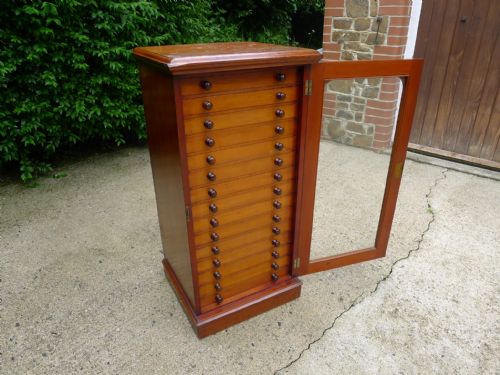

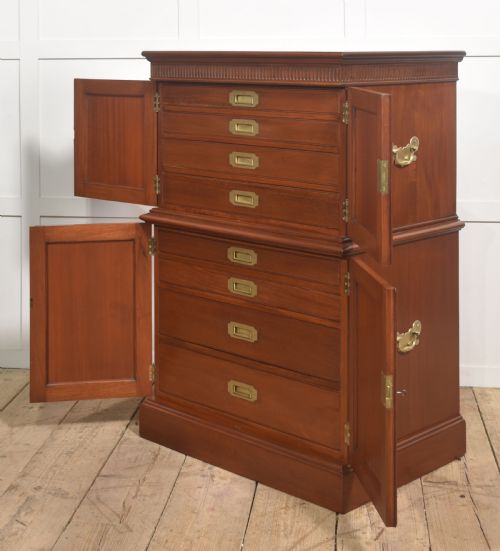

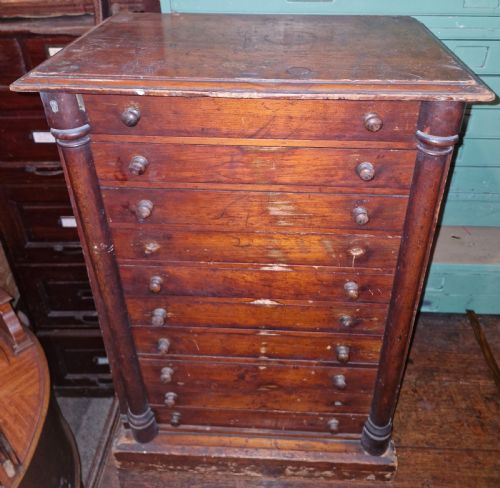


Mahogany Entomology Chest
A mahogany entomology chest is a disciplined piece of scientific furniture designed to protect delicate specimens behind glazed drawers.
Mahogany Entomology Chest
A mahogany entomology chest is built to house scientific collections, most commonly appearing as tall cabinets with multiple shallow drawers designed for insects, eggs, or microscope slides. These pieces date principally from the Victorian and Edwardian eras, spanning the nineteenth and early twentieth centuries, though earlier Georgian examples also emerge in the records.
The layout typically involves stacks of matching drawers enclosed by solid or glazed doors, sometimes resting on dedicated stands. A buyer exploring this page will encounter forms ranging from compact five-drawer chests to monumental thirty or forty-drawer cabinets constructed for serious naturalists.
How they were made
Makers built these cabinets using solid mahogany, Cuban mahogany, and flame mahogany veneer, occasionally accented with boxwood inlay, satinwood, or burr walnut. The primary timber provided a dense, stable carcass that resisted warping, which is vital for maintaining the airtight seals required to protect historical specimens.
Internal construction relied on precision joinery for the numerous shallow drawers, paired with brass hardware and glass panels set into frames. Many pieces incorporated specialised glazing to permit inspection without opening the drawers, while makers added secondary woods to drawer linings.
Listings span the Victorian, Edwardian, and Georgian periods, incorporating materials from solid mahogany and Cuban mahogany to satinwood and glass.
What varies in quality
The distinction between standard storage and masterwork production lies in the scale of the piece and the selection of timber. Cabinets featuring thirty or forty drawers demand exceptional joinery to ensure every drawer operates smoothly within a massive frame, whereas smaller five-drawer chests rely more directly on surface figure and veneer choice.
Attribution to documented makers introduces another tier of distinction, as specialised workshops brought refined engineering to drawer runners and dust-proofing. The integration of secondary materials like satinwood stringing or provenance linking a cabinet to historical naturalists elevates the standing of the piece.
Watkins And Doncaster·Brady Of Edmonton·Charles William Schofield·Standish
The Mahogany Entomology Chest Glossary
- Cuban mahogany
- A dense, richly figured tropical timber prized for fine cabinet-making. It offers superior weight and deep colour compared to alternative mahoganies.
- Flame mahogany veneer
- A sheet of timber sliced from wood where the grain pattern resembles flickering flames. It creates a decorative, highly figured exterior on drawer fronts.
- Glazed door
- A timber frame fitted with glass panels to permit viewing of the contents. This protected specimens from dust and handling while allowing external inspection.
- Specimen cabinet
- A piece of furniture organised with numerous shallow drawers for organised storage. These housed natural history collections including insects, eggs, and slides.
- Boxwood inlay
- Narrow strips of pale wood inserted into contrasting darker timber to form linear borders. This technique defined panel edges on refined eighteenth and nineteenth-century furniture.
Mahogany Entomology Chest: Frequently Asked Questions
What were mahogany entomology chests used for?
These cabinets served as secure, orderly storage for natural history collections, particularly insects, bird eggs, and botanical or medical slides. The shallow drawers kept fragile items separated and flat.
Naturalists and collectors relied on the compartmentalised design to organise vast specimens by species while shielding them from light and pests.
How do I date a mahogany entomology chest?
Dating relies on timber selection, drawer construction methods, and overall stylistic markers spanning the Georgian, Victorian, and Edwardian periods. Earlier pieces often utilise Cuban mahogany, while late Victorian and Edwardian examples scale up to forty drawers.
Maker signatures, trade labels on the interior, or documented historical provenance can also pinpoint the exact decade of manufacture.
How should I care for a specimen cabinet?
Maintenance involves placing the cabinet in a stable environment away from direct sunlight and dramatic humidity shifts to protect the timber and veneer. Regular dusting with a dry, soft cloth preserves the polished mahogany surface.
Avoid chemical polishes and ensure the internal drawer seals remain undisturbed to maintain the historical integrity of the piece.