



Mahogany Corner Tub Chair
A mahogany corner tub chair brings architectural form and rich timber to a room, offering a snug seat designed to fit neatly into domestic angles.
Mahogany Corner Tub Chair
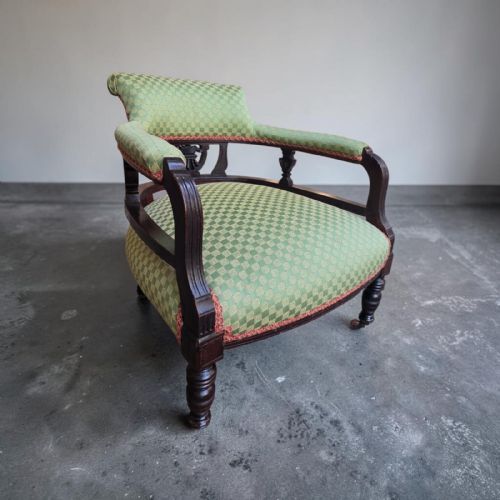
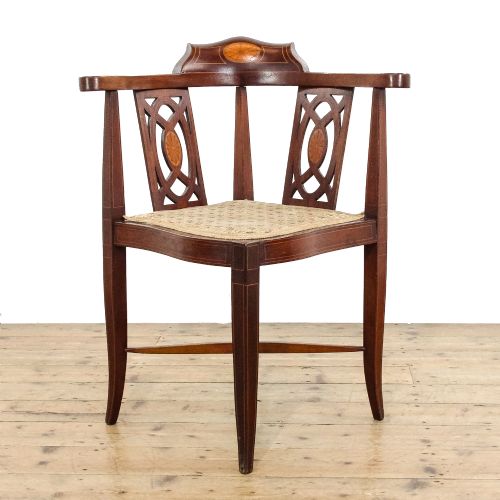
When you search for a mahogany corner tub chair, you encounter seating designed specifically to occupy the corners of Victorian and Edwardian rooms without wasting floor space. These pieces combine the curved, enclosing back of a tub chair with the diagonal geometry of a corner chair.
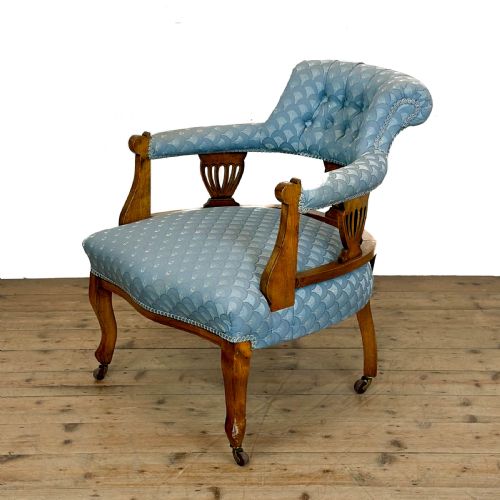
The selections span the late nineteenth century through the Edwardian period, with numerous examples dating around nineteen hundred. You will find standard corner armchairs, occasional chairs, and low salon armchairs sharing the characteristic curved backrest.
Makers from the Victorian era into the Edwardian decades produced these forms in mahogany, frequently incorporating details associated with the Sheraton Revival and Arts and Crafts movements.
How they were made
Craftsmen utilised solid mahogany for the structural frames, bending the wood to form the continuous curved rail typical of a tub chair. Secondary woods support internal framing, while selected pieces feature satinwood and boxwood stringing along the rails and splats.
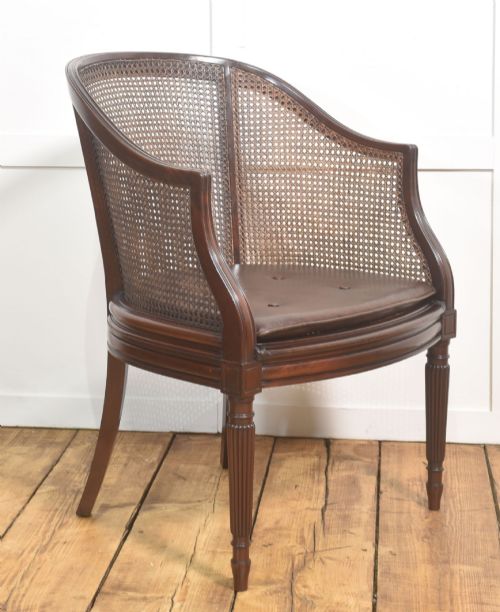
Decoration often includes marquetry inlay and marquetry details set into the mahogany backsplats. Upholstered versions employ fabric or leather coverings, and certain examples integrate woven cane panels into the backrest alongside brass components.
Some nineteenth century variants doubled as gentleman's gaming chairs, engineered for long hours at the card table.
What varies in quality
The distinction between standard examples and superior pieces rests largely on the precision of the joinery in the curved back rail and the crispness of the inlaid decoration. Finer versions exhibit intricate marquetry and careful matching of mahogany grain across the structural sections.
Upholstery finish and the condition of integrated cane work also separate ordinary production from finer salon seating. Pieces retaining original leather or well-executed fabric retain stronger visual balance.
The Mahogany Corner Tub Chair Glossary
- Tub chair
- An armchair featuring a continuous curved backrest that wraps around the sides to form a protective enclosure. This form provides a compact and enclosed seat.
- Marquetry inlay
- Decorative patterns formed by fitting contrasting pieces of wood veneer into a solid mahogany background. This technique defines Edwardian revival pieces.
- Satinwood
- A lustrous yellowish timber utilised for contrasting stringing and inlay details on darker mahogany frames. It creates sharp visual borders.
- Sheraton Revival
- A late nineteenth and early twentieth century design style drawing on eighteenth century neoclassical motifs. It favours slender proportions and delicate inlay.
Mahogany Corner Tub Chair: Frequently Asked Questions
What is a corner tub chair?
A corner tub chair is a piece of seating that merges a curved, enclosing back rail with a diagonal frame built to sit in a room corner.
These designs maximise space while providing a supportive, semi-enclosed seat for a desk, bedroom, or salon.
How do I date a mahogany chair?
Dating relies on stylistic clues, timber choice, and construction methods visible in the frame and any inlay work.
Victorian examples tend to be heavier and carved, whereas Edwardian pieces frequently display lighter frames with satinwood stringing and marquetry.
Where were these chairs placed?
These chairs served primarily as occasional seating in parlours, bedrooms, and studies where space economy mattered.
Their angled bases allowed them to tuck into unused corners while offering a comfortable spot for reading or conversation.
What is Sheraton Revival style?
Sheraton Revival describes furniture made around nineteen hundred that imitates the light, neoclassical forms of the late eighteenth century.
Such pieces utilise mahogany accented with satinwood inlay, tapered legs, and refined proportions.