


Inlaid Mahogany Tub Chair
An inlaid mahogany tub chair brings curved seating and delicate woodwork into a room.
Inlaid Mahogany Tub Chair
An inlaid mahogany tub chair is a low, curved armchair designed for comfort, combining a rounded backrest with rich timber and decorative contrasts. Most pieces meeting this search phrase originate from the Edwardian period and the early twentieth century, though examples also appear from Victorian and Regency times.
These seats serve varied roles around the home, appearing as occasional chairs, desk chairs, or elements within larger salon suites. The defining circular or semi-circular back encloses the sitter, offering a distinct profile compared to standard straight-backed armchairs.
How they were made
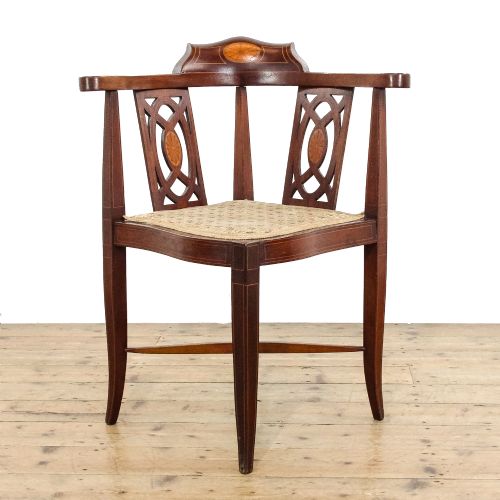
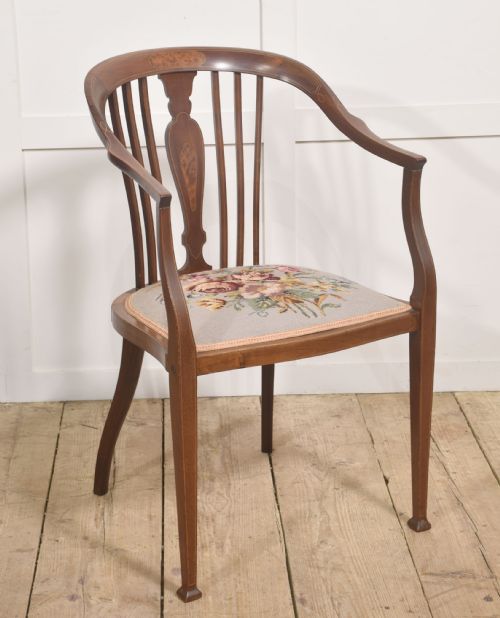
Makers constructed the primary framework from mahogany, often shaping the curved tub back from steam-bent timber or segmented solid wood. This sturdy base received surface embellishment through contrasting woods like satinwood and boxwood, alongside marquetry panels.
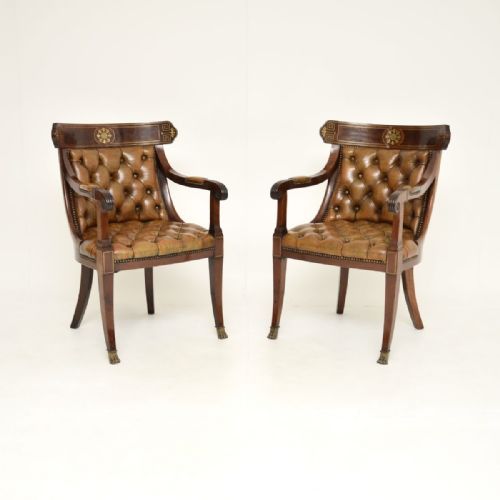
Detailing frequently involved fine stringing and brass inlays embedded directly into the mahogany surface. Upholstery completed the seat, utilising fabric or leather stretched over supportive padding.
Listings span the Edwardian period, Victorian era, and Regency times, constructed from mahogany, satinwood, and brass.
What varies in quality
The sophistication of the woodwork marks the division between standard production and superior craftsmanship. Finer examples display intricate, multi-wood marquetry and precise satinwood stringing rather than simple printed motifs or sparse inlay.
Structural integrity and timber selection further separate pieces. Heavier mahogany framing, balanced proportions, and retained original upholstery elements indicate higher workshop standards.
Jenks and Wood
The Inlaid Mahogany Tub Chair Glossary
- Tub chair
- An armchair featuring a continuous curved back and arms forming a rounded enclosure. This shape offers a low profile suitable for parlours and bedrooms.
- Marquetry
- Decorative veneer work arranged in pictorial or geometric patterns using various coloured woods. Craftsmen apply these designs directly to the mahogany surfaces.
- Satinwood
- A durable, yellowish timber native to India and Sri Lanka, utilised for contrasting inlays. Its bright tone stands out against darker mahogany grain.
- Stringing
- Thin lines of contrasting wood inlay used to edge panels and frame components. This technique defines the linear geometry of Edwardian and Sheraton Revival furniture.
- Corner chair
- A seating form designed to fit into room angles, featuring a diagonal orientation and curved back rail. Several examples integrate tub styling with this corner layout.
Inlaid Mahogany Tub Chair: Frequently Asked Questions
What is a tub chair?
A tub chair is an upholstered armchair with a low, rounded back that curves continuously to form the arms.
This enclosed shape was designed for comfort and conversation, keeping drafts away from the sitter.
When were these chairs made?
Most surviving examples date from the Edwardian period around nineteen hundred, alongside late Victorian and Sheraton Revival pieces.
Earlier nineteenth century and Regency examples also exist, featuring distinct brass inlays and heavier proportions.
How do I use one at home?
These chairs function well as occasional seating in living rooms, bedrooms, or studies.
Their compact rounded profile allows them to sit comfortably in corners or alongside low desks without dominating the floor space.
What woods are used?
The primary timber is mahogany, selected for its strength and deep reddish-brown grain.
Decorative elements utilise lighter contrasting woods such as satinwood and boxwood for inlays and stringing.