
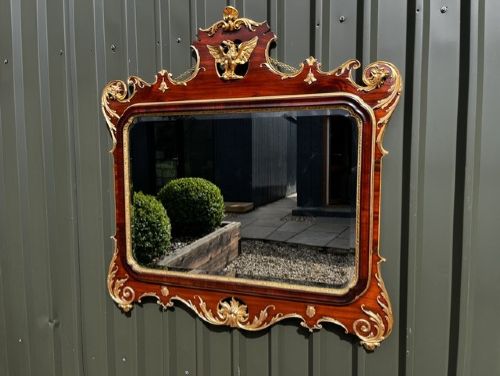

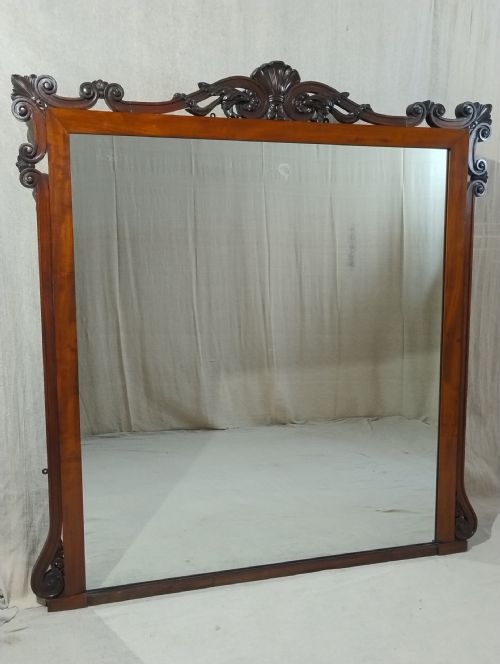


Mahogany Chimney Glass
These mahogany chimney glass mirrors bring warmth and presence to a room, hung above the hearth or mounted as grand wall pieces.
Mahogany Chimney Glass
A mahogany chimney glass is a large mirror designed to sit upon the mantelpiece or hang directly above the fireplace, anchoring the room's proportions. The selection on this page spans several distinct eras, including 18th Century, Regency, Victorian, and Edwardian periods.
The form is most commonly encountered as an overmantel mirror, often framed in rich timbers alongside variants featuring parcel gilt or marquetry. These pieces function both to bounce natural light around the interior and to provide a decorative focal point above the hearth.
How they were made
Cabinetmakers constructed these frames using solid mahogany and hardwood, frequently employing wood inlay and parcel gilt accents to catch the eye. Bevelled glass and standard reflective glass plates were fitted carefully into carved wooden rebates.
Styles range from Chippendale and Georgian restraint to heavier Victorian and Edwardian interpretations, utilising traditional joinery and carving techniques appropriate to each century.
Listings feature mahogany, giltwood, and rosewood overmantel mirrors spanning from the 18th century through to the Edwardian era.
What varies in quality
Quality rests upon the depth of the timber figuring, the crispness of any carved details, and the integrity of the original gilding. Finer examples display harmonious proportions where the weight of the frame balances the expanse of the glass.
The condition and age of the mirror plate itself also define the tier of the piece, with older plates showing characteristic silvering oxidation that distinguishes them from later replacements.
The Mahogany Chimney Glass Glossary
- Overmantel mirror
- A large mirror specifically designed to be hung or placed upon the mantelpiece above a fireplace. These often feature wide horizontal proportions to suit the hearth below.
- Parcel gilt
- A decorative technique where selected raised portions of a wooden frame are partially covered in gold leaf. This creates a subtle contrast against the dark mahogany background.
- Marquetry
- The art of applying pieces of veneer to a structure to form decorative patterns and pictures. Edwardian examples often utilise this to introduce lighter contrasting woods.
- Bevelled glass
- A glass pane whose outer edges are cut and polished at an angle thinner than the rest of the sheet. This creates a framed, prismatic border effect along the perimeter.
- Triptych
- A mirror plate divided into three distinct vertical sections within a single frame. This layout is frequently seen in Victorian fretted interpretations.
Mahogany Chimney Glass: Frequently Asked Questions
Where should I hang a chimney glass?
These mirrors are traditionally positioned directly above a fireplace mantelpiece to reflect light and fill the vertical wall space. They also work effectively as principal wall mirrors in a hallway or principal reception room.
Ensure the wall fixings are robust enough to support the substantial weight of a timber-framed mirror. Hanging the piece at eye level maximises its reflective impact within the room.
How do I date a mahogany mirror?
Dating relies on observing the timber choice, the style of carving, and the construction methods used in the frame. Georgian and Regency pieces typically show lighter, more refined framing, whilst Victorian versions tend to be heavier.
Examining the reverse of the mirror, the type of screws, and the condition of the glass plate can offer further clues to the period of manufacture.
Can I clean the antique glass safely?
Use a soft cloth and a gentle, ammonia-free glass cleaner applied to the cloth rather than directly onto the mirror surface. This prevents moisture from seeping behind the plate and damaging the old silvering.
Take care around the edges of the glass and the surrounding wooden frame to protect any original gilding or polish.
What is parcel gilt?
Parcel gilt refers to the practice of applying thin gold leaf to specific decorative elements of a carved wooden frame. It highlights details such as mouldings and scrollwork against the dark mahogany timber.
This technique was particularly favoured during the 18th and 19th centuries to add a touch of brightness to dark wood interiors.