


Louis XVI Candelabrum
A louis xvi candelabrum brings neoclassical symmetry, gilded metal and white marble into a room with distinct French grandeur.
Louis XVI Candelabrum
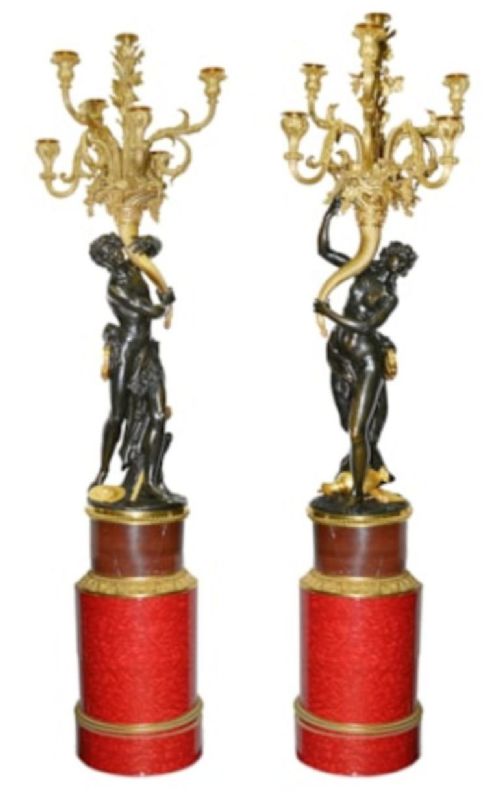
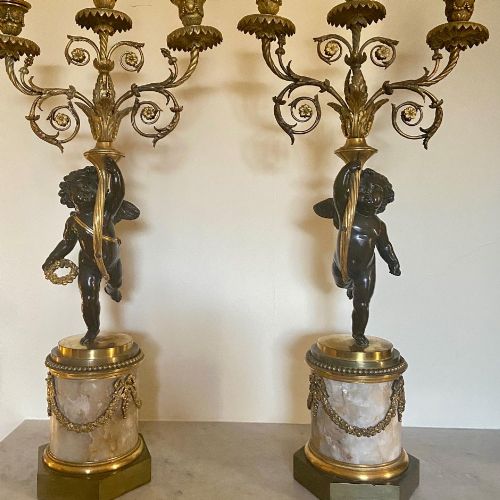
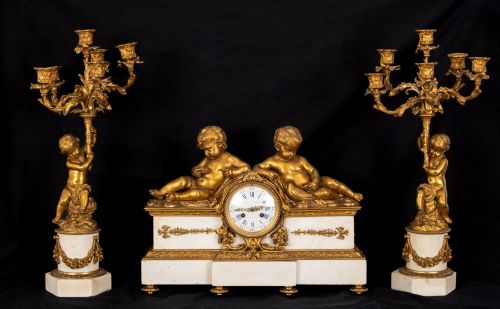
A louis xvi candelabrum is a multi-armed candle holder rooted in eighteenth-century French design, though the examples seen here span the nineteenth century and revival periods. Buyers encounter pairs fashioned as part of clock garnitures alongside standalone pieces mounted with bronze, marble and putti.
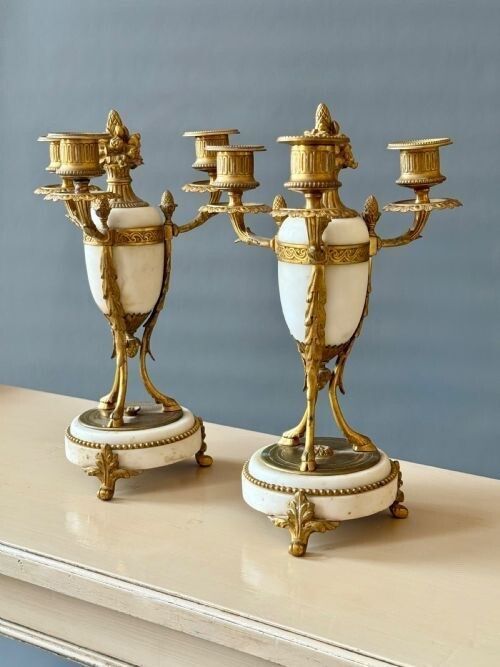
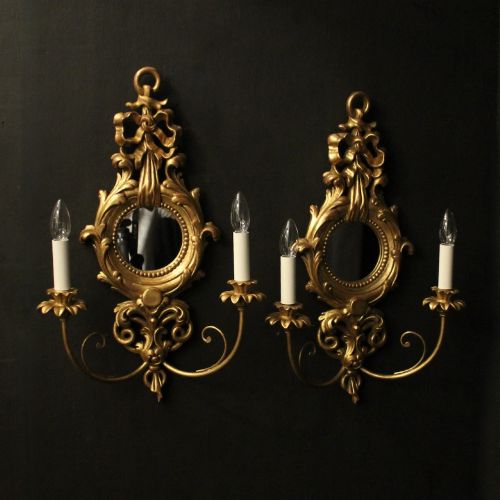
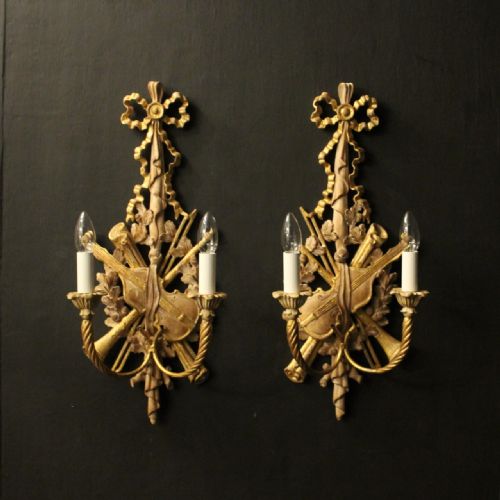
The objects take the form of monumental gilt bronze candelabra, twin-arm wall lights and towering ten-light sets. Many pieces follow the Louis XVI style and Neoclassical idiom, incorporating classical figures, cherubs and urns.
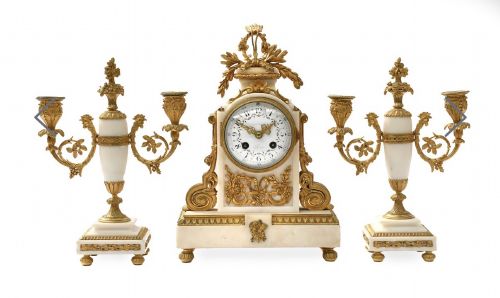
Origins stretch from eighteenth-century workshops to nineteenth-century revival studios, with French manufacture dominating the selection. Pieces frequently appear alongside matching mantel clocks to form complete garniture sets on a mantelpiece.
Materials and Construction
Metalwork forms the core of these pieces, utilising gilt bronze, ormolu, patinated bronze and brass cast with crisp neoclassical detail. Gilding and patination highlight the modelled foliage and classical figures.
White marble and occasional fluorspar provide contrasting pedestals and bases for the metal mounts, turned and polished to support heavy arms. Glass and enamel components appear on associated clock dials and garniture fittings.
Object forms include standalone candelabra, complete clock garnitures, wall sconces and twin-arm girandoles.
Judging Quality
The distinction between ordinary production and top-tier work lies in the crispness of the bronze chasing and the depth of the fire gilding. Master founders achieved sharp definition in the hair, drapery and floral swags of putti and classical figures, whereas lesser pieces show softened cast details and flat finishes.
The selection of materials further divides the range, particularly the density and flawless polish of the white marble bases compared to flawed or patched stone. Heavier gauge metalwork ensures the candelabrum arms remain rigid and straight under weight.
Francois Redmond·Henry Dasson·H Luppens Paris·AD Mougin Paris·Claude Clodion
The Louis XVI Candelabrum Glossary
- Ormolu
- Gilded bronze produced through a mercury amalgamation process common in eighteenth and nineteenth-century France. This technique yields a deep, warm metallic lustre that differs from modern electroplating.
- Garniture
- A set of matched ornamental objects designed to display together on a mantelpiece, typically comprising a central clock flanked by a pair of candelabra or vases. These sets share identical bronze mounts and marble bases.
- Putto
- A plump male child figure, often winged, derived from classical art and frequently modeled in bronze supporting the arms of a candelabrum. These figures form a central decorative motif in Louis XVI revival metalwork.
- Girandole
- A branched wall-mounted light fixture or candelabrum designed to reflect candlelight from polished backplates or mirrors. They utilise twin or triple arms to project light into a room.
- Neoclassical
- An artistic movement reviving the architectural and decorative vocabulary of ancient Greece and Rome. It emphasises symmetry, straight lines, urns and classical drapery.
Louis XVI Candelabrum: Frequently Asked Questions
How do I clean a gilt bronze candelabrum?
Dust the piece gently with a soft, dry brush to prevent dirt accumulation in the chased crevices of the metalwork. Avoid chemical dips or abrasive metal polishes, which strip the original fire gilding.
Use a lint-free cloth for the white marble base, taking care not to let moisture seep into unsealed stone joints or bronze mounts.
Are these candelabra wired for electricity?
Most antique pieces retain their original candle sockets and have not been converted for modern electric bulbs. This preserves the historical integrity and structural balance of the twin or triple arms.
Buyers wishing to use them for lighting typically employ standard taper candles rather than altering the bronze or brass components.
How do I distinguish eighteenth-century pieces from nineteenth-century revivals?
True eighteenth-century pieces display hand-chased construction methods and specific patination traits characteristic of the Louis XVI period. The vast majority of marketplace examples originate from nineteenth-century revival periods.
Nineteenth-century makers adopted earlier neoclassical motifs enthusiastically, producing heavier bronze castings and distinct marble turning styles.