
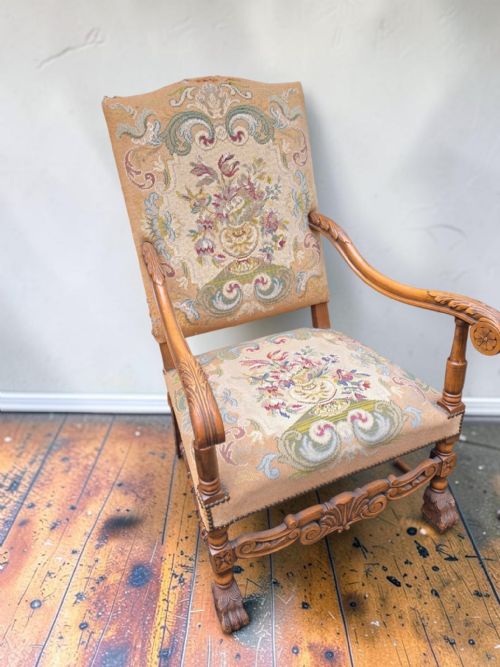
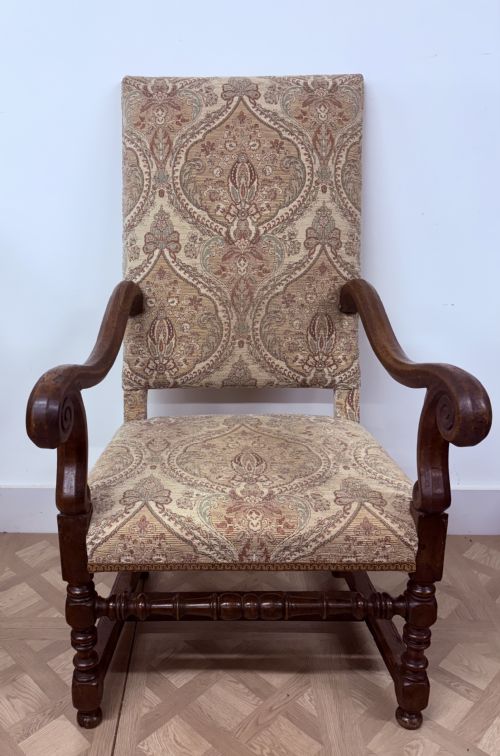


Louis XIV Fauteuil
These walnut and giltwood louis xiv fauteuil seating pieces bring grand French Baroque presence into a room.
Louis XIV Fauteuil
The pieces listed on this page span several centuries, with nineteenth-century French armchairs and giltwood throne armchairs appearing frequently alongside late seventeenth-century examples. Makers during the nineteenth-century revival often drew heavily upon earlier French Baroque and chateau aesthetics.
Forms vary from large walnut frames to giltwood structures upholstered in tapestry, wool, emerald silk, or needlepoint. Buyers most often meet nineteenth-century interpretations that emulate the imposing scale and carved ornamentation of the original seventeenth-century models.
How they were made
Makers constructed these frames predominantly from walnut or giltwood, carving the wood with structural detail before applying upholstery. Traditional joinery secured the components while brass tacks frequently fastened the fabric covering to the wooden frame.
Textiles played a central role in the construction, utilising tapestry, wool, silk, and needlepoint to cover the seat and back panels. These materials were tightly stretched over internal padding to provide both rigidity and comfort.
Upholstery materials recorded across the current inventory include tapestry, wool, emerald silk, and needlepoint.
What varies in quality
The refinement of the wood carving separates standard examples from exceptional pieces, particularly in giltwood and walnut frames where depth and precision indicate workshop skill. Elaborate throne armchairs display intricate detailing that demands greater sculptural ability from the maker.
The integrity and authenticity of the textile covering, whether period needlepoint, tapestry, or silk, substantially influence the character of the armchair. Original or period-appropriate upholstery materials demonstrate a higher degree of historical alignment than later replacements.
The Louis XIV Fauteuil Glossary
- Giltwood
- Wood that has been coated with a thin layer of gold leaf. This finish appears frequently on revival throne armchairs.
- Tapestry
- A heavy hand-woven textile featuring pictorial designs. These are commonly utilised for the seat and back covers.
- Needlepoint
- Embroidery stitched onto a canvas mesh ground. Pieces often utilise this technique for detailed decorative upholstery.
- Walnut
- A dense hardwood utilised for furniture frames. It provides structural stability and a rich dark grain.
Louis XIV Fauteuil: Frequently Asked Questions
What is a louis xiv fauteuil?
A louis xiv fauteuil is an open-armed upholstered chair originating from the French Baroque period. These seats are characterised by their substantial wooden frames and formal proportions.
They serve as prominent seating options that reflect the architectural and decorative tastes of seventeenth-century France. Revival versions from later centuries replicate these same grand stylistic elements.
How do I date a louis xiv fauteuil?
Dating requires examining the wood species, carving techniques, and underlying frame construction methods. Seventeenth-century originals differ in joinery wear and material handling from nineteenth-century revival pieces.
The upholstery fabric and needlepoint work also provide clues, though covers are frequently replaced over time to match changing interiors.
Were these chairs used at desks?
These armchairs were primarily designed for formal reception rooms, salons, and galleries rather than writing desks. Their wide proportions and open arms suited the elaborate dress of the period.
They functioned as status symbols within grand rooms rather than practical seating for work.
How should I live with giltwood?
Giltwood requires careful placement away from direct sunlight and excessive moisture to protect the delicate gold leaf finish. Gentle dusting with a dry cloth maintains the surface without abrasion.
Positioning these statement pieces where they receive minimal physical contact preserves the carved wooden details and gilded edges.